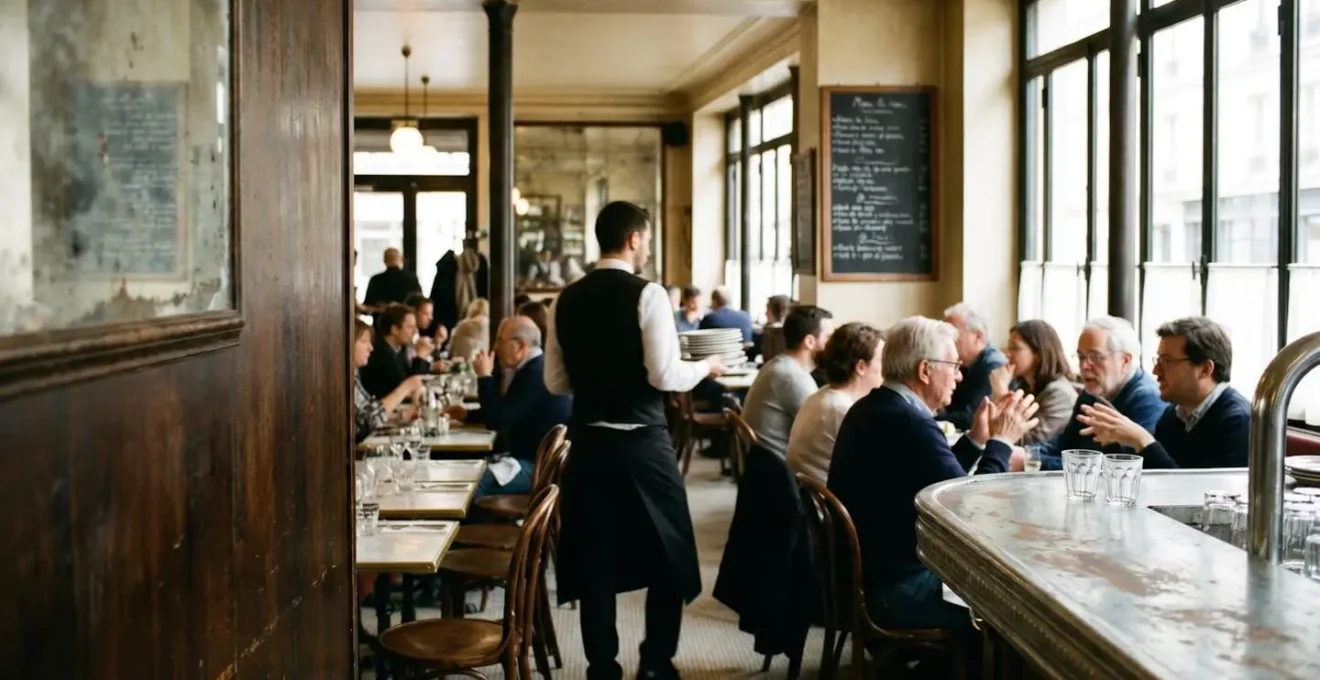
Authenticity in a Parisian brasserie is not a vintage aesthetic; it is a verifiable system of cultural and economic signals that separates a living institution from a themed restaurant.
- Genuine brasseries exhibit “patina of use”—real wear on zinc bars and mosaic floors—not artificial distressing.
- Authentic service is a professional ritual of efficiency, not performed friendliness, and market-driven menus (ardoise) signal freshness over industrial food.
Recommendation: To find a truly local experience, learn to decode these subtle signals of material honesty, service etiquette, and supply chain transparency rather than just following visual clichés.
For the discerning traveller staying in Paris, the city presents a tantalizing yet perilous culinary landscape. You stand on a street corner, flanked by two seemingly identical brasseries. Both boast red awnings, wicker chairs, and menus promising “cuisine française.” Yet, as a gastronomic historian, I can assure you one is a living cultural artifact, a nexus of local life, while the other is a meticulously crafted stage set, designed to extract maximum revenue from fleeting visitors. This is the central dilemma for anyone seeking a genuine experience.
Common advice—”avoid tourist traps near landmarks” or “look for places filled with locals”—is well-intentioned but critically insufficient. In a globalized city, how does one truly distinguish a savvy local from a well-researched tourist? And what of the quiet hours when even the best places are nearly empty? The usual platitudes offer little practical guidance, leaving you to chance your euros on a meal that might be a pre-packaged, reheated disappointment.
But what if the key was not passive observation, but active decoding? The truth is that authentic brasseries broadcast a series of subtle, yet entirely legible, signals through their pricing, their service, their décor, and their very sourcing. This guide is not a simple list of addresses, which are ephemeral. It is a lesson in connoisseurship, designed to arm you with the critical faculties to read the Parisian brasserie for what it is: a complex, living institution. By understanding the ‘why’ behind these codes, you will be able to identify authenticity for yourself, anywhere in the city.
This exploration will dissect the brasserie experience into its core components. We will examine the hidden language of the menu, the unspoken rules of service, the tell-tale signs of genuine versus fabricated décor, and the crucial questions to ask to unlock true insider knowledge, ensuring your next Parisian meal is not just sustenance, but a genuine cultural immersion.
Summary: Decoding the Authentic Parisian Brasserie
- Why Do Parisian Brasserie Menus Show Different Prices Inside?
- How to Navigate Parisian Brasserie Service Etiquette as a Foreigner?
- Historic 1900s Brasserie or Contemporary Reinvention: Which Feels More Parisian?
- The Walk-In Error That Seats You by the Kitchen Door
- When Do Parisian Brasseries Receive Their Daily Market Deliveries?
- How to Spot Fake Regional Dishes Created for Tourists?
- How to Spot Genuine Local Design Versus Tourist-Themed Décor?
- How to Ask Hotel Staff Which Local Dishes You’re Actually Missing?
Why Do Parisian Brasserie Menus Show Different Prices Inside?
The first and most powerful signal of a brasserie’s authenticity is not its décor, but its economic transparency. A genuine establishment, with roots in serving a diverse local populace, operates on a three-tiered pricing structure that is a direct legacy of Parisian social history. You will see different prices for the same item—a coffee, a beer—depending on where you consume it: ‘au comptoir’ (at the bar counter), ‘en salle’ (seated in the dining room), and ‘en terrasse’ (on the outdoor terrace). This is not a trick; it is a code. The bar is for the worker grabbing a quick espresso, the room for a leisurely lunch, and the terrace for watching the world go by, with the price reflecting the labour and real estate involved in each experience.
Tourist-focused replicas flatten this system, offering one high price everywhere because their business model is not based on repeat local custom but on one-time, high-margin transactions. In fact, coffee at the bar costs roughly half what it does at a table, a clear indicator of a place that still values its neighbourhood clientele. The ultimate test is the price of an espresso at the bar; if it exceeds €3, you are likely in an establishment that prioritizes tourists over locals. This pricing structure is a fundamental sign of a brasserie that functions as a part of the city’s social fabric, not just as a picturesque backdrop.
The posted menu outside should clearly display these tiers. Furthermore, look for the crucial phrase ‘service compris’, meaning the service charge is included in the price. Hidden service charges are a hallmark of places designed to prey on the uninitiated. A transparent menu is the first handshake from an honest establishment.
Observing this pricing is your first and most reliable filter, separating the working institutions from the theatrical facsimiles before you even step inside.
How to Navigate Parisian Brasserie Service Etiquette as a Foreigner?
One of the greatest cultural misunderstandings for visitors to Paris is the brasserie waiter, the garçon de café. Often perceived as rude or aloof by those accustomed to the performative friendliness of North American service, the traditional Parisian waiter is, in fact, a highly trained professional upholding a specific service ritual. Their efficiency, formality, and seeming distance are marks of respect for the client’s privacy and the dining experience, not signs of hostility. Understanding this is key to appreciating the authenticity of an establishment.
The waiter’s role is a respected, full-time career in France, often with years of formal training. As the following analysis points out, their goal is precision and discretion, not to become your temporary best friend. They are paid a full wage, not reliant on tips, which results in a different service model: fewer check-ins, no unsolicited small talk, and a focus on getting the order correct and the food delivered seamlessly. This is service as a professional ritual, not an emotional transaction.
The Professional Garçon de Café: Reframing Perceived Rudeness
In traditional Parisian brasseries, the waiter is a respected, full-time profession requiring years of training. Their efficiency and formal demeanor are marks of professionalism, not hostility. French waiters are paid full wages (not tips), resulting in fewer waiters per client and less frequent check-ins—a feature designed to respect dining privacy rather than neglect. The absence of forced friendliness or unsolicited small talk (‘Hey, I’m Jacques and I’ll be your server tonight’) is intentional, distinguishing authentic establishments from tourist-centric restaurants where staff perform exaggerated hospitality.
A simple ‘Bonjour, monsieur/madame’ upon entering, making eye contact when ordering, and a ‘Merci, au revoir’ upon leaving are all that is required. Do not snap your fingers or shout; a subtle hand gesture and patience will suffice. The waiter’s briskness is a sign you are in a real, working brasserie, not a theme park.
Embrace this formality. It is an integral part of the authentic brasserie’s rhythm and a clear differentiator from the ersatz hospitality of tourist traps.
Historic 1900s Brasserie or Contemporary Reinvention: Which Feels More Parisian?
The question of authenticity often gets muddled with a simple equation: old equals authentic. While magnificent historic brasseries like Bofinger are living museums of the Belle Epoque, the spirit of the brasserie is not frozen in time. A new wave of ‘neo-brasseries’ has emerged, run by chefs who honour the core principles—quality ingredients, a lively atmosphere, and accessibility—while reinventing the form. Judging authenticity, therefore, requires a more nuanced framework than simply dating the décor.
The Neo-Brasserie Movement: Modern Authenticity in Paris
Neo-brasseries represent a new generation of Parisian establishments run by chefs who honor the spirit of traditional brasseries—quality, seasonality, lively atmosphere—while reinventing the menu with contemporary techniques and international influences. Examples include Brasserie Barbès and others offering fresh local products in modern settings. These establishments maintain core authenticity markers: short menus that change daily (ardoise), emphasis on named quality suppliers, and multi-generational crowds, while eschewing rigid adherence to Belle Epoque aesthetics.
The key is to look for a coherent vision, whether historic or modern, rather than a pastiche of clichés. As a comparative analysis from Paris Unlocked highlights, both models can be authentic if they adhere to certain principles. The following table breaks down the markers of authenticity across both styles.
| Authenticity Marker | Historic Brasserie (e.g., Bouillon Chartier, Bofinger) | Neo-Brasserie (e.g., Brasserie Dubillot, Brasserie Bellanger) |
|---|---|---|
| Décor Style | Belle Epoque/Art Deco: zinc bars, mirrors with foxing, mosaic floors, stained glass | Industrial chic, contemporary materials, modern interpretation of classic elements |
| Menu Structure | Long-standing classics: steak-frites, onion soup, sauerkraut, fixed offerings | Daily changing ardoise, seasonal market-driven plates, contemporary twists on classics |
| Price Point | €12-25 (bouillons); €35-60 (historic brasseries) | €25-50 (accessible neo-brasseries); €50-80 (upscale modern) |
| Clientele Mix | High tourist percentage but locals for specific dishes; multi-generational | Budget-conscious millennials, local professionals, foodie crowd; younger demographic |
| Service Model | Traditional formal waiters, non-stop service, established rituals | Friendly professionalism, modern efficiency, less rigid formality |
| Supplier Transparency | Regional specialties named but suppliers rarely specified on menu | Proudly lists specific suppliers (e.g., Hugo Desnoyer meats) on ardoise |
Ultimately, a neo-brasserie with a daily changing menu and proudly listed suppliers can feel more authentically ‘Parisian’ today than a tired historic establishment relying on frozen ingredients and a century-old reputation.
The Walk-In Error That Seats You by the Kitchen Door
In a genuine Parisian brasserie, not all tables are created equal. The default table offered to a non-reserved, non-French-speaking walk-in is often the least desirable: by the drafty entrance, in the high-traffic corridor to the kitchen, or next to the restrooms. This is not necessarily malice; it is a system of triage. The best tables—the plush banquettes, the window seats with a view—are often held for regulars or those who have had the foresight to reserve. As the authoritative Michelin Guide warns, a cardinal rule is to respect the house’s control over seating.
Never seat yourself. And never sit at a table that’s not clean.
– Kevin Deulio, co-owner of MICHELIN Guide Inspector-approved Soces, Paris Restaurant Rules: 10 Mistakes to Avoid (Michelin Guide)
Accepting the first table offered is a rookie mistake. A polite, savvy negotiation can dramatically improve your dining experience. This is sometimes a subtle test; demonstrating your discernment and willingness to wait can earn the waiter’s respect. Arm yourself with a few key phrases and a proactive strategy. Walk by the brasserie an hour or two before you plan to dine to scout the layout. Identify the tables you’d prefer and note which ones might be marked ‘réservée’.
When you arrive, if offered an undesirable spot, politely inquire about a better one. Use phrases like, ‘Auriez-vous une table un peu plus tranquille?’ (Would you have a slightly quieter table?). If you’ve spotted a free table you like, you can ask, ‘Cette table près de la fenêtre est-elle libre?’ (Is that table by the window free?). The most powerful tool is a polite refusal coupled with patience: ‘Je préférerais attendre quelques minutes pour une meilleure table, si possible’ (I’d prefer to wait a few minutes for a better table, if possible). This signals you are not an impatient tourist to be quickly processed, but a guest who values the experience.
Your ability to navigate this delicate interaction is a clear signal to the staff that you understand the unwritten rules, often resulting in better service and a superior overall experience.
When Do Parisian Brasseries Receive Their Daily Market Deliveries?
The most crucial element separating an authentic brasserie from a tourist-oriented restaurant is what happens in the kitchen. A real brasserie kitchen operates in rhythm with the city’s markets, most notably the Rungis International Market, the vast “belly of Paris” from where an astonishing 60% of the Paris region’s fresh produce consumption is sourced. This connection to fresh, seasonal ingredients is the lifeblood of authentic French cooking.
You can see the evidence of this rhythm if you know what to look for. A walk past a genuine brasserie between 7 and 9 AM might reveal small vans from local suppliers making their daily drops. But the most reliable indicator is on the menu itself. Look for the ‘ardoise’—a chalkboard menu. A short, handwritten ardoise that changes daily or weekly is the ultimate signal of a kitchen that cooks from scratch based on market availability. It is the antithesis of the long, laminated, multi-language menu with 40+ items available year-round, which is an unmistakable sign of a kitchen reliant on frozen, pre-packaged, industrial food.
The ‘plat du jour’ (dish of the day) should be a genuine reflection of what was best at the market that morning. An even stronger sign of authenticity is the ‘supplier name-drop’. Neo-brasseries, in particular, proudly display their sourcing on the ardoise, with phrases like ‘Veau de chez Hugo Desnoyer’ (veal from the butcher Hugo Desnoyer) or ‘Légumes de Joël Thiébault’ (vegetables from the farmer Joël Thiébault). This transparency is a guarantee of quality and a direct link to the agricultural terroir that underpins French gastronomy. It is a modern form of authenticity that is impossible to fake.
Ignore the glossy photos and the long, static menus. The humble, ever-changing ardoise is your most trusted guide to a fresh, authentic meal.
How to Spot Fake Regional Dishes Created for Tourists?
A long menu in a Parisian brasserie featuring “greatest hits” from every corner of France is a major red flag. Authentic French cooking is profoundly regional and seasonal. A brasserie that claims to offer a perfect Bouillabaisse (from Marseille), a classic Cassoulet (from the Southwest), and a traditional Choucroute (from Alsace) all at once, and at a low price, is almost certainly serving industrial, reheated versions of these complex dishes. This is the test of ‘geographic and seasonal honesty’.
Consider the ‘Bouillabaisse’ in Paris. A true version requires a specific roster of fresh Mediterranean rockfish that are difficult and expensive to transport to the capital. A cheap version is guaranteed to be a facsimile, a simple fish soup masquerading as a regional treasure. Likewise, look for ingredient seasonality. A fresh tomato and mozzarella salad in January or an asparagus dish in November is a clear sign that the kitchen is using out-of-season, imported, or frozen produce, not cooking in harmony with the French agricultural calendar.
The language used on the menu is another clue. Genuine dishes are often described with specificity: ‘Cassoulet de Castelnaudary’ or ‘confit de canard maison’ (house-made). Tourist versions use vague, generic terms like ‘Traditional French Casserole’. As critics from The Infatuation Paris sharply note, many so-called traditional spots are simply tourist traps.
Most of those old-school spots are tourist traps, and they often have menus full of store-bought, industrial beef bourguignon and steak tartare.
– The Infatuation Paris, The 20 Best Bistros In Paris editorial guide
Apply a reality check to pricing. A dish like cassoulet or coq au vin requires hours of slow cooking and quality ingredients. It simply cannot be sold profitably in Paris for less than €18-22 without significant compromises in quality and authenticity. Be skeptical of bargains that seem too good to be true.
Stick to brasseries with shorter menus that reflect the Parisian region’s own specialties (like onion soup, steak-frites, or jambon-beurre) or that demonstrate a clear, focused culinary vision.
Key Takeaways
- Decode the three-tiered pricing (‘comptoir’, ‘salle’, ‘terrasse’); it’s a primary signal of a genuine, locally-integrated establishment.
- Reframe service: The formal, efficient ‘garçon de café’ is a trained professional upholding a ritual, not a performer seeking tips.
- Prioritize material honesty: Look for the ‘patina of use’ on real zinc and wood, and favour the daily ‘ardoise’ (chalkboard) over long, laminated menus.
How to Spot Genuine Local Design Versus Tourist-Themed Décor?
The aesthetic of a Parisian brasserie—the mirrors, the zinc bar, the mosaic floors—is so iconic that it has become a globally replicated cliché. For the traveller, the challenge is to distinguish between an environment that has acquired its character through a century of daily life and one that has been assembled from a catalogue of “Parisian” props. The key is to look for the ‘patina of use’—the unmistakable signs of authentic age and wear that cannot be convincingly faked.
A genuine zinc or pewter bar top will not be perfectly polished; it will be soft, slightly matte, and bear the stains, scratches, and subtle depressions of a hundred years of elbows and coffee cups. Real Belle Epoque mirrors will show ‘foxing’ (slight discoloration and dark spots) around the edges. Vintage mosaic floors will have age-appropriate cracks and worn patches in high-traffic areas. These are not flaws; they are badges of honour, testaments to a history of continuous service.
Patina of Use: Bofinger’s Century of Authentic Wear
Bofinger, one of Paris’ most authentic brasseries, exemplifies genuine design through its celebration of use-patina. The establishment features stained glass windows with appropriate age-darkening and a zinc bar top worn smooth by over a century of service. The décor includes Belle Epoque frescos with natural aging rather than artificial distressing and solid bentwood chairs showing generations of use. This ‘patina of use’—the brass foot rail worn to a golden shine, slight dips in wooden banquettes from decades of diners—cannot be authentically replicated and serves as the definitive marker separating historic establishments from themed tourist replicas.
In contrast, a themed replica will give itself away with materials that are too perfect. Shiny stainless steel bars, flawless modern mirrors with etched Eiffel Tower logos, and perfectly uniform ‘vintage-style’ floor tiles are all red flags. Look for the details: are the brass foot rails worn smooth? Are the Thonet-style chairs solid wood with genuine signs of use, or lightweight reproductions with artificial distressing? Are the glasses classic, durable Duralex, or branded novelties?
Checklist: The Materiality Test for Brasserie Décor
- Bar Tops: Examine the bar material. Is it real zinc or pewter with natural patina and wear, or a shiny laminate or stainless steel substitute?
- Flooring: Inspect the floor. Are there worn mosaic or terrazzo tiles with authentic age, or is it modern vinyl with a printed vintage pattern?
- Mirrors: Look at the mirrors for signs of age like natural foxing and ornate, worn frames. Distrust perfectly clear mirrors or those with artificial ‘antique’ effects or clichés like Eiffel Tower logos.
- Seating: Assess the chairs and banquettes. Are they solid bentwood showing decades of use and worn leather, or mass-produced, artificially distressed replicas with vinyl seating?
- Red Flag Clichés: Actively scan for and dismiss places that rely on staged clichés like accordions, red-and-white checked tablecloths (more Italian bistro), or ‘Paris’ branded items. These signal a themed replica.
Ignore the staged accordions and Eiffel Tower stencils. The truth of a brasserie’s history is written in the wear of its surfaces.
How to Ask Hotel Staff Which Local Dishes You’re Actually Missing?
The hotel concierge can be your greatest ally or a purveyor of polished, tourist-friendly recommendations. The standard question, “Where’s a good restaurant nearby?” will almost always yield a list of safe, respectable, and often uninspired establishments that have a relationship with the hotel. To break through this veneer and get to the genuinely local recommendations, you must reframe your request with strategic precision. This is the ‘magic question’ strategy.
Instead of a generic inquiry, ask a question that shifts the concierge’s mindset from professional duty to personal advice: “If your Parisian friend was visiting for one night, where would you take them for a meal that feels truly local, not for tourists?” This simple change invites an insider’s perspective. Be specific in your desires. Rather than “French food,” ask for a category: “Is there a neighborhood ‘bistrot du quartier’ known for its lunch special?” or “Where can I find the best steak-frites around here, even if it’s not a fancy place?” This shows you’ve done your homework.
Expand your sources beyond the concierge desk. The doorman, the evening receptionist, or the bellhop often live in different neighborhoods and eat out on their own budget. A casual question to them—”Where do you like to eat on your day off?”—can yield absolute gold, as they are not bound by official partnerships. Finally, be upfront about your budget in a way that signals you’re seeking value, not just cheapness. “I’m looking for where locals eat for what guidebooks suggest are normal prices, like €25-35 per person for a casual lunch.” This tells them you are searching for authentic value, not the inflated prices of tourist destinations.
You can also ask for neighborhood-specific guidance. A query like, “Which arrondissement do Parisians actually eat in for casual weeknight dinners?” shows a high level of interest and will likely get you pointed towards the lively food scenes of the 11th, 10th, or 9th arrondissements, far from the tourist-saturated zones around the Louvre or Champs-Élysées.
The next time you are in Paris, don’t just search for a restaurant. Engage in the art of discovery. Use these tools to read the city’s culinary landscape, decode its signals, and bypass the facsimiles to find a place that offers not just a meal, but a moment of true Parisian life.