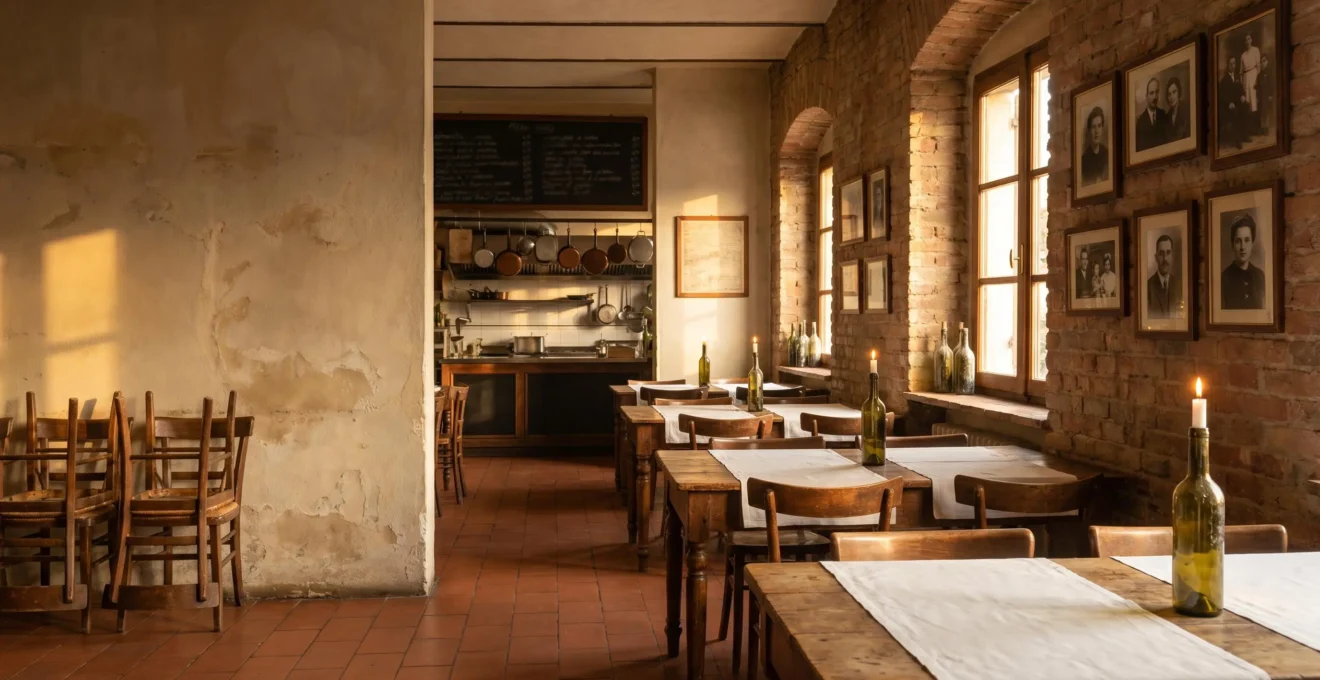
Finding a real Italian trattoria isn’t about avoiding tourist sites; it’s about decoding the cultural and economic signals the tourism industry ignores.
- Authenticity is signaled by what’s missing: English menus, long opening hours, and “international” dishes.
- The timing of your meal is the single biggest clue—locals eat at specific, condensed times.
Recommendation: Stop using checklists of red flags and start observing the rhythm of Italian daily life—that’s where the best food is hiding.
You’re in Florence, steps from the Ponte Vecchio, and your hotel concierge has just circled a “charming, traditional” restaurant on your map. You arrive to find a laminated menu in five languages and an unnervingly empty dining room at 7 PM. This is the moment every discerning traveller dreads: the realisation you’ve been funnelled into a tourist trap, a place engineered to process visitors, not to feed people. The conventional wisdom—avoid places with picture menus, look for locals—is not wrong, but it’s hopelessly incomplete. It treats the search as a game of “spot the difference” when it should be an exercise in cultural immersion.
The problem is that the entire tourism ecosystem, from luxury concierges to glowing online reviews, is often built on a foundation of safe, predictable, and profitable mediocrity. It’s a system designed to insulate you from the glorious, chaotic, and sometimes inconvenient reality of authentic Italian dining. But what if the key wasn’t about finding a restaurant, but about understanding the culture that creates it? What if the absence of an English menu, the confusing handwritten specials, and the “strange” local eating hours weren’t obstacles, but were actually the very signposts you’ve been looking for?
This guide is not another checklist. It is a lesson in reading the hidden language of the Italian street. We will dismantle the flawed logic of concierges, decode the subtle differences between an osteria and a ristorante, and master the art of ordering from a menu you can’t read. Forget hunting for restaurants; you’re about to learn how to let the best ones find you, by understanding the very pulse of the neighbourhoods they serve.
To truly master this approach, we’ll explore the essential signals that separate authentic kitchens from their tourist-focused counterparts. This guide breaks down the critical cultural and practical knowledge you need to eat like a local, every time.
Summary: Finding Authentic Italian Trattorias Beyond the Tourist Trail
- Why Do the Best Italian Trattorias Have No English Menu?
- How to Decode Italian Handwritten Specials When You Don’t Speak Italian?
- Osteria, Trattoria, or Ristorante: Which Delivers What You Actually Want?
- The Italian Coperto Charge: When It’s Legitimate and When It’s Theft?
- When Do Italian Locals Actually Eat Lunch at Trattorias?
- How to Spot Fake Regional Dishes Created for Tourists?
- Why Do Luxury Hotel Concierges Send Everyone to the Same Places?
- How to Choose Hotels That Connect You to Neighbourhood Culture?
Why Do the Best Italian Trattorias Have No English Menu?
The absence of an English menu isn’t a sign of hostility; it’s a declaration of identity. A family-run trattoria is not an international business, it’s a local institution. Its primary audience is the neighbourhood, the families who have eaten there for generations, and the workers who come for a reliable *pranzo*. Their menu is a direct reflection of their heritage, the season, and the local market, not a curated list of globally recognised Italian-American clichés. To translate the menu is to suggest that their identity is negotiable, that they are willing to flatten their unique culinary dialect into a generic tourist-friendly language. The best places don’t need to.
This fierce localism is the bedrock of Italy’s culinary strength. It’s a country where, according to the 2024 Italian Food and Wine Tourism Report, 70% of Italians chose food and wine as a primary motivation for their own holidays. They are a discerning domestic audience. A small trattoria in Rome has no economic incentive to cater to a tourist who wants Fettuccine Alfredo when their reputation is built on an impeccable *cacio e pepe* for the locals.
This regional focus is everything. An analysis of Italy’s restaurant landscape shows how deep this goes; Tuscan cuisine is served in 17.3% of all Italian restaurants, not because it’s a tourist favourite, but because it is a dominant, fiercely protected regional identity. A trattoria that proudly serves only Tuscan food, with a menu written only in Italian, is not excluding you. It is confidently expressing its own authentic self. This is not a red flag; it is the first, most important green light you are looking for.
When you see a menu only in Italian, don’t feel intimidated. Feel excited. You’ve just found a place that prioritises its soul over your dollar, and that is where you will find the meal you came to Italy for.
How to Decode Italian Handwritten Specials When You Don’t Speak Italian?
You’ve found it: a small, bustling spot with a chalkboard menu full of indecipherable cursive. This is the moment of truth. Panicking and retreating to a place with pictures is not an option. This menu is your treasure map, and you just need the right tools to read it. The key is to abandon the idea of a word-for-word translation and instead focus on deconstruction and communication. Modern tools are your ally, but they must be used with surgical precision.
This photograph captures the essence of the challenge: the beautiful, yet intimidating, handwritten menu. It’s a symbol of authenticity, not an obstacle.
As the image suggests, the texture and craft are part of the experience. Instead of being overwhelmed, start by understanding the structure. An Italian menu is not a random list; it’s a story told in five acts: Antipasti (starters), Primi (first courses, always pasta or rice), Secondi (main courses, meat or fish), Contorni (side dishes, ordered separately), and Dolci (desserts). You are not expected to order from every section. A simple *primo* and a glass of wine is a perfectly respectable lunch.
Use your phone’s camera, but wisely. A tool like Google Lens is powerful for identifying key ingredients (*funghi* for mushrooms, *cinghiale* for wild boar), but don’t translate entire sentences—you’ll get gibberish. The most powerful tool, however, is human. Catch the server’s eye and ask, “Cosa consiglia?” (What do you recommend?). This simple phrase transforms you from a confused tourist into an engaged guest. It’s an invitation for them to share their pride. When they point to an item, a simple nod and “Prendo questo” (I’ll have this) is all you need. You’ve just ordered not with your broken Italian, but with a shared respect for their food.
Embracing this moment of uncertainty is the final step. You might not know exactly what you’ve ordered, but you know it’s what the chef was proudest of today. And that is always a better bet than the “safe” option.
Osteria, Trattoria, or Ristorante: Which Delivers What You Actually Want?
In Italy, the name above the door is not just decoration; it’s a declaration of intent. It tells you everything about the expected price, atmosphere, and culinary ambition before you even step inside. Understanding the historical difference between an *osteria*, a *trattoria*, and a *ristorante* is crucial to aligning your desires with reality. While modern lines have blurred, the fundamental DNA of each establishment type remains a powerful guide for the discerning traveller.
This is not a simple case of “good, better, best.” Each serves a different purpose. An *osteria* was originally a place to get a simple glass of wine, perhaps with a few snacks. A *trattoria* is the heart of Italian home cooking, family-run with traditional recipes. A *ristorante* implies a professional kitchen, a trained chef, and a more formal dining experience. The following breakdown clarifies these essential distinctions.
| Type | Atmosphere | Menu Focus | Price Range | Service Style |
|---|---|---|---|---|
| Osteria | Casual, wine-focused | Simple snacks, wine by carafe, limited hot dishes | € (Low-Mid) | Informal counter or simple tables |
| Trattoria | Family-run, traditional | Full traditional meal, regional recipes, seasonal ingredients | €€ (Mid-range) | Warm hospitality, paper tablecloths, house wine |
| Ristorante | Professional, formal | Elaborate menu by trained chef, creative dishes | €€€ (Higher) | Impeccable service, starched linens, sommelier |
| Alimentari/Rosticceria | Deli/rotisserie shop | Ready-made food, local specialties | € (Budget) | Takeaway or few tables |
For the traveller seeking that elusive, perfect plate of pasta made by *nonna*, the trattoria is the holy grail. It promises a full, hearty meal grounded in tradition. An *osteria* is perfect for a lighter, more casual stop, while a *ristorante* is where you go for culinary innovation and professional service. Choosing the right type of establishment is the first and most important decision you’ll make. Don’t go to a fine-dining *ristorante* expecting the rustic charm of a *trattoria*, and don’t be disappointed when an *osteria* offers a limited food menu—it’s doing exactly what it’s supposed to do.
By matching the name on the door to the experience you’re craving, you move beyond the tourist’s game of chance and start making informed choices, just like an Italian would.
The Italian Coperto Charge: When It’s Legitimate and When It’s Theft?
Few things cause more confusion and frustration for visitors in Italy than the bill. A mysterious charge appears: the *coperto*. Is it a tip? Is it a scam? The answer is neither. The *coperto* is a legitimate, traditional, and legally regulated per-person cover charge. Understanding its function is key to avoiding both unwarranted suspicion and actual tourist scams. It is not a tip; it’s a fee for the place setting, the bread, the linens, and the privilege of occupying the table.
The legitimacy of the charge hinges on one thing: transparency. Italian law requires that the *coperto* be clearly listed on the menu. If it’s not printed there, you are not obligated to pay it. The amount itself is also a clue. While Italian restaurant billing regulations allow for flexibility, a typical *coperto* will be between €1 and €3 per person. If you see charges of €5 or more in a standard trattoria, especially outside of hyper-tourist zones like St. Mark’s Square in Venice, you are right to be suspicious. It’s also critical to know that the *coperto* is legally banned in the Lazio region, which includes Rome. Restaurants there might charge for bread (*pane*) separately instead, which should also be on the menu.
To distinguish a fair charge from a tourist-gouging tactic, you need a clear audit process. This isn’t about being confrontational; it’s about being informed. An informed diner is a respected diner.
Your Action Plan: Verifying the Coperto Charge
- Menu Verification: Before you sit down, find the *coperto* listed on the menu. Italian law mandates it must be displayed. If it’s not there, it’s not a valid charge.
- Amount Check: Confirm the charge is within the normal range of €1-€3 per person. Higher amounts are a red flag unless you’re in a prime tourist location or a high-end restaurant.
- Understand the Service: Remember the *coperto* covers the table setting, bread, and basic service. It is not a tip (*mancia*), which is always optional and given for exceptional service.
- Regional Rules: Be aware that the *coperto* is banned in Rome and the Lazio region. Any similar charge there should be scrutinized. Restaurants may charge for bread separately if it’s listed on the menu.
- Beware the Double-Dip: Watch for a *servizio* (service charge) of 10-20%. Having both a *coperto* AND a *servizio* is very rare and highly suspicious. If you see both, politely ask for clarification: “Potrebbe spiegarmi questa voce, per favore?”
Mastering the *coperto* is a rite of passage. It moves you from the category of “confused tourist” to “savvy visitor” who understands and respects the local customs, while also being able to spot when those customs are being abused.
When Do Italian Locals Actually Eat Lunch at Trattorias?
The single most reliable indicator of an authentic trattoria is not the decor, the menu, or even the language. It is the clock. Italians eat with a rhythm that is dictated by centuries of culture, not by the whims of tourist schedules. A restaurant that serves lunch at noon or dinner at 6 PM is not a restaurant for Italians. It is a food-service business for foreigners. To find the real deal, you must align your stomach with Italian time.
Locals typically eat lunch between 1:00 PM and 2:30 PM. The real rush, especially for the cherished weekday *pranzo di lavoro* (worker’s lunch), hits like clockwork around 1:15 PM. This fixed-price menu is a cornerstone of daily life, offering a first course, second course, water, wine, and coffee for a remarkably fair price, often advertised on a simple chalkboard. If you walk past a restaurant at 12:45 PM and it’s empty, then see it packed with locals by 1:20 PM, you’ve found an authentic spot.
The same logic applies to dinner. Most authentic restaurant kitchens in Italy do not even open before 7:30 PM, with most locals sitting down to eat between 8:00 PM and 9:30 PM. Any establishment serving lasagna at 6:00 PM is catering exclusively to a tourist palate and schedule. The pre-dinner hours of 6:00 to 8:00 PM are reserved for the sacred ritual of the *aperitivo*, a pre-meal drink with light snacks. Observing which bars are packed with locals for *aperitivo* can be an excellent reconnaissance mission for identifying quality establishments in the area.
Use this timing to your advantage. Arrive at a prospective lunch spot at 12:45 PM. Don’t go in. Watch. If it doesn’t fill up with Italians by 1:30 PM, walk away. This isn’t just a tip; it’s a foolproof system for filtering out 90% of the tourist traps. You are using the very rhythm of local life as your ultimate authenticator.
Forget what you think you know about meal times. In Italy, the clock is not just a measure of time; it is a measure of authenticity. Dine when the Italians dine, and you will eat what the Italians eat.
How to Spot Fake Regional Dishes Created for Tourists?
The menu in front of you is a minefield. For every authentic, time-honoured dish, there is a counterfeit counterpart created specifically to comfort and deceive the unsuspecting tourist. These “fake” dishes are the culinary equivalent of a knock-off handbag: they look vaguely familiar, but they lack the quality, history, and soul of the real thing. Learning to spot them is an essential self-defense skill for any traveller serious about food.
The most infamous imposter is Fettuccine Alfredo. You will not find this creamy, heavy dish in any authentic Italian kitchen; it is an American invention. The real Roman pasta is a masterclass in simplicity, like *cacio e pepe* or *carbonara*. Similarly, Spaghetti with Meatballs is a dish that simply does not exist in Italy. Meatballs (*polpette*) are a respected *secondo* in their own right, never to be combined with pasta. And that “Pepperoni Pizza” you’re about to order? “Peperoni” means bell peppers in Italian. You’re looking for *salame* or *salamino piccante*.
These dishes are a clear signal that the restaurant’s primary goal is to cater to a tourist’s preconceived notions, not to showcase authentic regional cuisine. The warning signs are clear:
- Spaghetti Bolognese: The world’s most famous fake Italian dish. The rich meat sauce from Bologna is called *Ragù alla Bolognese* and it is always served with fresh tagliatelle, not spaghetti, as the wider noodle better holds the sauce.
- Chicken on Pasta: An absolute sacrilege. In Italy, chicken is a main course (*secondo*), and pasta is a first course (*primo*). The two shall never meet in the same bowl.
- Out-of-Season Dishes: Seeing asparagus on the menu in October or porcini mushrooms in May is a dead giveaway that you’re being served frozen, not fresh, ingredients. A true trattoria cooks with the market’s daily offerings.
An authentic kitchen celebrates the simple, powerful flavours of real, seasonal ingredients. It doesn’t need to hide them under a blanket of cream or combine them in bizarre ways.
When you see these fake dishes on a menu, it’s a clear signal. It tells you that the restaurant views its customers not as guests to be cherished, but as a market to be exploited. Turn around and walk away. The real thing is waiting for you somewhere else.
Key Takeaways
- A menu only in Italian is a sign of confidence and authenticity, not exclusion.
- Decode menus by understanding their structure (Antipasti, Primi, etc.) and asking for recommendations (“Cosa consiglia?”).
- The single most reliable indicator of an authentic restaurant is its timing: locals eat lunch from 1-2:30 PM and dinner after 8 PM.
Why Do Luxury Hotel Concierges Send Everyone to the Same Places?
The hotel concierge seems like the ultimate insider, a trusted local with the keys to the city’s hidden gems. This is a carefully cultivated illusion. More often than not, the concierge is a gatekeeper for a small, closed loop of restaurants that are safe, predictable, and often have a financial arrangement with the hotel. They are not recommending the *best* place; they are recommending the *least risky* place.
Consider the economic pressure. With Italy’s tourism revenue reaching $58.7 billion, the industry is a massive machine. A concierge at a five-star hotel is responsible for the satisfaction of hundreds of guests with wildly different tastes. Recommending a tiny, chaotic, family-run trattoria where no one speaks English is a customer service nightmare waiting to happen. What if the guest doesn’t like the “simple” food? What if they are confused by the bill? It’s far safer to send them to a polished, professional *ristorante* with an international menu, impeccable English-speaking staff, and the ability to handle large groups—a place that is, by definition, not a true local trattoria.
This creates the “concierge’s dilemma”: their job is not to provide you with an authentic cultural experience, but to provide a frictionless, complaint-free transaction. To get past this, you must disrupt their script. Don’t ask, “What’s the best restaurant?” You will get the standard, safe answer. You need to ask a better question, one that forces them to think outside their professional obligations and tap into their personal life.
The Three-Question Script to Get Real Recommendations
To bypass the standard tourist-friendly list, use this precise, three-part script. First, disarm them: “I’m not looking for the best restaurant in the city…” This signals you are not a typical tourist seeking prestige. Second, get personal: “…I’m looking for YOUR favorite neighborhood spot for a simple, delicious bowl of pasta.” The word “your” shifts the request from a professional duty to a personal opinion. Finally, add a dose of reality: “Where would you take your own family on a Tuesday night?” The specificity of a weekday grounds the request in everyday life, not a special occasion. Listen for key phrases in their response: “very simple” or “they don’t speak much English” are green lights, while “great atmosphere” is often code for “tourist-friendly.”
The concierge can be your greatest ally or your biggest obstacle. By understanding their motivations and changing the nature of the conversation, you can turn a gatekeeper into a genuine guide.
How to Choose Hotels That Connect You to Neighbourhood Culture?
Your quest for authentic food doesn’t begin when you feel hungry; it begins the moment you book your hotel. The choice of accommodation is the most critical decision you will make, as it determines the entire ecosystem you will inhabit. A large, international chain hotel, no matter how luxurious, is an island. It is designed to be self-sufficient and isolated from the neighbourhood it occupies. A truly local hotel, however, functions as a bridge, actively connecting you to the fabric of the community.
To find these gems, you must become a digital detective. Don’t just read the hotel’s marketing copy about its “authentic location.” Verify it. Use Google Street View to virtually walk around the block. Is the hotel surrounded by other hotels and souvenir shops, or is it next to a local bakery, a butcher, and a small hardware store? Check the hotel’s geotag on Instagram. Are guests tagging the hotel pool, or are they tagging the neighbourhood wine bar the front desk recommended? Mine guest reviews for specifics, searching for mentions of local businesses by name, not just generic comments like “great location.”
The most profound examples of this integration can be found in models like the *Albergo Diffuso*, or “dispersed hotel.” This is not just a place to sleep; it’s a philosophy.
Case Study: The Albergo Diffuso and True Immersion
The ‘Albergo Diffuso’ model, particularly visible in historic neighbourhoods like Trastevere in Rome, breaks the hotel concept apart. Instead of one large building, rooms are scattered across multiple buildings within a village or district. This structure forces a deep and immediate integration with the local community. To get breakfast, you may need to walk to the local *pasticceria* with a voucher from the hotel. There is no central restaurant, so you are naturally guided to patronize the neighbourhood’s trattorias. The “concierge” is often the owner of the guesthouse, whose family has lived in the area for generations. Their “recommendations” are not a list from a corporate office; they are the lived experience of their entire life. This model represents the pinnacle of neighbourhood symbiosis, transforming you from a visitor into a temporary resident.
Ultimately, choosing the right hotel is about choosing the right perspective. By selecting an accommodation that is in and *of* the neighbourhood, you are setting yourself up for a journey of authentic discovery, where every meal is a genuine connection to the place you’ve come to explore.