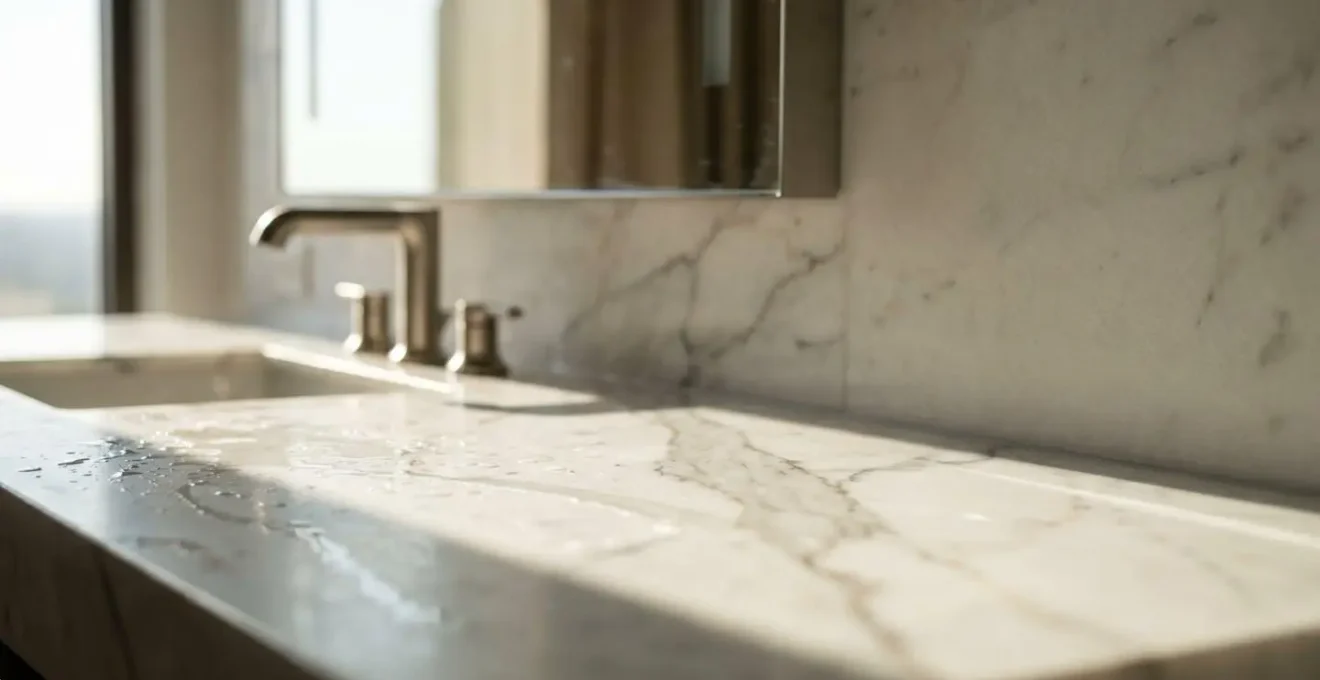
The seductive gleam of a marble bathroom is often a misleading indicator of luxury; it’s the hidden functional details that reveal a hotel’s true commitment to a superior guest experience.
- Streaks, water spots, and dull patches on marble are not just cleaning oversights; they are signs that a hotel has prioritized a fleeting “Instagrammable” look over durable, guest-centric design.
- Genuine luxury is found in functional elements: task lighting that works, intuitive water controls, and high-quality hardware that feels substantial to the touch.
Recommendation: Stop being impressed by the material alone. Instead, use the bathroom as a diagnostic tool to assess whether a hotel’s luxury is merely surface-deep or built to serve you.
The moment you step into a luxury hotel bathroom clad in floor-to-ceiling marble, the message seems clear: you have arrived. The dramatic veining, the cool, solid feel underfoot—it’s an immediate, visual shorthand for opulence. Hotels invest heavily in this look, banking on its power to impress and its popularity on social media. For many travelers, a stunning bathroom is a key part of the five-star promise, a private sanctuary of indulgence.
But after the first shower, a different reality often emerges. Water spots mar the polished surface. Streaks appear where you’ve placed your toiletries. The space, so perfect upon arrival, suddenly seems fragile and high-maintenance. This raises a critical question for the discerning guest: Is this material, so prone to showing wear, truly the pinnacle of functional luxury, or is it a design choice that prioritizes a photograph over the practicalities of your stay? The truth is, the state of a hotel’s marble is a powerful tell.
This article moves beyond the surface gleam. We will deconstruct the luxury bathroom, not as a designer, but as a guest. We will explore why that pristine marble looks worn so quickly and teach you how to assess functionality over mere finishes. We’ll weigh the real-world value of trendy features and show you how to spot the tiny details that signal a hotel’s genuine commitment to care. It’s time to become a critic of comfort and learn to recognize design that serves your experience, not just the hotel’s marketing.
To guide you through this critical assessment, we’ve broken down the key areas of evaluation. This structured approach will help you look past the initial “wow” factor and analyze the thoughtful—or thoughtless—design choices that truly define a luxury stay.
Table of Contents: A Critic’s Guide to the Luxury Bathroom
- Why Do Luxury Hotel Marble Bathrooms Look Streaky After One Shower?
- How to Assess Luxury Bathroom Functionality Not Just Finishes?
- Rainfall Shower or Freestanding Tub: Which Luxury Bathroom Feature Matters?
- The “Spacious” Luxury Hotel Bathroom That’s Barely 4m²
- When Do Luxury Bathrooms Create Value Beyond Instagram Potential?
- When Does Luxury Room Design Serve Function Versus Just Impressing?
- How to Spot the Tiny Hotel Details That Reveal True Care?
- How to Recognize Genuine Design Excellence in Luxury Hotel Rooms?
Why Do Luxury Hotel Marble Bathrooms Look Streaky After One Shower?
The pristine, uniform shine of a marble bathroom is often fleeting, a state of perfection that lasts only until the first guest checks in. The primary culprit is marble’s chemical composition. As a porous, calcite-based stone, it is highly reactive to both acids and alkaline substances. This is not just a cleaning issue; it’s a fundamental conflict between the material and its intended environment. The “streaks” and dull spots you see are often not stains that can be wiped away, but a form of permanent surface damage called etching.
This degradation happens with surprising speed. According to Rose Restoration International, a leading stone maintenance company, the root of the problem is often the guest’s own products. They note:
Guest room vanity etching occurs when toiletries — perfume, cologne, hair products, toothpaste — contact marble countertops. Most guests do not know that these products can permanently dull a marble surface, and even brief contact can cause visible etching.
– Rose Restoration International, Hotel Marble Maintenance: A Property Manager’s Complete Guide
This creates a paradox: the very products you bring to a luxury hotel to feel your best can actively degrade your “luxurious” surroundings. The issue is compounded by hard water, which leaves mineral deposits that are difficult to remove without harsh chemicals that would further damage the stone. The rapid decline is quantifiable; industry maintenance data reveals a potential 15-20% surface clarity loss in the first year of a hotel’s operation if a rigorous (and expensive) maintenance program isn’t in place. That streaky appearance is the first clue that a hotel may have chosen an aesthetic that is fundamentally at odds with its function.
How to Assess Luxury Bathroom Functionality Not Just Finishes?
A truly luxurious bathroom is one where everything works intuitively and effectively. It’s an environment that anticipates your needs, rather than simply providing a dramatic backdrop. Assessing this functional luxury requires shifting your focus from the material (marble, brass, tile) to the experience it enables. The ultimate test is how the space performs its core tasks: grooming, bathing, and relaxing. Does the design serve you, the user, or does it serve a photograph?
One of the most critical, yet often overlooked, functional elements is lighting. A single, dramatic chandelier might look impressive, but it creates shadows, making tasks like applying makeup or shaving difficult. A well-designed space features layered lighting: ambient overhead light, and most importantly, excellent task lighting. This means fixtures placed at eye level on either side of the mirror to provide even, shadow-free illumination on your face. This is a detail that doesn’t always read on Instagram but makes a world of difference to the guest experience.
This approach of prioritizing function is a sign of mature design thinking in the hospitality industry. As Anne Wilkinson of the design firm BAMO states, the focus has evolved:
Luxury hospitality design continued to shift toward authentic, immersive environments shaped around personalization and service, with design focusing on how spaces function, feel, and support the guest experience over time.
– Anne Wilkinson, BAMO, Design Movements That Defined Hospitality in 2025
This philosophy extends to every element. Are the outlets conveniently located? Is there adequate, accessible surface area for your toiletries, or is the sink a beautiful but impractical vessel? Is the shower control clearly marked and easy to operate? These are the questions that separate true luxury from a mere stage set.
The image above illustrates this perfectly. The focus isn’t on a grand, sweeping view but on a detail that works. The warm, flanking lights create perfect, even illumination on the vanity—a clear sign of guest-centric design. It is in these thoughtful, functional choices that you find the real measure of a luxury bathroom.
Your 5-Point Bathroom Functionality Audit:
- The Lighting Test: Stand at the mirror. Is your face evenly lit from the front, or are there harsh shadows from overhead? Good task lighting is non-negotiable.
- The Surface-Area Check: Look at the vanity. Is there a dry, accessible space to place your toiletries, or is everything cramped around a stylish but impractical sink?
- The Outlet Hunt: Are there outlets near the mirror for hair tools or shavers, or are they hidden in inconvenient locations? Bonus points for integrated USB ports.
- The Water-Control Intuition: Look at the shower controls. Can you instantly tell how to turn it on and adjust the temperature, or is it a cryptic puzzle that risks a blast of cold water?
- The Towel Reach: When you step out of the shower, is a towel rack or hook within easy arm’s reach? Or is it an afterthought placed across the room?
Rainfall Shower or Freestanding Tub: Which Luxury Bathroom Feature Matters?
The freestanding tub has become an icon of the luxury hotel bathroom. It’s a sculptural, statement piece that signals indulgence and the promise of a long, relaxing soak. It has so thoroughly conquered the market that, according to hospitality suppliers, freestanding bathtubs are replacing corner built-in tubs as the new industry standard. They are often placed dramatically, sometimes by a window with a view, reinforcing the idea of the bathroom as a destination for leisure, not just utility.
The appeal is undeniable. Mike Rizzuto of Infinity Drain explains, “The aesthetic is luxurious and the design is more space-efficient than deck-mounted bathtubs.” For designers, it’s a win-win: a powerful visual symbol that also helps a room feel more open. However, from a guest’s perspective, the practical value is debatable. Does the average guest on a two-night stay truly have time for a 45-minute bath? How easy is it to get in and out of, especially for older guests or those with mobility issues? Often, the statement tub sits unused, a beautiful but impractical piece of room decor.
In contrast, virtually every guest will use the shower. Here, the battle is between a standard showerhead and the ubiquitous rainfall shower. While the latter can feel luxurious, its true value is determined by function. The key factor is not the size of the showerhead, but the water pressure. A wide, gentle drizzle from a low-pressure rainfall head is far less satisfying than a powerful, invigorating spray from a smaller, well-engineered fixture. The ultimate functional luxury is a dual system: a rainfall head for ambiance, paired with a powerful, adjustable handheld wand for practicality. This demonstrates a hotel’s understanding that different guests have different preferences, and that true service is about providing choice.
The “Spacious” Luxury Hotel Bathroom That’s Barely 4m²
In the world of hotel design, perception often matters more than raw square footage. Many luxury hotels, especially in dense urban centers, face the challenge of creating a sense of spaciousness within a compact footprint. The solution isn’t to build bigger rooms, but to design smarter ones. This has led to a trend where, as hospitality design experts confirm, hotel bathrooms shifted to minimalist designs in recent years, using clever tricks to expand the feeling of space.
One of the most effective techniques is the use of glass. Replacing solid shower walls with floor-to-ceiling glass panels immediately extends the sightline, making the entire room feel like one continuous space. Similarly, a large, wall-to-wall mirror can visually double the size of the room. Floating vanities, which are mounted to the wall without touching the floor, create an uninterrupted floor plane, further enhancing the illusion of a larger area. These are not just aesthetic choices; they are strategic decisions designed to manipulate our perception of depth and volume.
This focus on creating an experience through clever design is a hallmark of modern luxury. It’s less about sheer size and more about the thoughtful combination of elements. As Javier Korneluk of Fantini North America notes, a key trend is “the mixing of aesthetics… noting the combinations of traditional and contemporary elements or the juxtaposition of different materials.” A designer might pair a sleek, minimalist glass shower with a rustic, heavily-veined marble wall. This contrast creates visual interest and depth, drawing the eye and making the small space feel more curated and deliberate. The goal is to create a room that feels expansive and uncluttered, regardless of its actual dimensions. A bathroom that feels cramped and poorly planned, no matter how large, will never feel luxurious.
When Do Luxury Bathrooms Create Value Beyond Instagram Potential?
The true value of a luxury bathroom is revealed not in a wide-angle photograph, but in the moments of direct interaction. It’s found in the details that you touch, hear, and feel. This is the realm of haptic quality—the tangible, sensory feedback that communicates craftsmanship and thoughtful design. While a dramatic marble wall creates a powerful first impression, it’s the solid, satisfying click of a heavy door handle or the smooth, weighted turn of a faucet that provides continuous, subconscious reassurance of quality throughout your stay.
These are the elements that separate surface-level, Instagram-driven design from deep, functional luxury. Think about the hardware: are the faucet and shower controls made of solid metal that feels cool and substantial in your hand, or are they lightweight, plated plastic? Does the toilet seat have a soft-close mechanism that prevents it from slamming shut? Are the towel bars securely fastened to the wall, or do they feel flimsy? These micro-experiences accumulate, collectively shaping your perception of the room’s quality far more than a single, static visual element ever could.
The image above captures this idea perfectly. It’s an extreme close-up of a faucet handle, focusing on the texture and finish of the metal. This is a detail you might not notice from across the room, but you feel it every time you use the sink. This is where a hotel’s investment in quality truly pays off for the guest—not in the broad stroke of a marble slab, but in the repeated, positive reinforcement of well-made, well-chosen objects.
This focus on the lived experience is the ultimate goal of great hospitality design. As designer Kia Weatherspoon eloquently puts it:
The most successful projects weren’t the loudest; they were the ones that understood how people want to feel when they arrive, stay, and return. Design became less about visual dominance and more about creating places that hold people well.
– Kia Weatherspoon, Determined by Design
A bathroom creates lasting value when it “holds you well.” It does this through intuitive design, high-quality touchpoints, and by anticipating your needs seamlessly. That is a form of luxury that lingers long after the Instagram post is forgotten.
When Does Luxury Room Design Serve Function Versus Just Impressing?
The choice of materials in a luxury hotel room is a constant balancing act between impressing the guest and serving the operational realities of a high-traffic environment. Marble has long been the go-to material for making a statement, a symbolic shorthand for wealth and opulence. However, as we’ve seen, it comes with significant functional drawbacks, particularly its high-maintenance nature. This conflict is forcing a shift in the industry, where the definition of “luxury” is evolving from purely symbolic to something more practical and intelligent.
Increasingly, hotel developers and designers are questioning the long-term wisdom of using materials that are both expensive to install and even more expensive to maintain. A chipped marble tile or an etched vanity top is not just an aesthetic issue; it’s a cost that erodes the hotel’s bottom line and, more importantly, detracts from the guest experience. This has led to a quiet revolution in material selection. Savvy hoteliers are recognizing that a pristine, high-quality porcelain tile that looks great for a decade can provide a more consistently luxurious experience than a “prestigious” marble surface that looks worn after just one year.
This trend is confirmed by industry analysis. While marble is still popular, recent hospitality material reports indicate that traditional marble is losing dominance in new hotel construction projects, precisely because of its cost and maintenance challenges. The focus is shifting towards “lifecycle cost,” which considers not just the initial price but the total expense of a material over its lifespan, including cleaning, repairs, and eventual replacement. A design serves function when it looks good not only on opening day but also on day one thousand. This is the transition from a philosophy of “impress” to one of “perform.” True luxury is not fragile; it is resilient and designed to last.
Key Takeaways
- The condition of a hotel’s marble is a direct reflection of its operational standards; streaks and etches signal a priority of looks over long-term guest experience.
- True luxury is functional. Assess a bathroom based on the quality of its task lighting, the intuitiveness of its controls, and the adequacy of its space, not just its materials.
- High-quality details you can touch and feel—like solid metal hardware and soft-close mechanisms—create more lasting value than a dramatic but impractical statement piece.
How to Spot the Tiny Hotel Details That Reveal True Care?
True care in a hotel is revealed in the details that most guests will never consciously notice, but which collectively create an environment of seamless comfort. It’s about the proactive, thoughtful decisions made by management and staff that prevent problems before they occur. The state of the bathroom, and particularly its high-maintenance surfaces like marble, is a prime area to spot these signals.
The choice of cleaning products is one such invisible detail with very visible consequences. As one luxury hotel industry report highlights, “applying an acidic cleaner to marble instead of one that is pH-neutral dulls the stone’s finish over several months.” As a guest, you won’t see the cleaning cart, but you will see the result: a bathroom where the marble has lost its luster and depth. This dullness is a sign of a systemic issue—either a lack of proper staff training or a cost-cutting measure on appropriate supplies. It reveals that the hotel’s commitment to its “luxury” material was only purchase-deep.
Other tiny details can be just as revealing. Look at the grout lines in the shower. Are they perfectly clean, or do they show signs of mildew? Is the silicone sealant around the tub and sink fresh and white, or is it discolored and peeling? These are not signs of a single poor cleaning job but of a cumulative lack of deep maintenance. Consider the towels. Are they thick, plush, and brilliantly white, or are they thin and grayish from over-laundering? Even the humble toilet paper can be a clue: is the end neatly folded into a point, a small gesture indicating that the room has been thoroughly attended to and untouched since cleaning?
These small things matter because they are proxies for a hotel’s overall operational excellence. A management team that ensures its housekeepers use the correct pH-neutral cleaner for marble is also likely the team that ensures the air filters are changed regularly and the mattresses are flipped on schedule. They are not just cleaning a room; they are stewarding an asset and, by extension, caring for the guest.
How to Recognize Genuine Design Excellence in Luxury Hotel Rooms?
In an age dominated by social media, the pressure for hotels to create “Instagrammable” moments has never been higher. This has fueled the use of visually arresting materials like large, dramatically-veined marble slabs, which serve as perfect backdrops for selfies and influencers. As Mordor Intelligence notes in its market analysis, “Hotel brands create Instagram-friendly interiors that rely on dramatic stone backdrops.” This is a marketing-driven design choice, and it can sometimes be at odds with the principles of genuine design excellence.
Genuine design excellence is not about creating a static image. It is about choreographing a seamless and delightful human experience within a space. It is quiet, intuitive, and often invisible. It’s the placement of a light switch right where your hand expects it to be in the dark. It’s the sound of a heavy door closing with a soft, reassuring thud, not a jarring bang. It’s the realization that there is an outlet exactly where you need one to charge your phone on the nightstand.
Therefore, to recognize excellence, you must move through the room and live in it, even for a few moments. Sit in every chair. Is it comfortable for more than 30 seconds? Open and close the drawers. Do they glide smoothly? Turn on the shower. How does the water pressure feel? How easy is it to adjust the temperature? The answers to these questions reveal the true quality of the design far more than the choice of stone on the wall. A room that looks spectacular but functions poorly is a design failure. A room that might look simple but where everything feels right and works perfectly is a design triumph.
Ultimately, the most telling sign of design excellence is a feeling of ease. It’s the absence of friction. You don’t have to hunt for things, you don’t struggle with the controls, and you don’t have to adapt your behavior to the room’s quirks. The room adapts to you. This is the highest form of luxury—a space so thoughtfully and intelligently designed that it recedes into the background, allowing you to simply relax and enjoy your stay. It’s a luxury of function, not just form; an experience, not just an aesthetic.
Your journey as a more discerning guest begins now. The next time you check in, look beyond the sweeping gestures and pay attention to the small, functional details. You will not only have a better-calibrated sense of value, but you will also derive a deeper appreciation for the quiet, unsung excellence of a truly well-designed space.