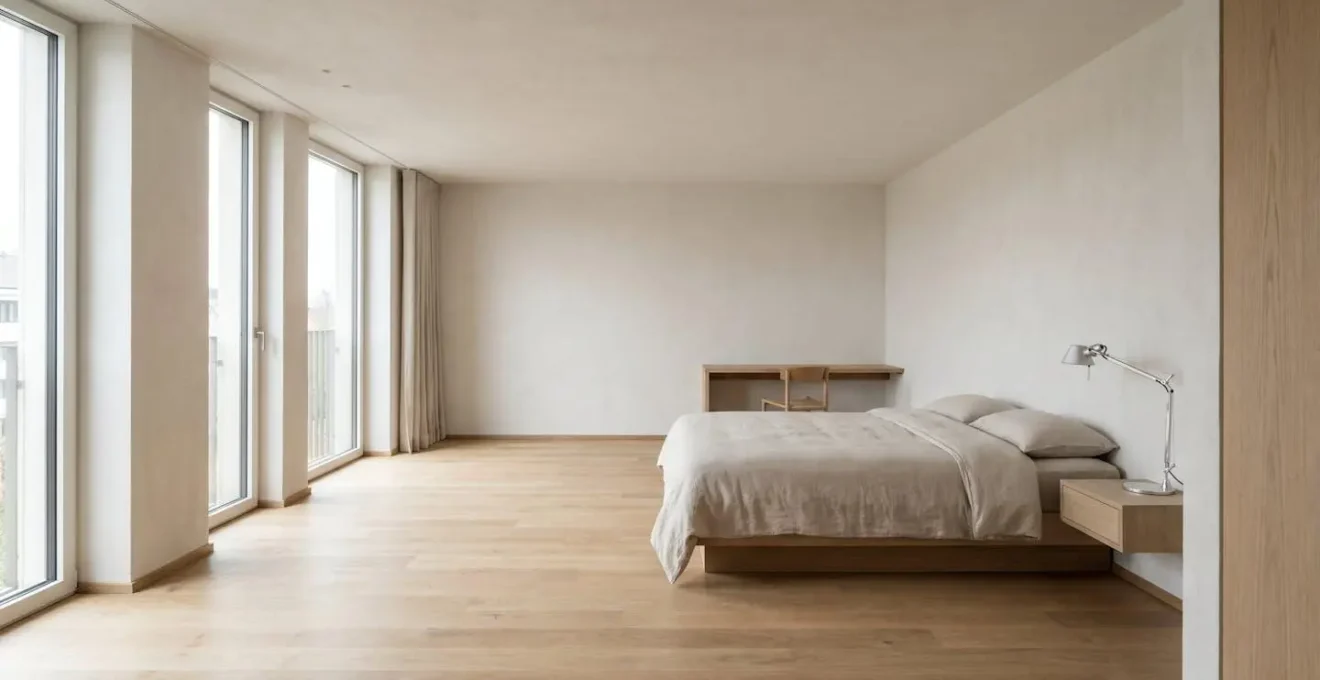
The advertised square footage of a European hotel room is often a misleading metric; true spaciousness depends on layout, photo analysis, and decoding marketing terms.
- Historical buildings and high real estate costs mean European rooms are fundamentally smaller than their US counterparts.
- Wide-angle photography can make rooms appear up to 40% larger, and terms like “Junior Suite” don’t guarantee separate spaces.
Recommendation: Stop trusting the brochure and become a “space detective”: analyze floor plans, question the exact size difference of upgrades, and target modern business districts or specific hotel chains known for larger room standards.
The feeling is universally disappointing. You’ve booked a premium five-star room in a beautiful European capital, imagining cityscape views and ample room for your family to unwind. Yet, upon arrival, the reality is a shoebox. Your luggage barely fits, you have to shuffle sideways past the bed, and the “sitting area” is a single chair crammed into a corner. For families and travelers prioritizing comfort, this experience is a frustratingly common consequence of paying high rates for rooms that fail to deliver on the promise of space.
The standard advice is often to “look at the photos” or “book a suite,” but this rarely solves the problem. Hotel photography is an art of illusion, and vague category names are designed to upsell, not to inform. Relying on these superficial markers is why so many travelers end up feeling cramped and deceived. But what if the key wasn’t just looking at the advertised size, but understanding the hidden language of hotel real estate?
The true measure of a room’s value isn’t its listed square meterage, but its effective livable area. This guide moves beyond the brochure to give you a forensic toolkit for finding genuine space. We’ll explore the fundamental reasons for Europe’s smaller rooms, teach you how to see through photographic tricks, deconstruct misleading room categories, and reveal which cities and hotel types are your best bet for a comfortable stay. You’ll learn to stop being a hopeful booker and start being a savvy space detective.
This comprehensive guide is structured to take you from understanding the core problem to mastering the practical strategies for your next booking. Follow along to arm yourself with the knowledge needed to secure the space you’re paying for.
Summary: A Guide to Decoding European Hotel Room Space
- Why Are London Five-Star Rooms Half the Size of New York Luxury Hotels?
- How to Convert Hotel Room Measurements Into Realistic Space Expectations?
- Junior Suite or Executive Room: Which Delivers Real Extra Space?
- The Wide-Angle Photo Trick Making Hotel Rooms Look 40% Larger
- Where in Europe Do Hotels Offer 30+ Square Metre Standard Rooms?
- How to Know if the £40 Room Upgrade Is Worth It?
- Why Does a 40m² Aparthotel Feel Smaller Than a 30m² Apartment?
- How to Choose Aparthotel Layouts That Maximize Livable Space?
Why Are London Five-Star Rooms Half the Size of New York Luxury Hotels?
The stark difference in hotel room size between Europe and North America isn’t just a perception; it’s a structural reality rooted in history and economics. On average, analysis confirms that European hotel rooms are approximately 30% smaller than their U.S. counterparts. This gap is even more pronounced in the luxury sector. A standard five-star room in central London can be a mere 180 square feet (around 17 m²), while a comparable new-build luxury hotel in New York or Orlando might offer 350-500 square feet (32-46 m²) as its baseline.
The primary reason for this discrepancy is the architectural footprint. Many of Europe’s most desirable hotels are housed in historic, protected buildings. These charming 19th-century townhouses or grand old palaces were built long before modern tourism, with layouts that are difficult and expensive to alter. Stringent heritage protection laws prevent developers from knocking down walls or significantly reconfiguring spaces, forcing them to fit rooms into a pre-existing, often cramped, structural grid. In contrast, American cities, with more recent construction cycles and less restrictive building codes, can design hotels from the ground up with space as a key luxury feature.
Case Study: The American Standard in Manhattan
The former London NYC hotel in Manhattan perfectly illustrated this difference in philosophy. It offered standard suites starting at a generous 500 square feet (46 m²), which is more than double the size of many typical New York City hotel rooms and a giant compared to its London namesake. This demonstrates the North American luxury standard where even entry-level suites prioritize generous space allocation. This approach contrasts sharply with London’s five-star offerings, where similar properties in historic buildings are constrained by architectural heritage laws and some of the world’s most expensive real estate, making every square meter a significant cost factor for the hotel operator.
This fundamental difference isn’t about a lack of willingness to provide space; it’s a reflection of urban density, building age, and real estate costs. For the traveler, this means resetting expectations is the first crucial step. A “spacious” room in Paris or Rome operates on an entirely different scale than a “spacious” room in Las Vegas or Dubai. Understanding this context is key to avoiding disappointment.
How to Convert Hotel Room Measurements Into Realistic Space Expectations?
The first step in becoming a savvy space-hunter is to learn the language of square meters and translate it into real-world, livable area. A number on a website is abstract; what matters is whether you’ll be tripping over your suitcase or enjoying a clear path to the window. You must develop a mental benchmark to instantly contextualize a room’s advertised size. For instance, anything under 20 square meters (215 sq ft) is effectively a “crash pad” in a major European city – fine for a solo traveler who’s out all day, but challenging for a couple and nearly impossible for a family.
A more comfortable compact room, suitable for two people who travel light and spend most of their time exploring, falls into the 20-25 square meter (215-270 sq ft) range. It’s when you cross the 25-30 square meter (270-320 sq ft) threshold that a room begins to feel like a comfortable studio apartment, with enough space for a small sitting area. For those who prioritize in-room comfort, the target should be 35 square meters (375 sq ft) or more, which typically provides distinct zones for sleeping, working, and relaxing.
This visual benchmark helps bridge the gap between a number and the physical experience. Below is a more detailed breakdown to use as your personal reference scale when comparing hotel options.
- Under 15-20 m² (160-215 sq ft): A ‘crash pad’ layout. Expect to navigate around your luggage with minimal floor space.
- 20-25 m² (215-270 sq ft): A comfortable compact layout. Adequate for one or two travelers who plan to spend most time exploring the city.
- 25-30 m² (270-320 sq ft): A comfortable studio apartment feel. Enough space for a small sitting area or workspace in addition to the bed.
- 30-35 m² (320-375 sq ft): A spacious standard room. Comfortable movement space, a dedicated work area, and proper luggage storage without feeling cramped.
- 35+ m² (375+ sq ft): A genuine one-bedroom apartment feel or junior suite, with distinct zones and generous circulation space.
Junior Suite or Executive Room: Which Delivers Real Extra Space?
One of the most confusing areas for travelers is navigating the hotel’s own room categories. Terms like “Deluxe,” “Executive,” and “Junior Suite” sound appealing but often have no standardized meaning. An “Executive Room” might simply be a standard-sized room on a higher floor with access to a lounge, offering minimal extra living space. The most common point of confusion is between a Junior Suite and a One-Bedroom Suite. It’s a critical distinction: a Junior Suite is almost always one single, large room that includes a sitting area, whereas a true One-Bedroom Suite has a physical wall and a door separating the bedroom from the living area. For families or anyone needing privacy, this is the only feature that truly guarantees spatial separation.
To avoid paying a premium for marketing fluff, you must become surgical in your questioning. Don’t accept vague assurances of “more space.” Instead, demand precise figures and features. The difference between a 30m² standard room and a 32m² “Deluxe” room is negligible and not worth an upgrade fee. However, a jump from 30m² to 45m² is significant. The following table deconstructs common room categories, but remember, the ultimate truth always lies in the specific hotel’s details.
The following table, based on common industry definitions, helps clarify what you can generally expect. However, always verify with the specific hotel, as standards can vary dramatically.
| Room Category | Typical Size Range | Key Features | What It Actually Means |
|---|---|---|---|
| Standard Room | 250-350 sq ft (23-32 m²) | Bed + minimal furniture | Base category – size varies dramatically by city and hotel age |
| Executive Room | 300-400 sq ft (28-37 m²) | Upgraded amenities + lounge access | Often prioritizes perks (lounge, breakfast) over significantly more space |
| Junior Suite | 350-500 sq ft (32-46 m²) | Single room with sofa area | One large room with sitting area – NO separate bedroom with door |
| One-Bedroom Suite | 500-800 sq ft (46-74 m²) | Physical wall separating bedroom/living | True separate spaces with solid wall and door – the only guarantee of structural separation |
| Deluxe/Superior Room | 350-450 sq ft (32-42 m²) | Marketing term – varies by hotel | Vague label with no standardized meaning – always verify actual square footage |
To cut through the marketing language and determine if an upgrade offers genuine value, you need to ask the right questions before you commit.
Your Pre-Upgrade Interrogation Checklist
- Ask: ‘What is the exact square meter (or square foot) difference between the standard room and the upgraded category?’ – Demand the precise numerical measurement, not vague descriptions.
- Ask: ‘Is there a full, solid wall and a door separating the bedroom from the living area?’ – This is the ultimate litmus test for a true suite versus a marketing label.
- Ask: ‘What specific features does the upgraded room include – balcony, bathtub, better view, corner location?’ – Identify tangible benefits beyond just size.
- Request a floor plan or room layout diagram if available, particularly for aparthotels and suite categories where configuration varies significantly.
- Check if the upgraded category includes a corner room assignment – these often have irregular, more generous layouts due to building structure.
The Wide-Angle Photo Trick Making Hotel Rooms Look 40% Larger
You’ve found a room with a promising square meterage and a “Deluxe” label. The photos look bright, airy, and spacious. But this is where the second major deception occurs: photographic distortion. The hospitality industry, like real estate, systematically uses wide-angle lenses to create an illusion of depth and space that simply doesn’t exist in reality. A professional hotel photographer’s job is not to document reality, but to sell a dream. According to industry professionals, most interior hotel photography uses focal lengths between the 16-24mm range. These lenses stretch the space, making a room feel significantly larger than it is.
This technique creates several tell-tale signs of distortion. Objects at the edges of the frame, like a chair or the foot of a bed, will appear unnaturally elongated. Straight lines, such as door frames or walls, may appear to curve slightly outwards (an effect known as barrel distortion). The photographer will almost always shoot from an extreme corner or the doorway, a position that maximizes the perceived depth but gives a completely unrealistic sense of the room’s true proportions. A chair photographed this way can look as wide as a loveseat, and a small desk can appear to be a generous workspace.
To combat this, you must learn to become a photo detective. Ignore the overall impression of the photo and instead, scrutinize the details for signs of distortion. The most powerful antidote to professional marketing shots is user-generated content. Photos taken by previous guests on their smartphones (found on TripAdvisor, Google Maps, or Instagram location tags) lack the wide-angle trickery and provide a much more honest depiction of the room’s actual size and condition.
Photo Detective Techniques to Spot Wide-Angle Distortion
- Look for curved lines: Check furniture and walls near the edges of photos. Barrel distortion from ultra-wide lenses makes straight edges appear bowed.
- Identify elongated objects: Notice stretched beds or door frames at the photo’s periphery. Wide-angle lenses make foreground objects appear 2-3 times larger than background objects.
- Check the photographer’s position: A shot from the doorway or an extreme corner is a classic technique to maximize apparent depth while distorting proportions.
- Find mental anchors: Use objects of a known size, like a coffee machine, TV remote, or bedside lamp, to mentally rescale the room to its realistic dimensions.
- Seek user-generated content: Search TripAdvisor, Google Reviews, and Instagram. Guest photos taken on smartphones provide a more accurate representation than professional marketing shots.
Where in Europe Do Hotels Offer 30+ Square Metre Standard Rooms?
While the general rule is that European rooms are smaller, it is still possible to find generously sized accommodation if you know where to look. The key is to trade proximity to the charming-but-cramped historic center for the more spacious layouts of modern developments. Cities that were heavily rebuilt post-war or have developed major new business districts are often the best bets for finding rooms that meet American or international size standards. For instance, data from 2025 shows the average hotel room in Germany is 269 square feet (25 m²), compared to a meager 172 square feet (16 m²) in the UK, reflecting Germany’s more modern hotel stock.
American hotel chains are also a good strategic choice. Brands like Marriott, Hyatt, and Hilton often build to more generous global brand specifications, even in Europe. Their higher-tier brands, such as Park Hyatt or JW Marriott, are particularly known for maintaining a high standard of space, often with entry-level rooms starting at 30-35 square meters. These are frequently located in newer business districts like La Défense in Paris or Canary Wharf in London, which may require a short metro ride to the main tourist sites but reward you with significantly more comfortable and modern accommodation.
Resort destinations also offer larger rooms by default. Since the hotel itself is a central part of the holiday experience, properties in places like the Algarve in Portugal or Spain’s Costa del Sol tend to offer larger standard rooms, often with balconies, as space is a key selling point. The strategic principles below provide a clear roadmap for your search.
- Target newer business districts: Areas like La Défense (Paris), Zuidas (Amsterdam), or Canary Wharf (London) have modern hotels with American-style room sizes (25-35 m² for standard rooms).
- Prioritize post-war rebuilt cities: Berlin, Warsaw, and parts of Rotterdam offer more generous hotel layouts (25-30+ m²) due to modern urban planning.
- Book American hotel chains: Brands like Hyatt, Marriott, and Hilton often maintain more generous size specifications, especially their higher-tier brands like Park Hyatt or JW Marriott.
- Choose resort or coastal destinations: Hotels in the Algarve, Canary Islands, or Costa del Sol typically offer larger standard rooms (28-35 m²) as part of the destination experience.
- Look for city-specific exceptions: In Paris, grand Haussmann buildings in the 8th or 16th arrondissements often have rooms exceeding 25 m², while the historic Le Marais or Latin Quarter averages just 15-18 m².
How to Know if the £40 Room Upgrade Is Worth It?
The front desk offer is tempting: “For just £40 more per night, we can upgrade you to a Superior Room.” But is it a genuine offer of enhanced comfort or just a clever way to increase revenue? The decision to upgrade should be a calculated one, not an emotional impulse. The value of that extra £40 depends entirely on your trip’s purpose, duration, and what the upgrade tangibly delivers. For a business traveler who will only be in the room to sleep, an extra 5 square meters has very low practical value. For a family with young children on a week-long trip, that same 5 square meters—or better, 15—could be the difference between a relaxing holiday and a week of cabin fever.
The key is to quantify the benefit. Think of it as purchasing space and comfort. If a £40 upgrade gives you a dedicated workspace for a 3-night business trip where you’ll be working in the room, you are essentially paying around £13 per night for a more productive and comfortable office. For a family, that extra space to prevent tension and give everyone breathing room has critical “sanity value” that is often well worth the price. Conversely, if the upgrade only offers a slightly better view or marginally more space for a short romantic weekend, the money might be better spent on a nice dinner.
The following framework helps assess the value of an upgrade based on your specific travel context. Use it as a guide to make a rational, value-based decision rather than an emotional one.
| Trip Purpose | Stay Duration | Typical Size Increase | Value Assessment | Recommendation |
|---|---|---|---|---|
| Romantic Weekend | 2-3 nights | +10-15 m² (108-160 sq ft) | High emotional value | Worth upgrading – ambiance and comfort are priorities |
| Business Trip (out all day) | 1-2 nights | +5-10 m² (54-108 sq ft) | Low practical value | Not worth it – minimal time in room, prioritize location instead |
| Business Trip (working in room) | 3-5 nights | +10-15 m² with work area | High productivity value | Worth upgrading – calculate as £8-13/night for workspace and comfort |
| Family with Children | 4-7 nights | +15-20 m² (160-215 sq ft) | Critical sanity value | Highly worth it – extra space prevents cabin fever and family tension |
| Solo Leisure Travel | 1-3 nights | +5-10 m² | Moderate luxury value | Situational – worth it if upgrade includes balcony or exceptional view |
Why Does a 40m² Aparthotel Feel Smaller Than a 30m² Apartment?
Aparthotels and serviced apartments seem like the perfect solution for travelers seeking more space. They often advertise generous square footage and include kitchenettes, promising a “home away from home” experience. However, travelers are often perplexed to find that their 40m² aparthotel studio feels significantly more cramped than a well-designed 30m² city apartment. The reason for this paradox lies in the concept of effective livable area versus total footprint. The advertised size includes every square inch of the unit, but not all of that space is equally useful.
Aparthotels, especially in the standard category which design guidelines indicate can range from 15 to 25 square meters, are often designed for maximum efficiency of construction, not maximum comfort of living. This can result in several “space killers”:
- Inefficient Layouts: A long, narrow “bowling alley” layout is a common problem. It creates significant wasted circulation space—a corridor you have to walk down—that adds to the total size but contributes nothing to the feeling of spaciousness.
- Poorly Integrated Kitchenettes: A bulky kitchenette unit placed awkwardly along a main wall can eat into the primary living space, making it difficult to place furniture and creating a cluttered feel.
- Lack of Zoning: In a single, large, rectangular studio, there is no psychological or physical separation between sleeping, eating, and relaxing zones. Everything feels jumbled together, which makes the space feel smaller and less functional.
A well-designed 30m² apartment, by contrast, might use an L-shape layout, a small partition wall, or even different flooring to create distinct “zones.” This clever design creates a much greater sense of order and space, even with a smaller overall footprint. Therefore, when evaluating aparthotels, it’s crucial to look beyond the total square meterage and focus on the intelligence of the layout.
Key Takeaways
- The raw square meterage is only a starting point; prioritize layout and “effective livable area.”
- Become a photo detective: learn to spot the distortions of wide-angle lenses and always seek user-generated photos for a reality check.
- Deconstruct marketing terms like “Junior Suite” by demanding specifics, and always ask if there’s a solid wall and door for true separation.
How to Choose Aparthotel Layouts That Maximize Livable Space?
Mastering the art of selecting the right aparthotel layout is the final and most advanced skill for a space-seeking traveler. It involves moving beyond the listed size and becoming an amateur architect, analyzing floor plans to identify designs that maximize the feeling of space and functionality. The goal is to find layouts that create clear, distinct zones for living, sleeping, and working, even within an open-plan studio. An L-shaped unit, for example, is almost always superior to a rectangular one of the same size because the bend in the “L” naturally creates two separate zones.
One of the most powerful but underused tools is the “Blueprint Hack.” Major aparthotel brands like Adagio, Citadines, or Staycity often have floor plans available on their websites, though they can be hidden. Look in sections targeted at corporate clients, such as ‘Events,’ ‘MICE,’ or ‘Group Bookings,’ where detailed layouts are sometimes provided. These blueprints are the ultimate source of truth, allowing you to compare the geometry of different units directly. Additionally, don’t underestimate the impact of natural light and ceiling height. Taller ceilings (aim for 2.7m+ instead of the standard 2.4m) and larger windows dramatically increase the perception of spaciousness, independent of the actual floor area.
Finally, always prioritize a true one-bedroom unit if your budget allows. Even if a studio and a one-bedroom are listed with the same total size (e.g., both 40m²), the presence of a physical door provides a massive psychological and practical boost to the ‘livable space.’ It creates privacy, separates activities, and makes the unit feel far more like a real home than a temporary lodging.
Aparthotel Layout Selection Strategy
- The Blueprint Hack: Search for floor plans on aparthotel websites, often hidden in ‘Events’ or ‘Group Bookings’ sections, to compare layouts directly.
- Prioritize Corner Units: Specifically request a corner unit, which often has more windows, better light, and non-standard (sometimes larger) layouts.
- Demand True One-Bedroom Separation: A physical door creates a massive increase in ‘livable space’ through zone separation, even if the total square meterage is the same as a studio.
- Look for ‘Zoned’ Open-Plan Layouts: In studios, seek layouts that use a half-wall, an L-shape, or a change in floor material to create distinct zones, which feels larger than a single box.
- Check Window Placement and Ceiling Height: Request information on window size and ceiling height. More light and height dramatically impact perceived spaciousness.
By adopting this forensic mindset—questioning everything, demanding specifics, and analyzing layouts—you can finally break free from the cycle of disappointment and consistently book European hotel rooms that deliver the genuine space and comfort you deserve.