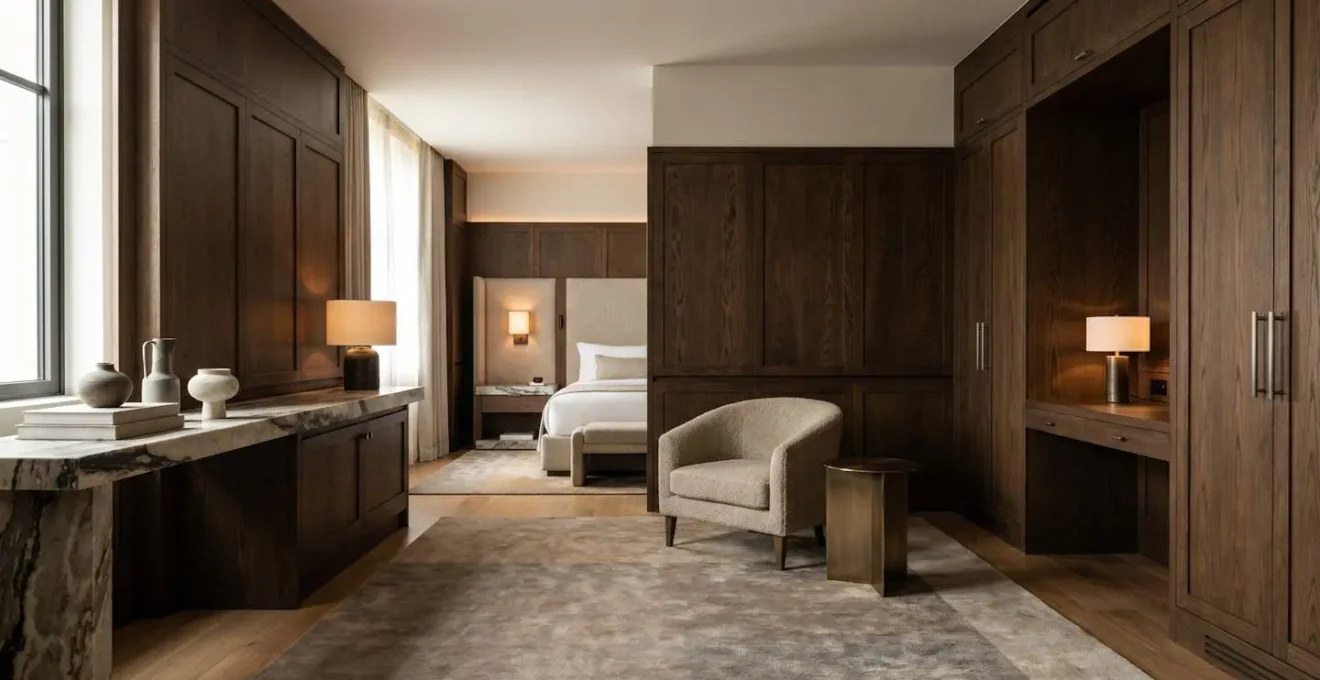
True luxury design isn’t measured in marble and gold, but in the intelligence of its functional and emotional details.
- It prioritises timeless quality and materials that age gracefully over fleeting, high-impact trends.
- It serves the guest through “invisible” comforts like superior acoustics and anticipatory ergonomics, not just visual spectacle.
Recommendation: To assess a room’s quality, look beyond the primary surfaces and scrutinize the small details: hardware haptics, joinery, and the logic of the layout.
You step into a luxury hotel room, and the initial impression is dazzling. Polished stone, gleaming fixtures, a statement headboard that commands the eye. Yet, after the first few minutes, a sense of hollowness can creep in. The light switch is in an awkward place, the beautiful chair is impossible to sit in, and the whole space feels more like a showroom than a sanctuary. This experience is common: a collision with design that is expensive by the yard but poor in spirit, built for the camera lens rather than the human occupant.
The common vocabulary of luxury—brand names, rare materials, bold gestures—often fails to capture the essence of a truly superior space. We are trained to look for the obvious signifiers of wealth, but these can be, and often are, mere marketing ploys. The real markers of excellence are quieter, more deliberate. They are not shouted but whispered through thoughtful functionality, material honesty, and a deep, empathetic understanding of the guest’s sensory and practical needs.
But what if the key to discerning real quality wasn’t about adding more to your checklist, but about shifting your perspective entirely? What if you could learn to read a room not for what it says, but for what it does? This is not a matter of taste, but of design literacy. It’s about understanding the difference between decoration and design, between fleeting trends and enduring quality.
This guide will equip you with a critic’s eye, moving beyond the superficial to decode the subtle language of genuine design excellence. We will explore how to identify transient trends, assess a room from photos, understand the power of quiet elegance, and spot the tiny, deliberate details that are the true signature of world-class hospitality design.
To navigate this deep dive into the art of hotel design, here is a structured overview of the core principles we will deconstruct. Each section builds upon the last, providing a comprehensive framework for your new, more discerning eye.
Summary: How to Spot Genuine Design Excellence in a Luxury Hotel Room
- Why Do “Contemporary Luxury” Hotels Feel Dated So Quickly?
- How to Assess Luxury Hotel Room Design From Photos Alone?
- Bold Design Statement or Quiet Elegance: Which Luxury Approach Ages Better?
- The “Bespoke Furniture” in Luxury Hotels That’s Actually Catalogue
- When Does Luxury Room Design Serve Function Versus Just Impressing?
- Restored Historic Interiors or Modern Local Design: Which Expresses Place Better?
- How to Spot the Tiny Hotel Details That Reveal True Care?
- How to Find Hotels Whose Décor Reflects Local Design Heritage?
Why Do “Contemporary Luxury” Hotels Feel Dated So Quickly?
The paradox of “contemporary luxury” is that it often has a startlingly short shelf life. The blush pink velvet, the geometric brass lighting, the terrazzo everything—these elements, so celebrated one moment, can feel tired and derivative the next. This rapid aging isn’t an accident; it’s the result of a design philosophy rooted in trend-chasing rather than in creating enduring appeal. When a hotel’s identity is built on the fleeting fashion of the moment, its relevance is destined to fade just as quickly.
This isn’t just an aesthetic observation; it has a measurable impact. The pressure to be current leads to a cycle of costly renovations that fail to address fundamental quality. In fact, an industry analysis suggests up to 67% of hotel redesigns are considered failures precisely because they prioritise short-sighted trends over long-term guest experience and operational reality. These spaces are designed for the immediate “wow” factor, often at the expense of timelessness.
The antidote to this is a shift in focus from novelty to longevity. As one design analysis aptly puts it, the goal should be to create spaces that possess an intrinsic quality. Travel Curator’s design analysis highlights this very point:
Rather than chasing novelty, the focus is on longevity and sensory balance — spaces that age well rather than date quickly.
– Travel Curator Design Analysis, Luxury Rewritten: The Hotel Design Trends
Genuine luxury builds on a foundation of classic proportions, honest materials, and sensory comfort. It creates a backdrop that can absorb stylistic shifts without becoming obsolete. The truly sophisticated hotel room of today will still feel relevant in a decade because its core value lies not in its adherence to a trend, but in its fundamental quality and its ability to provide a sense of calm and well-being.
How to Assess Luxury Hotel Room Design From Photos Alone?
In the age of digital booking, our first encounter with a hotel room is almost always through a screen. Professionally shot photographs are designed to entice, but they can also cleverly conceal a multitude of design sins. For the discerning traveller, learning to read these images with a critical eye is an essential skill. It requires looking past the wide-angle compositions and perfect lighting to find the tells of true quality—or the lack thereof.
The key is to train your eye to scrutinize the details that are difficult to fake. Mass-produced luxury and genuine craftsmanship leave different fingerprints. While a photo can make a printed laminate look like real marble from a distance, a close crop reveals the truth in the repetition of patterns. Authentic materials have unique variations—no two veins in a slab of Calacatta are the same. This forensic approach allows you to perform a virtual audit, separating the pretenders from the truly well-crafted.
To move from a passive viewer to an active assessor, you need a structured framework. The following checklist helps you analyse the visual evidence presented in hotel photography, focusing on the small details where quality is most revealed.
Your Visual Audit Plan: Evaluating Design Authenticity from Images
- Examine material veining and texture detail: Look for unique, non-repetitive marble patterns and detailed wood grain that indicate authentic materials rather than printed laminates.
- Analyse light and shadow interaction: Observe whether metal fixtures cast sharp, realistic reflections and if shadows reveal deep relief on millwork, indicating solid construction.
- Scrutinize peripheral details: Check seams on upholstery, curtain track quality, door frame precision, and grout line consistency—areas where budget cuts typically show.
- Assess the functional narrative: Mentally walk through room usage. Verify convenient power outlet placement, proper luggage surfaces, and ergonomic furniture positioning.
- Evaluate material continuity: Notice if high-quality materials extend to hidden areas or if there’s a visible shift to cheaper alternatives in less prominent zones.
By applying this methodical lens, you begin to see beyond the styled image. You start noticing the perfect alignment of grout lines, the substantial thickness of a door, or the way light authentically reflects off solid bronze. These are not accidents; they are the result of deliberate choices and investment that signal a deeper commitment to quality.
Bold Design Statement or Quiet Elegance: Which Luxury Approach Ages Better?
Luxury hotel design often presents a philosophical choice: should it strive for the unforgettable, high-impact “design statement,” or cultivate a “quiet elegance” that soothes and reassures? The former grabs attention with dramatic forms, vibrant colours, and Instagram-ready moments. The latter focuses on texture, subtlety, and a harmonious sensory experience. While bold statements can be thrilling, it is the path of quiet elegance that invariably proves more enduring and, ultimately, more luxurious.
The problem with a design centered on bold statements is its reliance on novelty. A shocking pink sofa or a lobby filled with oversized sculptures is powerful on first viewing, but its impact diminishes with every exposure. It can quickly become a caricature of a specific era. Quiet elegance, in contrast, derives its power from material honesty and tactile richness. It invests in materials that are not just beautiful on day one but are designed to acquire a patina, to deepen in character with time and use. Unlacquered brass that mellows, vegetable-tanned leather that softens, and solid wood that bears the marks of its history tell a story of longevity.
This approach is about creating an emotional connection that transcends the visual. It recognizes that in a turbulent world, true luxury provides a sense of sanctuary. As Julia Uherek, a leading voice in consumer trends, observes, there is a clear cultural shift. Her insight, quoted in Travel Curator, captures this evolution perfectly:
In times of uncertainty, hospitality spaces become places of reassurance. We see a clear shift from spectacle to substance — from visual statements to emotional resonance.
– Julia Uherek, Vice President of Consumer Goods Fairs at Messe Frankfurt, quoted in Travel Curator
This “emotional resonance” is achieved not through a single loud gesture, but through a hundred quiet, correct decisions. It’s the pleasing weight of a solid door handle, the soft texture of a linen curtain, and the acoustic calm of a well-insulated room. This is a design you feel more than you see, and it’s this sensory depth that creates a lasting impression of quality and care.
The “Bespoke Furniture” in Luxury Hotels That’s Actually Catalogue
“Bespoke” is perhaps the most overused and misunderstood term in the luxury lexicon. It promises uniqueness, meticulous craftsmanship, and a perfect fit for its environment. However, in many hotels, what is labelled “bespoke” or “custom” is often just a slightly modified piece from a large-scale commercial furniture catalogue. True bespoke design is not about choosing a different fabric; it’s a ground-up process where furniture is conceived and fabricated for a specific spatial and functional need.
Recognizing the difference requires looking for signs of authentic craftsmanship versus mass production. Mass-produced furniture is engineered for efficiency: simple joinery, standardized dimensions, and materials chosen for cost-effectiveness. Genuinely bespoke pieces, on the other hand, often feature complex joinery like dovetails or mortise-and-tenon joints, which are labour-intensive but offer superior durability. They exhibit a “sign of the hand”—subtle variations in finish or form that betray their human origin and are a hallmark of quality.
An exemplary case of true bespoke manufacturing can be seen in high-end projects where designers and makers collaborate intimately. This approach ensures every piece is not just an object in a room, but an integral part of the architectural and experiential narrative.
Case Study: The London Edition Hotel – Genuine Bespoke Manufacturing
For the London Edition, designed by icons Ian Schrager and Yabu Pushelberg, the Brooklyn-based manufacturer SENTIENT fabricated genuinely bespoke pieces for distinct zones across the hotel. This included custom American black walnut sofas, solid wood tables, and upholstered banquettes, each uniquely designed and constructed for its specific location, be it the lobby, bar, or dining areas. This demonstrates true bespoke practice, where furniture is an architectural component designed for precise spatial requirements, not a simple catalogue replication.
So, the next time you see the word “bespoke,” look closer. Examine the joints, the material transitions, and the overall form. Does it feel like it could only exist in this specific space, or could you imagine seeing it in a hundred other hotels? The answer to that question separates marketing fluff from genuine design integrity.
When Does Luxury Room Design Serve Function Versus Just Impressing?
A truly luxurious hotel room is a masterclass in functional empathy—the art of anticipating a guest’s needs and desires before they are even consciously felt. This contrasts sharply with design that merely aims to impress, which often prioritizes visual drama over livability. The most profound elements of functional luxury are often invisible. You don’t necessarily notice the perfectly silent air conditioning or the absence of noise from the hallway, but their failure would immediately ruin your experience.
Acoustic performance is a prime example of this invisible luxury. A beautiful room is worthless if your sleep is disturbed by the neighbouring television or footsteps from the floor above. Top-tier hotel brands understand this and invest heavily in soundproofing, which goes far beyond standard construction. This is a technical and expensive commitment to guest comfort that has no visual payoff but is fundamental to a luxury experience. According to experts in the field, most high-end hotel brands require walls and floor/ceiling assemblies to meet a Sound Transmission Class (STC) rating of 50-55, a standard significantly higher than typical residential construction.
This focus on unseen quality is a powerful indicator of a hotel’s genuine commitment to its guests. As the experts at Commercial Acoustics note, it’s a non-negotiable aspect of the guest experience.
Hotel acoustics drive the guest experience more than almost anything else. A beautiful room with great amenities still fails if noise leaks through walls, doors, ceilings, or mechanical systems.
– Commercial Acoustics, Hotel Soundproofing Guide: STC Ratings & Acoustics Standards
This principle extends beyond acoustics. It’s in the placement of power outlets and USB ports on both sides of the bed. It’s in providing a proper surface for two suitcases, not just one. It’s the quality of the reading light, providing focused illumination without glare. These are not grand, photogenic gestures, but a series of small, correct decisions that accumulate to create a seamless and friction-free experience. When a room works this effortlessly, it’s a sign that the designers were focused not on impressing you, but on serving you.
Restored Historic Interiors or Modern Local Design: Which Expresses Place Better?
One of the great joys of travel is experiencing a genuine “sense of place,” and hotel design plays a crucial role in creating it. This often sparks a debate: what is more authentic? A meticulously restored historic interior that acts as a time capsule, or a contemporary design that reinterprets local vernacular through a modern lens? While both can be successful, the more sophisticated and ultimately more meaningful approach is often found in the latter, a practice known as critical regionalism.
Slavish historical reproduction can be beautiful, but it can also feel like a museum—stuffy, reverential, and disconnected from contemporary life. Conversely, a generic “international modern” style, while clean and efficient, erases all local identity. Critical regionalism seeks a third way. It engages deeply with the history, climate, materials, and craft traditions of a place, but uses them as a grammar to write a new, contemporary story. It’s about evoking a feeling and a connection, not creating a themed replica.
This nuanced approach allows a property to honour its past while fully embracing the present, creating a layered experience that is both intellectually stimulating and emotionally resonant. A powerful example is found in properties that transform historic estates with a thoughtful, modern sensibility.
Case Study: The Florentin Hotel, Frankfurt – Critical Regionalism in Practice
The Florentin, part of the Althoff Collection in Frankfurt, exemplifies this approach. The design team, Unscripted Design, transformed the historic Villa Kennedy estate not by creating a pastiche of the past, but by reinterpreting its history. As detailed in Travel Curator, they created nine distinct villas inspired by historical figures associated with the residence, achieving a unique, residential rhythm. The result is a design that is deeply connected to its local context and history, yet feels entirely contemporary—”layered without tipping into decoration for decoration’s sake,” a hallmark of true critical regionalism.
Ultimately, the most successful designs are those that facilitate a dialogue between the guest and the location. Whether through sensitive restoration or thoughtful modern interpretation, the goal is the same: to create a space that could exist nowhere else in the world, and in doing so, enrich the traveller’s understanding of their destination.
How to Spot the Tiny Hotel Details That Reveal True Care?
After you’ve assessed the big picture—the materials, the furniture, the layout—the final layer of design excellence is revealed in the small, almost imperceptible details. These are the markers of anticipatory design and operational intelligence, where a hotel demonstrates that it has thought not just about how a room looks, but how it will be lived in and cared for. These details are the difference between good design and true hospitality.
Anticipatory design is about solving a need before the guest even registers it. It’s the small, soft-lined dish on the nightstand, perfectly placed for a watch or earrings. It’s the discreet hook in the bathroom, just the right height for a toiletry bag. It’s the satisfyingly silent ‘thunk’ of a well-made door closing, engineered for acoustic peace. These elements speak volumes about a design process that is fundamentally empathetic to the human experience of the traveller.
Equally important is operational intelligence—design that acknowledges the reality of housekeeping and maintenance. Materials that stain at the slightest touch or intricate dust-traps may look good on opening day, but they signal a lack of long-term thinking. A truly great design is one that is not only beautiful but also robust and easy to maintain, ensuring that the guest on day one and the guest on day one thousand have the same pristine experience. This includes:
- The Haptics of Hardware: The substantial weight of a door handle, the smooth glide of a drawer, and the satisfying click of a high-quality light switch are all indicators of investment in the things you touch every day.
- Material Hierarchy: Surfaces are chosen for their specific purpose. A durable, non-reflective desk surface is for working, while a bedside table is resistant to water rings from a glass of water. It shows that thought was given to function, not just a single aesthetic.
- The Housekeeping Test: Look at corners and crevices. Are they easy to clean? A design that considers the staff who maintain it is a design that is built on a foundation of holistic care.
These tiny details are the final and most definitive proof of a hotel’s commitment. They are easy to overlook, but impossible to fake. When you find them, you know you are in a space that has been conceived with genuine care and profound intelligence.
Key Takeaways
- True luxury is functional and emotional, prioritizing timelessness and sensory comfort over fleeting visual trends.
- Scrutinize the details: the quality of joinery, the feel of hardware, and the silence of the room reveal more than a “wow” feature.
- The best design connects you to a sense of place, reinterpreting local heritage with modern sensibility, not clichés.
How to Find Hotels Whose Décor Reflects Local Design Heritage?
Having cultivated a discerning eye for quality, the final and most rewarding step is to apply this skill to find hotels that offer an authentic sense of place. The goal is to move beyond generic international luxury and discover properties whose very design is a celebration of local culture, materials, and craftsmanship. This is where your journey as a traveller and your literacy as a design critic converge.
The most powerful indicator of this commitment is a philosophy of hyper-localization. This goes beyond hanging a few pictures by local artists. It’s a deep integration of the local environment into the hotel’s DNA. A tangible sign of this is the trend towards what some call “100-mile sourcing”, where hotels prioritize using materials, furniture, and even food sourced from within a close radius. This not only supports the local economy but also ensures the space is a true product of its environment.
This connection to place is often expressed through a carefully considered material and textural palette. It’s about using materials that feel native to the region, creating a subconscious link between the interior and the landscape outside. As design experts from Safeway Groups note, this textural authenticity is key to creating a welcoming and genuine atmosphere.
Textures are now considered one of the most powerful elements for the interior design for hotels. Limestone, warm-toned wood, bamboo, rattan, linen, and clay finishes bring about a calm and welcoming mood, lending a sense of genuineness which leads to guests being able to identify with the surrounding nature on a deeper level.
– Safeway Groups Design Team, Interior Design for Hotel: Luxury Trends Redefining 2026
To find these gems, look for hotels that talk about their architects and designers, that explain the story behind their material choices, and that highlight their partnerships with local artisans. Dig into the “About Us” section of their website and read interviews with their creators. A hotel that is proud of its design story is almost always one that has a compelling story to tell—one that is deeply and authentically rooted in its unique corner of the world.
Equipped with this critical framework, your next hotel booking becomes more than a transaction—it becomes an intentional choice to seek out and reward genuine design artistry. Start applying these principles to see the world of luxury hospitality not just as a guest, but as a connoisseur.