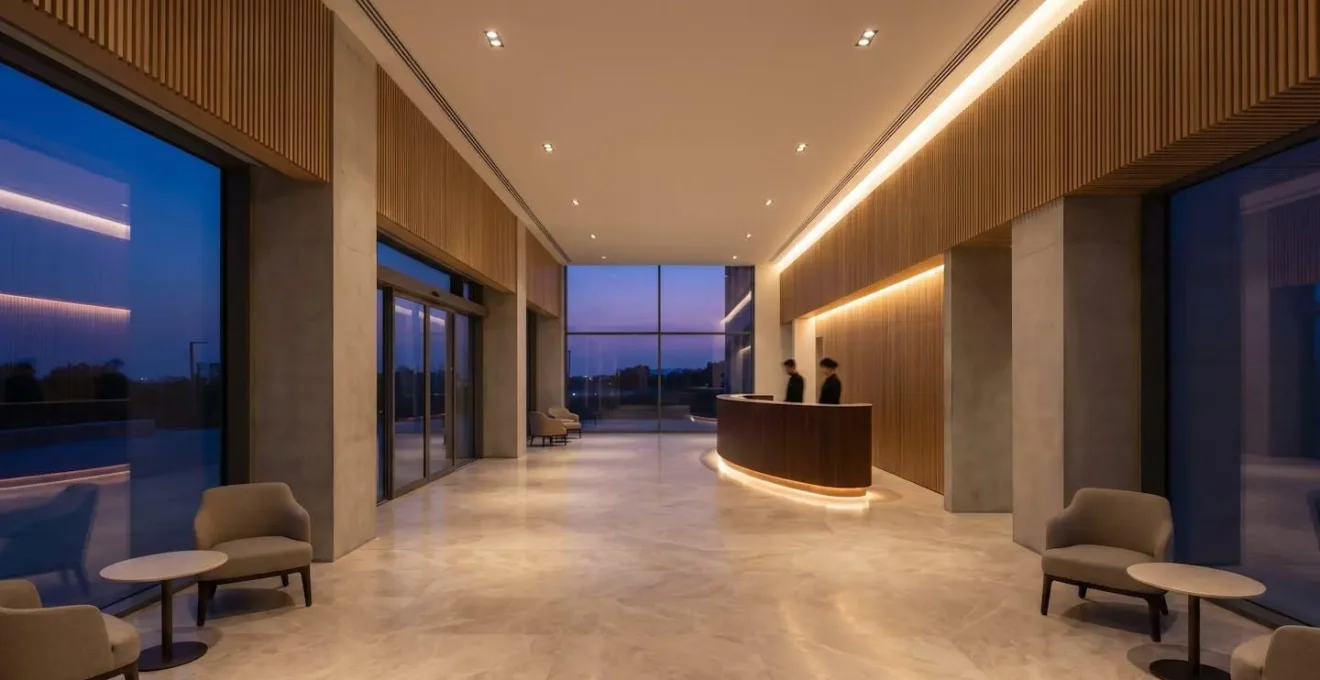
The promise of ’24/7 hotel service’ is often a marketing mirage that fails when irregular-schedule travellers need it most.
- Service quality inevitably degrades after midnight due to skeleton staffing and limited authority, creating operational blind spots for late arrivals.
- Success hinges not on hope, but on implementing proactive ‘de-risking protocols’ to verify every detail from check-in to shuttle times.
Recommendation: Shift from a passive guest to an active operational manager of your stay by using pre-arrival communication and verification to ensure services are not just available, but truly accessible.
The hum of a plane’s engines fades, replaced by the silent, sterile corridors of an airport at 1 a.m. For the business traveller or red-eye passenger, this is not the end of the journey, but a critical midpoint. The final destination is a hotel bed, but between here and there lies a gauntlet of potential failures: a missed shuttle, an unstaffed front desk, a room service menu that vanished at 10 p.m. The common advice—”choose a hotel with 24/7 service”—rings hollow in these moments. It assumes that ’24/7′ is a guarantee of quality, not just a marketing claim.
The reality is that most hotel operations are optimized for the 9-to-5 guest. After hours, a phenomenon of service degradation kicks in, where even the best hotels operate with a skeleton crew whose primary function is security and basic oversight, not full-service support. This creates operational blind spots that can derail a carefully planned trip. But what if the solution wasn’t just to find a hotel that’s ‘open’ but to fundamentally change how you interact with it? The key isn’t just booking a room; it’s about mastering the art of schedule-adaptability and proactively managing the hotel’s systems from afar.
This guide moves beyond generic tips. It provides an operational framework for the irregular traveller. We will deconstruct the common failure points of after-hours hotel services and provide concrete protocols to de-risk your arrival, secure your comfort, and ensure the hotel’s schedule adapts to yours, not the other way around.
By adopting the mindset of a flexibility specialist, you can navigate the complexities of late-night travel. The following sections break down the specific strategies needed to master everything from check-in and dining to transportation, ensuring your hotel experience is efficient and restorative, no matter the hour.
Summary: A Strategic Guide to Maximizing After-Hours Hotel Services
- Why Does Hotel Service Quality Drop 60% After Midnight?
- How to Ensure Late-Night Hotel Check-In Goes Smoothly?
- Human Night Reception or Self-Service Kiosk: Which Solves Late Arrival Better?
- The Midnight Room Service Menu With Only 4 Items
- When Does Round-the-Clock Service Actually Matter for Your Trip?
- How to Confirm Hotel Shuttle Times Won’t Leave You Stranded?
- The Paris Hotel Breakfast Schedule That Conflicts With 8am Meetings
- How to Choose Paris Business Hotels That Don’t Waste Your Time?
Why Does Hotel Service Quality Drop 60% After Midnight?
The term “24/7 service” suggests a consistent standard of excellence, yet any seasoned late-night traveler knows this is rarely the case. The dramatic dip in service quality after midnight isn’t due to a lack of care, but to a series of harsh operational realities. This is service degradation: a predictable decline in capability as a hotel shifts from its fully staffed, peak-hour operation to its overnight skeleton crew. This small team is often juggling the night audit, security patrols, and preparing for the morning rush, leaving them with limited bandwidth and authority to handle complex guest requests.
When a problem does arise, the delayed response time can be critical. Research highlights that when hotels resolve issues, they must do so quickly; however, with fewer staff and resources overnight, even minor issues can escalate. This delayed response significantly impacts guest satisfaction. The core issue is that the night staff’s primary directive is to maintain the status quo, not to innovate solutions. They may lack the system access, managerial approval, or simply the manpower to fulfill requests that would be simple at 2 p.m. but are monumental at 2 a.m. Understanding this limitation is the first step toward effectively navigating it.
The solution is not to demand more from an over-stretched team but to adapt your communication. Frame your requests in a way that acknowledges their constraints and makes it easy for them to say yes or to defer the task appropriately.
- Frame your request as reducing their workload: ‘I know you’re handling the night audit, could you just note this for the morning manager?’
- Acknowledge their limited authority: ‘I understand you may need manager approval—could we schedule this for first thing tomorrow?’
- Offer to self-service: ‘If it’s easier, I’m happy to handle this myself in the morning when more staff are available.’
- Use collaborative language: ‘What’s the best way for us to solve this given your current availability?’
By shifting your approach from demanding immediate service to facilitating a future solution, you partner with the night staff instead of creating friction, ensuring your needs are met efficiently.
How to Ensure Late-Night Hotel Check-In Goes Smoothly?
The single most critical failure point for any late-arriving traveler is the check-in process. A smooth check-in sets the tone for the entire stay, while a problematic one can lead to stress and lost sleep. Assuming your reservation guarantees access is a rookie mistake. The key to a seamless late-night arrival is a robust, multi-step confirmation protocol that leaves nothing to chance. This isn’t just about calling ahead; it’s about creating a clear, documented, and acknowledged plan with the hotel staff.
When hotels implement clear after-hours procedures, guest satisfaction soars. A survey by TripAdvisor revealed that 68% of travelers find after-hours check-in convenient when instructions for lockboxes or self-service options are provided transparently. This proves that the problem isn’t the late hour; it’s the communication gap. Your job is to close that gap proactively. By treating your late arrival as a mini-project to be managed, you remove uncertainty and de-risk the most crucial moment of your journey. The following protocol is not just a set of tips; it’s a critical system for any traveler with an irregular schedule.
Late Arrival Confirmation Protocol: Your Step-by-Step Plan
- Contact the hotel as soon as you know your late arrival time—ideally 24 hours in advance.
- Send a confirmation email including your flight number, estimated arrival time, and a request for a direct reply confirmation.
- Ask specifically for after-hours access procedures: gate codes, the night security phone number, or lockbox location.
- Request that pre-made key cards be left with security or in a secure lockbox, bypassing the front desk entirely.
- Save the hotel’s direct line (not the corporate number) in your phone for a call-upon-landing confirmation.
By following this checklist, you transform your arrival from a potential problem into a confirmed event, ensuring your room is ready and accessible the moment you arrive, no matter the hour.
Human Night Reception or Self-Service Kiosk: Which Solves Late Arrival Better?
The modern hotel presents two primary solutions for late arrivals: the traditional human night receptionist and the increasingly common self-service kiosk. Each has distinct advantages and disadvantages, and the “better” option depends entirely on your priorities as a traveler: personalized problem-solving versus streamlined efficiency. A human receptionist offers flexibility and the ability to handle exceptions—a lost reservation, a specific room request, or a sudden travel disruption. However, this is contingent on that individual being empowered and available.
On the other hand, the self-service kiosk offers a promise of speed and predictability. It is designed to perform one function—checking you in and dispensing a key—with maximum efficiency. For the traveler whose plans are confirmed and who simply wants to get to their room as quickly as possible, the kiosk is often the superior choice. It eliminates queues and the potential for human error or distraction.
The growing adoption of this technology by major chains underscores its effectiveness in meeting the needs of the modern, independent traveler. By automating the standard check-in process, hotels can free up staff to handle more complex guest needs, theoretically improving service for everyone. The key is knowing which system best aligns with your arrival scenario.
Case Study: Marriott’s Self-Service Kiosk Implementation
In 2021, Marriott International began a significant rollout of self-service kiosks across numerous properties. The goal was to streamline operations and enhance the guest experience by offering an independent check-in/out option. The results were clear: properties with kiosks saw a significant increase in guest loyalty and positive reviews. Guests frequently cited the convenience and efficiency of bypassing the front desk, particularly during peak or late-night hours, as a major factor in their improved satisfaction.
For a guaranteed, no-fuss arrival, a hotel with a confirmed and reliable self-service kiosk is often the most strategic choice for a late-night traveler. For more complex itineraries, confirming the capabilities of the night staff is essential.
The Midnight Room Service Menu With Only 4 Items
Arriving in your room after a long journey, you open the room service menu with anticipation, only to be met with the crushing reality of the “After-Hours Menu”: a sad, limited selection of a club sandwich, a Caesar salad, a brownie, and a fruit plate. This common scenario is a direct result of overnight operational constraints. The main kitchen is closed, and the limited offerings are prepared by a staff member whose primary role is not culinary. The focus is on items that are simple to assemble and require minimal cooking, prioritizing safety and efficiency over variety and quality.
Recognizing this limitation is the first step toward overcoming it. Expecting a gourmet meal at 3 a.m. from room service is a recipe for disappointment. The strategic traveler doesn’t rely on this flawed system; they create their own. By planning ahead, you can bypass the four-item menu entirely and ensure a satisfying meal is waiting for you, regardless of your arrival time. The following strategies transform you from a passive recipient of limited options into the architect of your own late-night dining experience.
These proactive measures ensure you’re not at the mercy of the hotel’s limited overnight capabilities:
- Day-to-Night Menu Hack: Call the hotel restaurant during its daytime hours to pre-order a specific meal from the full menu. Arrange for it to be held and delivered via room service upon your late-night arrival.
- Delivery App Gambit: Before you land, contact the front desk to confirm their policy on outside food deliveries. Provide precise delivery instructions for services like Uber Eats or DoorDash, ensuring the staff will accept and hold the delivery on your behalf.
- Arrival Feast Curation: Use local grocery delivery services like Instacart to have snacks, beverages, and simple meals delivered to the hotel *before* you arrive. The concierge can hold them, and you can stock your in-room mini-fridge immediately.
- Bar Menu Alternative: Always check the hotel bar’s closing hours and food menu. Bars often stay open later than the main kitchen and offer a more substantial menu of “bar food” that can be a significant upgrade from the late-night room service list.
Ultimately, the best late-night meal is the one you’ve arranged in advance, turning a potential travel frustration into a seamless and satisfying experience.
When Does Round-the-Clock Service Actually Matter for Your Trip?
The “24/7” label is slapped on nearly every hotel as a marketing badge of honor, but its practical value varies wildly. For a traveler on a standard schedule, it’s often irrelevant. So, when does it truly matter? Round-the-clock service becomes a non-negotiable, trip-defining feature for specific traveler archetypes whose schedules are inherently unpredictable or misaligned with standard business hours. It’s not just about a late check-in; it’s about access to a suite of services that support a demanding itinerary.
The Red-Eye Warrior arriving at 5 a.m. needs more than a key; they need a guarantee of quiet and immediate room access. The Global Executive with a virtual meeting in a different time zone requires a 24/7 business center that is fully functional, not just a dusty PC in a corner. The Family Coordinator needs the peace of mind that comes from knowing medical assistance or emergency support is available at any hour. Understanding your own traveler archetype helps you identify which “24/7” services are critical and which are just noise. The following table breaks down the needs of different travelers.
| Traveler Archetype | Primary 24/7 Needs | Critical Services | Premium Justification |
|---|---|---|---|
| The Red-Eye Warrior | Guaranteed late check-in, absolute quiet | 24/7 reception, noise control, flexible arrival | High – Arrival time unpredictability |
| The Global Executive | Business center access, printing, car service | 24/7 business center, concierge, room service | Very High – Meeting failures costly |
| The Night Owl Tourist | Late-night local recommendations, safety | 24/7 concierge, security presence | Medium – Convenience vs. necessity |
| The Family Coordinator | Emergency support, variable schedules | 24/7 front desk, medical assistance access | High – Child safety paramount |
However, you cannot take marketing claims at face value. You must learn to deconstruct them.
- Differentiate ’24/7 check-in’ (often just a kiosk or security guard with an envelope of keys) from ’24/7 full-service’ which implies a staffed concierge, room service, and business center.
- Search the hotel’s own FAQ section for specific descriptions and operating hours of late-night services.
- Filter TripAdvisor or Google reviews using keywords like ‘late arrival’, ‘midnight’, ‘3am’, or ‘night staff’ to uncover real guest experiences.
- Call the hotel’s direct line and ask the crucial question: ‘If I arrive at 2 a.m., which specific services will be fully available to me?’
- Apply the ‘First Night, Last Night’ rule: Prioritize true 24/7 services for the nights most affected by your travel schedule, often your arrival and departure days.
True 24/7 service matters most when your schedule is most fragile. By vetting a hotel’s claims against your specific needs, you ensure you’re paying for a genuine capability, not just a marketing promise.
How to Confirm Hotel Shuttle Times Won’t Leave You Stranded?
The complimentary airport shuttle is a tempting amenity, promising a seamless transition from baggage claim to hotel lobby. However, it’s also one of the most common points of failure for late-arriving travelers. Shuttles advertised as “24/7” often operate on a limited schedule, run only on-demand during off-hours with long waits, or cease service entirely after midnight. Relying on vague information from a booking website is a direct path to being stranded at the curb at 1 a.m.
Understanding the “why” behind shuttle unreliability is key. Running a shuttle service is a significant operational expense for a hotel. Industry data reveals that a single shuttle operation can cost between $150,000 and $175,000 per year when factoring in the vehicle, insurance, maintenance, and driver salaries. This high cost incentivizes hotels to minimize runs during low-demand, late-night hours. To counteract this, you must adopt a rigorous “Triple Confirmation Protocol” to transform the shuttle from a hopeful convenience into a confirmed logistical asset.
This protocol ensures that your arrival is anticipated and the shuttle is dispatched for you specifically:
- Step 1 – Reservation Confirmation: During the booking process, inform the hotel of your exact flight details. Confirm that the shuttle will be available for your specific arrival and departure times and request this confirmation in writing via email.
- Step 2 – 24-Hour Pre-Arrival Call: Phone the hotel’s direct line 24 to 48 hours before your trip to reconfirm the shuttle schedule and provide any updated flight information.
- Step 3 – Wheels-Down Notification: Call the hotel directly from the airport, ideally from baggage claim, to announce your arrival and confirm that the shuttle is being dispatched.
- Backup Protocol Request: Proactively ask the hotel, “If the shuttle is significantly delayed, what is your authorized backup plan? Will you reimburse the cost of a ride-share service?”
- Get Direct Dispatch Number: Request the mobile number of the shuttle driver or the hotel’s direct shuttle dispatch line (not the main switchboard) for immediate communication if needed.
By executing this protocol, you take control of the process, ensuring the hotel shuttle works on your schedule, not the other way around.
The Paris Hotel Breakfast Schedule That Conflicts With 8am Meetings
For a business traveler, time is the most valuable currency. A common, time-wasting frustration is the hotel breakfast schedule that is fundamentally misaligned with an early-morning work commitment. In a city like Paris, an 8 a.m. meeting across town requires a departure well before the hotel’s leisurely 7:00 or 7:30 a.m. breakfast service begins. This forces a difficult choice: skip the most important meal of the day, or risk being late. This conflict highlights a hotel’s lack of true schedule-adaptability, catering to tourists rather than time-crunched professionals.
This need for flexibility is a growing demand in the travel industry. For instance, while not directly about breakfast, a 2024 study found that 23% of travelers worldwide prefer the option to check out later and are even willing to pay for it. This reflects a broader desire for hotel services that adapt to the guest’s schedule, not a rigid internal clock. A hotel that understands business travel should have systems in place to accommodate early departures. The strategic traveler knows how to activate these systems.
Don’t let a rigid schedule dictate your morning. Here are four proven strategies to ensure you get a quality breakfast without compromising your punctuality:
- Breakfast Box Advance Request: Email the concierge or front desk manager at least 24 hours in advance. Request a prepared ‘to-go’ breakfast box (containing items like a pastry, fruit, yogurt, and juice) to be ready for pickup before the official breakfast service opens.
- Room Service Night-Before Order: The evening before, order a continental breakfast via room service for the earliest possible delivery time or ask for it to be placed in your room’s mini-fridge, creating a ready-to-eat meal independent of restaurant hours.
- Elite Status Early Access: If you have elite status with a major hotel loyalty program (like Marriott Bonvoy or Hilton Honors), leverage your benefits. Inquire about early access to the Club Lounge or the possibility of using flexible timing benefits like ‘Your24’.
- Neighborhood Boulangerie Strategy: Task the concierge with identifying the best local bakery (boulangerie) that opens at 6 a.m. along your route. Factor a quick, 10-minute stop into your taxi or ride-share journey to the meeting location for a far superior and more authentic breakfast.
A successful business trip runs on efficiency, and that starts with a well-fed, on-time professional. These strategies ensure your hotel’s schedule doesn’t derail yours.
Key takeaways
- Anticipate Service Degradation: Understand that ’24/7 service’ doesn’t mean ’24/7 quality’ and plan for skeleton staff and limited capabilities after midnight.
- Embrace Proactive Protocols: Don’t leave things to chance. Implement multi-step confirmation protocols for critical services like check-in and shuttles to de-risk your arrival.
- Vet for True Flexibility: The best strategy is choosing the right hotel from the start. Use pre-booking tests and detailed scorecards to evaluate a hotel’s proven ability to adapt to your schedule.
How to Choose Paris Business Hotels That Don’t Waste Your Time?
The ultimate strategy for a seamless trip is not just managing a hotel’s limitations, but choosing a hotel that has none. For a business traveler in a fast-paced city like Paris, the right hotel is not the most luxurious or the most central, but the most operationally efficient. It’s an asset that saves time, eliminates friction, and actively contributes to the success of your trip. Vetting a hotel for this level of efficiency requires moving beyond glossy photos and guest reviews and instead applying a rigorous, data-driven evaluation matrix.
You must assess a hotel on the metrics that directly impact a business traveler’s productivity and peace of mind. This means scrutinizing everything from guaranteed Wi-Fi speeds to the quality of in-room coffee. The following scorecard provides a framework for grading potential hotels, separating the true business-grade properties from those that merely cater to tourists.
| Efficiency Metric | Basic Standard | Business-Grade | Verification Method |
|---|---|---|---|
| Wi-Fi Bandwidth | ‘Free Wi-Fi’ | Guaranteed 25+ Mbps | Ask for bandwidth SLA in writing |
| Morning Coffee | Sachet instant coffee | In-room Nespresso machine | Check room amenities list |
| Transportation Access | General taxi availability | Dedicated taxi rank <2 min walk | Google Maps satellite view verification |
| Business District Proximity | Same arrondissement | <15 min commute to key district | Google Maps time estimates (morning rush) |
| Concierge Response Time | Email reply within 24h | Email reply within 2h | Pre-booking ‘Concierge Test’ email |
The final metric on this scorecard, concierge response time, can be actively measured before you even book. The “Pre-Booking Concierge Test” is a powerful method to gauge a hotel’s true service level. Before committing, email the concierge teams of your top choices with a hypothetical complex request, such as: “I need to arrange a car for a 5 a.m. departure and have a document printed and delivered to my room by 6 a.m.” Evaluate their response on speed (under 2 hours is excellent) and quality (a detailed solution vs. a vague promise). This simple test reveals more about a hotel’s operational competence than any brochure.
By applying these rigorous vetting techniques before your next booking, you shift from hoping for a good stay to engineering one, ensuring your hotel is a strategic partner in your business success.