True antique hotel furniture is exceptionally rare, not due to cost alone, but a complex ‘liability calculus’ that prioritizes guest safety and operational durability over fragile history.
- Hotels often prioritize a durable ‘narrative’ using high-quality reproductions over pieces with genuine ‘provenance’.
- On-site verification moves beyond aesthetics to physical tells like non-uniform wear, hand-cut joinery, and period-correct hardware.
Recommendation: To find true authenticity, seek hotels with official heritage designations that protect interiors, or championing local, modern craftsmanship as the new expression of place.
The allure is undeniable: sleeping in a room where history whispers from the very grain of the furniture. For the heritage enthusiast, a hotel isn’t just a place to stay; it’s a living museum. But in an industry where image is paramount, the line between authentic period piece and masterful theatrical set has become increasingly blurred. Many travellers, armed with a general idea to “look for wear and tear,” are often ill-equipped to distinguish a 200-year-old Georgian highboy from a 2-year-old reproduction designed to look the part. The experience, while visually pleasing, can feel hollow if the story it tells is a fabrication.
This challenge goes beyond simple aesthetics. It delves into the economics of hospitality, the complexities of insurance liability, and a fascinating philosophical debate about what “authenticity” even means in a modern context. Is a 15th-century palazzo that feels frozen in time more “Venetian” than one that thoughtfully integrates contemporary local design? The key to navigating this landscape is to move beyond a simple “real vs. fake” mentality. It requires adopting the mindset of a curator, learning to decipher not just the object itself, but the hotel’s underlying ‘Curator’s Intent’. Was the goal to preserve a priceless collection, create a durable narrative, or mitigate immense operational risk? Understanding this intent is the true mark of a connoisseur.
This guide will equip you with an authenticator’s perspective. We will explore the compelling reasons hotels opt for replicas, provide a professional’s checklist for on-site verification, and reveal how to find those rare properties where genuine history is not just displayed, but lived in. You will learn to read the furniture and, in doing so, read the very soul of the hotel.
Summary: A Connoisseur’s Guide to Verifying Hotel Antique Furniture
- Why Do Boutique Hotels Claim Antiques When Using 2015 Replicas?
- How to Ensure Your Hotel Room Has Genuine Period Furniture?
- Museum-Grade Antiques or Decorative Vintage: Which Hotel Collections Matter?
- The Damage Liability Reason Hotels Avoid Real Antique Furniture
- Where in Europe Do Hotels Still Furnish With Authentic 18th-Century Pieces?
- Restored Historic Interiors or Modern Local Design: Which Expresses Place Better?
- 15th-Century Palazzo or Contemporary Conversion: Which Feels More Venetian?
- How to Find Hotels Whose Décor Reflects Local Design Heritage?
Why Do Boutique Hotels Claim Antiques When Using 2015 Replicas?
The primary reason boutique hotels favour high-quality reproductions is rooted in a simple business reality: they are selling an experience, not artifacts. A guest’s spilled wine or a child’s careless scratch on a genuine 18th-century commode represents a catastrophic loss. On a replica, it is merely an operational issue. This practical calculation is about creating a durable, consistent, and risk-averse “narrative” of history. The goal is to evoke the *feeling* of a period without shouldering the immense financial and curatorial burden of genuine antiques. High-end reproductions are built using robust modern techniques disguised by old-world aesthetics, specifically engineered to withstand the rigours of hospitality—a quality genuine antiques inherently lack.
Companies specializing in this niche, like Laurel Crown, have built their business on this very principle. Their work highlights the core of the hotel’s decision-making process. By using fine hardwoods, hand-carved details, and traditional joinery methods, they create pieces that are visually almost indistinguishable to the untrained eye. This serves the hotel’s narrative perfectly, providing the desired aesthetic without the sleepless nights over depreciation, insurance, and irreparable damage. The claim of “antiques” often becomes a marketing shorthand for “antique style,” a nuance most guests are willing to overlook for the sake of comfort and a flawless visual experience. In fact, some industry research suggests that 99% of guests prefer visually perfect and comfortable replicas over worn, fragile originals.
The Economics of High-Quality Reproductions
Laurel Crown, with over 30 years dedicated to reproducing antique furniture, exemplifies the business model favoured by boutique hotels. They guarantee their Victorian hotel furniture is not only visually authentic—using old-world joinery, hand-carved embellishments, and fine hardwoods—but also engineered for durability to last for decades in a high-traffic hospitality environment. This approach allows hotels to achieve a specific historical narrative without the prohibitive cost and operational risk associated with furnishing rooms with fragile, often irreplaceable, genuine antiques.
Ultimately, the use of replicas is not an act of deception but a pragmatic compromise between storytelling and operational reality. As one expert in Victorian hotel furniture succinctly puts it:
Hotels aren’t selling furniture; they’re selling a narrative. Replicas serve this narrative perfectly without the enormous operational risk and cost of genuine antiques.
– Laurel Crown Victorian Hotel Furniture, Victorian Hotel Furniture
How to Ensure Your Hotel Room Has Genuine Period Furniture?
Once you are on-site, moving beyond the hotel’s narrative to verify the furniture’s authenticity requires a tactile, forensic approach. It means training your eyes and hands to spot the subtle inconsistencies and imperfections that are the hallmarks of age and pre-industrial craftsmanship. A reproduction is designed for uniformity and perfection; a genuine antique is a document of its own history, complete with the scars of time. Your investigation should focus on construction, materials, and the one thing that is nearly impossible to fake convincingly: the natural patina of age. Start by looking where others don’t—underneath, inside, and behind. The most telling signs are often hidden from plain sight.
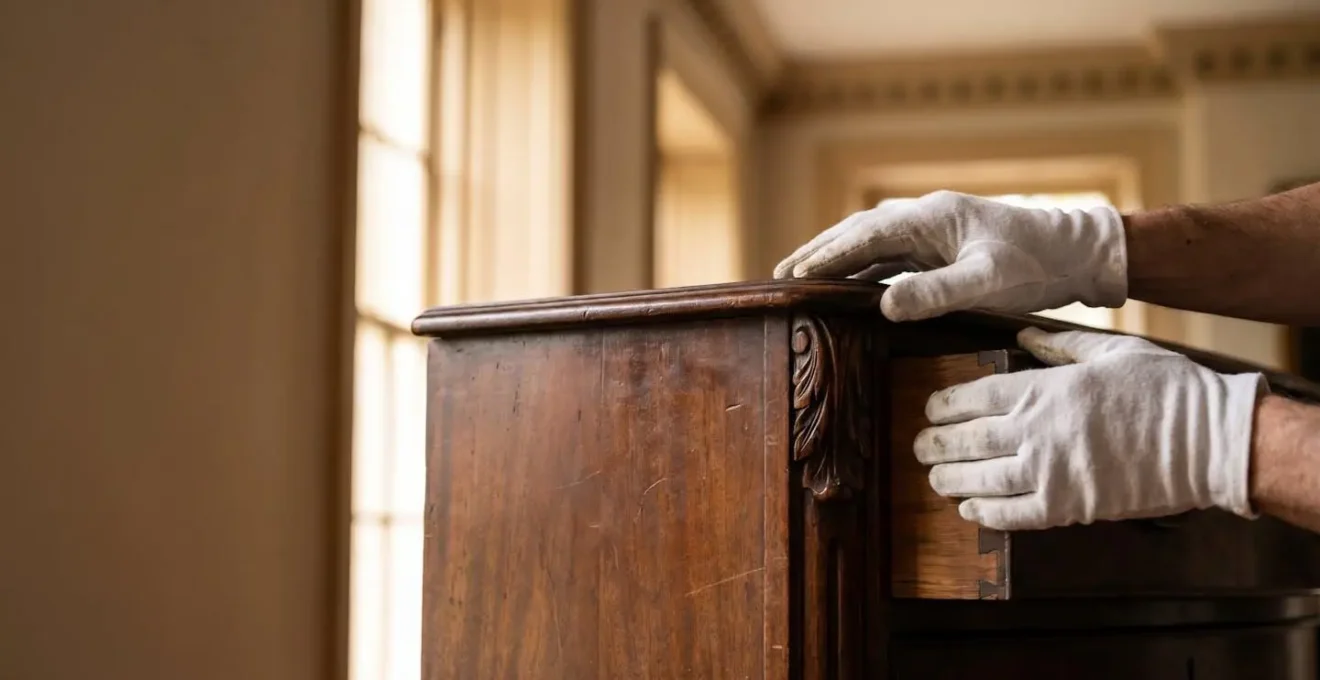
One of the most reliable indicators is the joinery. Before the late 19th century, dovetail joints—the interlocking pins and tails used to join drawer fronts to sides—were cut by hand. This resulted in slightly irregular, thinner pins and an uneven spacing that reflects the craftsman’s individual hand. Machine-cut dovetails, in contrast, are perfectly uniform and evenly spaced. This single detail can often date a piece to before or after the Industrial Revolution’s impact on furniture making around 1890.
The image above perfectly illustrates the irregular, hand-cut dovetails characteristic of pre-1890 craftsmanship. Beyond joinery, a methodical check of other key areas can build a compelling case for authenticity. The following steps provide a professional framework for your on-site assessment.
- Examine wear patterns: Genuine antiques exhibit wear that occurred naturally over time. Look for heavy wear on drawer runners, the feet of chairs and chests, and the arms of chairs—not uniform, artificially applied distressing.
- Inspect construction methods: Beyond dovetails, look for mortise-and-tenon joints, often secured with small wooden pegs. The presence of modern Phillips screws is a definitive sign of reproduction or significant later repair.
- Identify wood types: Early cabinetmakers were frugal. They used expensive primary woods (like mahogany or walnut) for visible surfaces and cheaper secondary woods (like pine or poplar) for drawer bottoms, backs, and interior structures. Reproductions often use the same wood throughout.
- Assess hardware authenticity: Original pulls, handles, and locks will show signs of age and use. They are often slightly asymmetrical and may not sit perfectly flush. The screws holding them should be single-slotted and may be irregular, not modern, uniform screws.
- Evaluate patina: True patina is a subtle sheen and depth in the wood’s finish, built up over centuries of polishing, dust, and exposure to air. It is uneven, being darker in crevices and lighter on exposed surfaces. Artificial aging often looks like a flat, uniform stain.
Museum-Grade Antiques or Decorative Vintage: Which Hotel Collections Matter?
Not all “authentic” antiques are created equal, and understanding the distinction is central to appreciating a hotel’s collection. The key differentiator is provenance—the documented history of an object. A piece of “decorative vintage” might be genuinely old, but it lacks a story; it’s a found object used for aesthetic effect. A “museum-grade” antique, however, carries its history with it. It might have belonged to the family that has owned the property for generations, or it could be a piece specifically curated to reflect the building’s unique past. It is this verifiable connection to a person, place, or time that elevates a piece from mere decoration to a significant artifact. A hotel that invests in provenance is not just decorating; it is actively curating a historical experience.
The ‘Curator’s Intent’ becomes clear in this context. Is the hotel’s collection a thoughtful assembly of items with a story to tell, or is it a stylish but historically anonymous assortment? A hotel that can speak to the history of its furnishings—who made them, who owned them, how they came to be in that room—is operating on a different level of authenticity. This approach values the story over the object itself, a commitment that is far rarer and more meaningful than simply filling a room with old things. It signals a deep respect for the property’s heritage and a desire to share that history with its guests.
Solar do Castelo: Provenance as the Ultimate Luxury
Ranked as one of the Best Historic Hotels in Europe, Solar do Castelo in Lisbon exemplifies the ‘Curator’s Intent’ approach. Situated in an 18th-century mansion within the castle walls, the hotel’s authenticity is built on provenance. While each guestroom is unique, the rich textiles and curated antiques reflect the grandeur of the past. Crucially, the hotel displays a collection of archaeological finds from the site’s former Royal Palace kitchens, providing documented historical context for guests. The furniture is not just antique; it’s part of a verifiable narrative tied directly to the location, transforming a stay into a historical immersion.
Therefore, the question for the connoisseur is not just “Is it old?” but “Does it matter that it’s old?” The collections that truly matter are those where the furniture acts as a primary source, telling a verifiable story about the place you are inhabiting. This dedication to provenance is the dividing line between a hotel that uses history as wallpaper and one that invites you to live within it.
The Damage Liability Reason Hotels Avoid Real Antique Furniture
Beyond the cost of acquisition, the single greatest deterrent for hotels using genuine antiques is the ‘liability calculus’. This is a complex web of risk management that encompasses insurance, guest behaviour, and the sheer irreplaceability of historic items. Standard commercial insurance policies are ill-equipped to handle items whose value lies in their history rather than their function. A broken leg on a modern hotel chair has a clear replacement cost; the same damage to a Queen Anne chair is an incalculable loss, both financially and culturally. This forces properties into a specialized and expensive insurance market.
As heritage property insurers point out, these are not just objects; they are scheduled assets. This is the core of the issue, as detailed by experts in the field:
Historic hotels typically house valuable period furniture, artwork, and fixtures that contribute to the property’s authentic atmosphere. These items often have significant antique value beyond their functional purpose and require specialized contents coverage that recognizes their historical and monetary worth.
– Insure24 UK, Historic Hotel Insurance: Specialized Coverage for Heritage Properties
This specialized coverage comes with stringent requirements for conservation, security, and guest usage protocols—creating an operational overhead that is simply unfeasible for most hotels. Placing a priceless marquetry chest of drawers in a room with an unpredictable flow of guests, luggage, and children is a risk few general managers are willing to take. The potential for a single incident to result in a massive insurance claim or, worse, the permanent loss of an irreplaceable asset, is a powerful motivator for choosing durable, replaceable replicas.
This reality means that when a hotel *does* choose to furnish with genuine antiques, it is a significant statement of intent. It signals a commitment to curation that transcends normal commercial logic. They are accepting the enormous liability and operational complexity because they believe the authentic experience is paramount. This is why such hotels are rare gems, as they are actively choosing the more difficult, expensive, and risky path in the name of historical integrity.
Where in Europe Do Hotels Still Furnish With Authentic 18th-Century Pieces?
Finding European hotels that still use genuine period furniture requires looking beyond standard booking platforms and focusing on properties where history is not a theme, but the very fabric of their existence. The most fertile ground for this search is among independently owned, often family-run, historic properties. In these establishments, the furniture is frequently ancestral property—heirlooms that have never left the building. This is not a curated collection acquired at auction; it is a living, inherited environment. Organizations like Historic Hotels of Europe are invaluable resources, as they specifically represent such properties where the line between home and hotel is beautifully blurred.
A second, more systematic approach is to search for hotels that hold a national heritage designation. These legal statuses, which vary by country, often extend protection beyond the building’s façade to its interior fittings and furnishings. A ‘Monument Historique’ in France or a ‘Listed Building Grade I’ in the UK carries legal obligations for preservation that make the retention of original or period-appropriate furniture a matter of law, not just choice. These designations act as a government-backed seal of authenticity. Seeking out these protected properties is one of the surest methods to find genuine historic interiors, as the state itself has deemed them worthy of preservation.
Historic Hotels of Europe: A Curated Collection of Ancestral Homes
The Historic Hotels of Europe collection is a prime example of where to find authentic interiors. Representing independent hotels across 24 countries, their selection criteria prioritize architectural and historical significance. Many members are family-run castles, manors, and villas where the furniture is part of the family’s legacy. In these cases, the pieces are not just ‘antique’; they are integral to the property’s continuous history, offering guests a rare opportunity to inhabit a space where the past has been lovingly maintained, not recreated.
For the dedicated heritage enthusiast, focusing your search on these legally protected and historically significant properties is the most effective strategy. The following national designations are a powerful starting point:
- ‘Monument Historique’ (France): This legal status can require the preservation of original interior fittings, including furniture.
- ‘Listed Building Grade I’ (UK): The highest level of protection, often mandating the retention of historic furnishings as part of the building’s character.
- ‘Monumento Storico’ (Italy): A designation for properties with regulations that can extend to preserving original interior elements.
- Spanish Paradors: Government-run hotels in converted castles, monasteries, and palaces, which often maintain original or period-appropriate furnishings.
- German Schlosshotels: Castle hotels that frequently preserve ancestral furniture collections passed down through generations.
Restored Historic Interiors or Modern Local Design: Which Expresses Place Better?
The pursuit of authenticity has led to a fascinating and vital debate within hospitality design: what better expresses the “spirit of a place” or its *genius loci*? Is it a meticulously restored room filled with period-perfect antiques, or is it a contemporary space furnished with pieces by local artisans using regional materials? The traditional view champions the restored interior as a pure, unfiltered window into the past. However, a more progressive and increasingly influential perspective argues for a more dynamic form of authenticity—one that reflects a place as a living, evolving culture, not a museum exhibit.
This new philosophy, what one might call the pursuit of “design terroir,” suggests that a modern table, crafted by a local woodworker from a nearby forest, can be more authentically “of that place” than an 18th-century French commode imported to a hotel in Portugal centuries ago. The imported antique speaks to a history of global trade and aristocratic taste, but the modern local piece speaks to the soil, the skills, and the aesthetic sensibilities of the region *today*. As experts in handcrafted hotel furniture note, this shift values a different kind of story.
A modern table, crafted by a local artisan using wood from a nearby forest or stone from a local quarry, can express the ‘terroir’ of a place more authentically than a period-piece antique imported from another country centuries ago.
– Levantiques, Antique Handcrafted Hotel Furniture Suppliers
This doesn’t invalidate the beauty or importance of historic interiors. Instead, it broadens the definition of authenticity. It suggests that the most compelling properties are often those that operate like a palimpsest—a manuscript on which later writing has been superimposed on effaced earlier writing. These hotels layer history, blending restored architectural elements with contemporary craft and antique accents. This layered approach tells a richer, more complex story: that this place has a past, a present, and a future. It acknowledges that the local culture is alive and continues to produce objects of beauty and significance.
The Palimpsest Philosophy: A Global Shift to Layered Authenticity
Luxury hospitality design worldwide is moving away from uniform décor toward a layered authenticity. High-end hotels in new-world cities like Dubai and Miami are collaborating with custom manufacturers to create interiors that feel both luxurious and deeply personal. In the United States, boutique hotels blend mid-century modern design with antique-inspired craftsmanship. This global trend demonstrates that handcrafted furniture, whether new or old, is an investment in storytelling. It proves that authenticity can be dynamic, expressing a place’s living heritage rather than simply preserving its fossilized past.
15th-Century Palazzo or Contemporary Conversion: Which Feels More Venetian?
The city of Venice, a place seemingly frozen in time, serves as the perfect crucible for testing the modern definition of authenticity. Does the quintessential Venetian experience lie in a 15th-century palazzo, preserved like a museum piece with heavy brocades and dark, imposing antiques? Or can it be found in a contemporary conversion that respects the ancient architecture while embracing modern Italian design? The answer, for the discerning traveller, often lies in the “palimpsest philosophy”—the artful layering of old and new that shows a culture is alive and evolving.
A hotel that purely replicates a historical period risks feeling like a static, lifeless theme park. It presents a version of Venice that is fossilized. While beautiful, it can feel distant from the vibrant, creative city that Venice is today. Conversely, a thoughtful contemporary conversion within a historic structure can feel more authentically Venetian. By placing modern, exquisitely crafted furniture from nearby Murano or the mainland alongside restored 15th-century frescoes and terrazzo floors, the hotel tells a more complete story. It acknowledges its deep past while participating in its creative present, creating a dialogue between the centuries.
The most successful historic hotels are those that master this balance. They understand that luxury is not just about historical accuracy but also about comfort, light, and a sense of belonging to the present moment. They curate their spaces to reflect the layered reality of the city itself.
Palazzo Dalla Rosa Prati: Living History vs. a Fossilized Past
While located in Parma, the Palazzo Dalla Rosa Prati perfectly illustrates the Venetian dilemma. It is a beautifully preserved 14th-century palace where modern amenities, like an elevator, are seamlessly blended with historical charm. Each room features vintage decor and furniture, but the overall feeling is one of comfort and contemporary elegance, not stuffy historical reenactment. The hotel has been thoughtfully updated to ensure guest comfort without compromising its historical essence. This approach demonstrates the ‘palimpsest philosophy’ in action, creating a layered expression of place that shows the culture is alive and evolving, not frozen in time.
For the visitor, this means the most “Venetian” hotel may not be the one that looks most like a painting by Canaletto. It may be the one that feels most like a conversation with the city’s past, present, and future, where the furniture and design reflect that dynamic, ongoing dialogue.
Key Takeaways
- The ‘Curator’s Intent’ is paramount: determine if a hotel is preserving provenance, creating a narrative with replicas, or managing liability.
- On-site verification is a forensic process: check for hand-cut joinery, non-uniform wear, period-correct hardware, and the use of secondary woods in hidden areas.
- True authenticity is often found in legally protected properties (e.g., ‘Monument Historique’) or in modern craft that expresses a local ‘design terroir’.
How to Find Hotels Whose Décor Reflects Local Design Heritage?
Locating hotels that genuinely embody local design heritage—whether through preserved antiques or contemporary craft—requires a more sophisticated search methodology than simply typing “historic hotel” into a search engine. It demands a shift in strategy, moving from a consumer-first to a creator-first approach. Instead of looking for the hotel, you should start by looking for the people who create and validate authentic spaces: renowned architects, specialized designers, and the curators of heritage awards. This reverse-search method allows you to discover properties that have already been vetted by experts for their commitment to heritage.
Start with an ‘Architect-First’ search. Identify architects or interior designers known for their work in heritage restoration within your target country (e.g., “heritage hotel architect Portugal”). Their professional portfolios are a goldmine of curated projects, leading you directly to hotels that have invested heavily in authentic design. Similarly, websites for prestigious design awards, such as the AHEAD awards’ “Hotel Renovation & Restoration” category, or publications like Dezeen, provide a pre-selected list of the world’s most significant heritage hotel projects. These properties are celebrated precisely for their sensitive and intelligent integration of design and history.
Finally, once you have a shortlist, master the art of reading a hotel’s “About Us” page. This is often where the ‘Curator’s Intent’ is explicitly stated. Look past the generic marketing copy for specific keywords: “restoration philosophy,” “in collaboration with local craftsmen,” “materials sourced from the region,” and the names of specific architects or designers. These phrases are indicators of a deeper commitment to authenticity. This combined methodology—starting with the creators and then cross-referencing with the hotel’s own narrative—is the most reliable way to find properties whose décor is a true reflection of local design heritage, with collections spanning across 24 European countries represented in some directories.
Action Plan: Advanced Search for Heritage-Led Hotels
- Use the ‘Architect-First’ Reverse Search: Identify renowned local architects or interior designers known for heritage projects. Explore their online portfolios to discover hotel projects they have completed.
- Explore Specialized Design Awards: Scour the archives of design and architecture awards (e.g., AHEAD, Dezeen Awards) under categories like ‘Hotel Renovation & Restoration’ for expert-vetted projects.
- Master the Hotel’s ‘About Us’ Page: Scrutinize the hotel’s website for keywords like ‘restoration philosophy,’ ‘local craftsmen,’ ‘regional materials,’ and specific architect or designer names to gauge their commitment.
- Utilize Curated Heritage Directories: Search dedicated databases such as Historic Hotels of Europe, Historic Hotels Worldwide, and Historic Hotels of America, which select properties for their architectural significance.
- Research Local Artisan Guilds: Find directories of local craftsmen (master woodworkers, tile makers) and check their project portfolios for collaborations with hotels, identifying properties that genuinely support local heritage.
Armed with this connoisseur’s framework, you are now prepared to engage with hotel interiors on a much deeper level. Your next stay in a historic property will not just be a visit, but an investigation—a rewarding process of reading the stories told by the objects around you and appreciating the complex choices that brought them into your room.