Finding a hotel with authentic local character requires you to stop searching for “boutique” and start decoding the design language of a place.
- Global luxury chains often prioritize brand consistency, leading to a uniform aesthetic that erases local identity.
- Authentic design is revealed in the use of regional materials, contextual motifs, and genuine artisan integration, not in isolated, stereotypical props.
Recommendation: Shift your focus from photogenic aesthetics to functional comfort and the stories behind the design to find a truly immersive stay.
You’ve felt it. That sense of placelessness when you walk into a five-star hotel room. The polished marble, the neutral colour palette, the impeccably made bed—it could be Paris, Tokyo, or Dubai. While comfortable, it’s the interior design equivalent of a globalized dialect, understood everywhere but native to nowhere. The common advice is to seek out “boutique hotels” or “design hotels,” but these labels have become diluted, often describing properties that simply follow global trends on a smaller scale. You scroll through polished photos, but a nagging question remains: is this a genuine expression of the local culture, or is it just a well-executed theme for tourists?
The frustration is valid. It stems from a desire for travel that goes beyond sightseeing—a desire to connect with the essence of a destination. The key isn’t in finding a new search filter or a secret booking website. It lies in developing a new skill: the ability to read a hotel’s interior. This guide moves beyond the superficial to provide a critical framework. We will not just list what to look for, but explain how to distinguish deep-seated authenticity from shallow aesthetics. We’ll explore the tension between historic preservation and modern interpretation, identify the warning signs of an “Instagram-first” design, and reveal what makes a collaboration with local artisans truly meaningful. By the end, you’ll be equipped to decode the design of any hotel and find accommodations that are not just places to sleep, but are extensions of the destination itself.
This article provides a complete framework for discerning travellers. The following sections will guide you through the key concepts and practical checks to ensure your next hotel stay is a genuine cultural experience.
Summary: A Traveller’s Guide to Decoding Hotel Design Authenticity
- Why Do Five-Star Hotels Look Identical in Paris, Tokyo, and Dubai?
- How to Spot Genuine Local Design Versus Tourist-Themed Décor?
- Restored Historic Interiors or Modern Local Design: Which Expresses Place Better?
- The Photogenic Hotel Décor That’s Uncomfortable to Live With
- When Do Hotel-Artisan Collaborations Deliver Authentic Design?
- Why Do International Hotel Chains Feel Identical Regardless of City?
- 15th-Century Palazzo or Contemporary Conversion: Which Feels More Venetian?
- How to Choose Hotels That Connect You to Neighbourhood Culture?
Why Do Five-Star Hotels Look Identical in Paris, Tokyo, and Dubai?
The feeling of “global beige” that permeates many luxury hotels is not a failure of imagination but a deliberate business strategy. For major international hotel chains, the primary objective is to deliver a predictable, reliable, and standardized experience to a global clientele. This philosophy of brand consistency ensures that a loyal customer knows exactly what to expect, whether they are checking in for business in Singapore or a holiday in Spain. It is a model built on minimizing risk and maximizing operational efficiency, where a unique regional design can be seen as a variable that introduces complexity and potential inconsistency.
This approach is deeply rooted in operational logistics. As a Mews hospitality analysis points out, the goal is for a hotel to have “key design elements that can easily be associated with your brand,” regardless of location. This standardization extends far beyond the logo on the towels. It dictates architectural layouts, furniture procurement from global suppliers, and even the scent diffused in the lobby. The entire system is engineered for replicability and scalability. Research shows that international hotel chains invest heavily in standardized operating procedures and rigorous training to ensure service quality remains consistent across all locations. This operational mindset inevitably influences the physical environment, favouring proven, universal design formulas over bespoke, place-specific solutions.
Ultimately, this model prioritizes the brand’s identity over the location’s identity. The hotel becomes a destination in itself, a hermetically sealed bubble of familiar comfort, rather than a porous membrane through which the local culture can be experienced. While this meets the needs of many travellers, for those seeking a deeper connection to place, it creates the very uniformity they are trying to escape.
How to Spot Genuine Local Design Versus Tourist-Themed Décor?
Distinguishing genuine local design from its tourist-themed imitation is the foundational skill for a design-conscious traveller. The difference lies in context and integration versus isolation and cliché. Themed décor shouts, while authentic design whispers. It extracts a few stereotypical motifs—a sombrero in a “Mexican” hotel, a tartan pattern in a “Scottish” one—and uses them as loud, disconnected props. This approach lacks what can be called cultural legibility; it doesn’t tell a real story about the place, its people, or its history. It merely performs a caricature of the culture for visitor consumption.
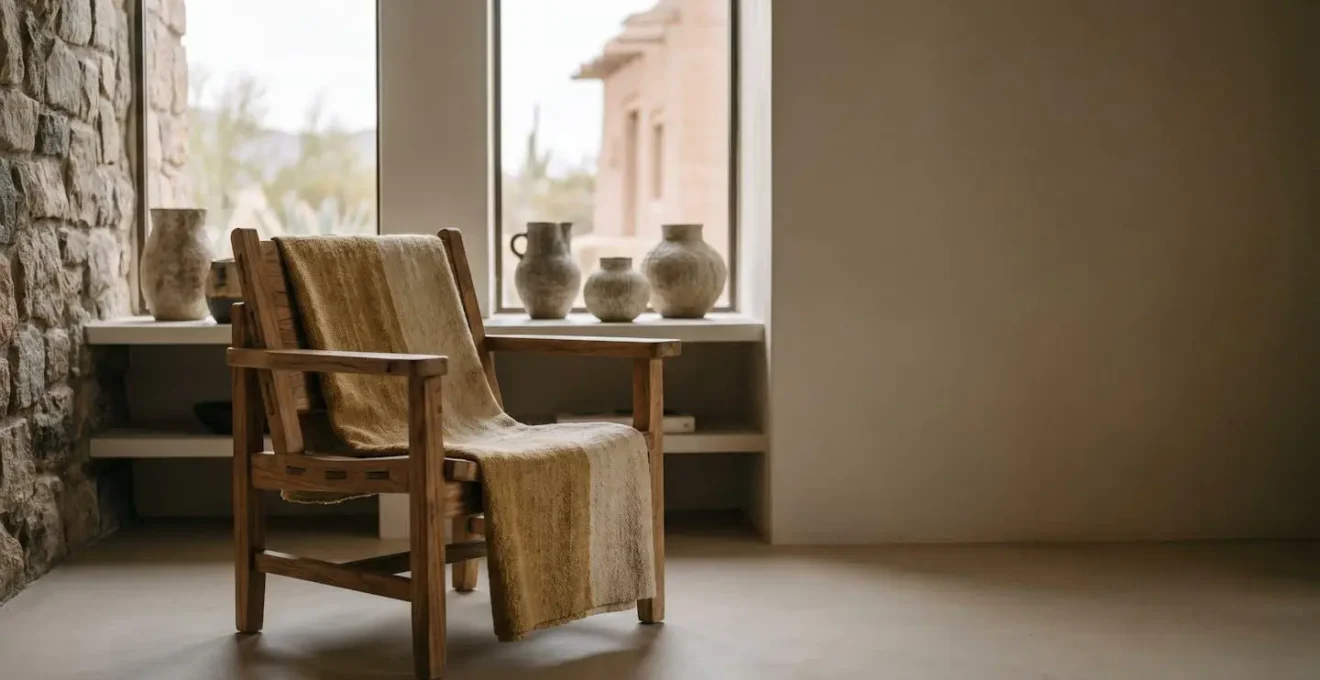
In contrast, genuine vernacular design integrates local culture deeply and subtly. It is expressed through three primary vectors: materials, motifs, and meaning. An authentic hotel’s design is rooted in its environment. The choice of wood, stone, and textiles will be native to the region, reflecting a long history of local building practices. A critical eye can often tell the difference between solid, locally-sourced timber and a generic laminate, or a hand-woven fabric and a mass-produced print. The photograph below highlights the textural richness that only genuine, regional materials can provide.
This focus on materiality is where authenticity truly reveals itself. Motifs are not isolated but are integrated contextually; for instance, a traditional roof tile pattern might be reinterpreted in the flooring, or a historical weaving technique might inform the texture of a wall covering. Finally, authentic hotels aren’t afraid to share the story. Their websites and staff can explain the significance of a particular design choice, profile the local artisans they worked with, and share the history of the building. Themed hotels, by contrast, offer only generic marketing copy. Developing an eye for these details allows you to see past the surface and read the true character of a hotel’s design.
- Examine materials: Verify if wood, stone, and textiles are native to the region rather than imported composites or generic printed patterns.
- Check integration vs. isolation: Genuine design integrates local motifs contextually (e.g., traditional patterns in flooring), while themed décor isolates them as props.
- Investigate the hotel’s story: Authentic hotels proudly profile artisans and building history on their ‘About’ pages.
- Look for flexible spaces: See how traditional elements are adapted, like shoji screens in a modern Japanese meeting room.
- Assess shared spaces: Lobbies and dining areas should showcase local artwork and cultural references, not generic international décor.
Restored Historic Interiors or Modern Local Design: Which Expresses Place Better?
When seeking a “sense of place,” travellers often face a choice: a meticulously restored historic building or a new construction featuring modern, locally-inspired design. There is no single correct answer, as both can fail or succeed spectacularly. A poorly executed restoration can feel like a stuffy, irrelevant museum, while a “modern local” design can easily slip into the very tourist-themed clichés we seek to avoid. The success of either approach depends entirely on the intelligence and sensitivity of the execution. A restored interior feels most authentic when it allows the patina of history to show, embracing imperfections and telling the story of its past life rather than erasing it with over-polished perfection.
The most compelling projects often blend both approaches through “adaptive reuse.” This involves transforming a heritage building for a new purpose while preserving its architectural character. It creates a powerful dialogue between old and new. As Dan Peek of JLL Hotels & Hospitality notes, “Adaptive reuse not only saves these buildings but preserves the character and repurposes them for years to come.” This method is also an act of profound sustainability. Considering that buildings account for a staggering 42% of annual global CO2 emissions, renovating an existing structure is almost always the more environmentally responsible choice than building anew.
Case Study: The Warehouse Hotel, Singapore
A prime example of successful adaptive reuse is The Warehouse Hotel in Singapore. This project transformed a former industrial godown, built in 1895 with a colourful history involving secret societies and liquor distilleries, into a 37-room boutique hotel. Opened in 2017, the design doesn’t hide its industrial past; it celebrates it. The new, modern elements are designed to coexist with and highlight the original structure, creating a dynamic interplay between the building’s storied history and its contemporary function as a luxury hotel.
Whether historic or modern, the design that best expresses “place” is the one that engages in a thoughtful conversation with its context. It’s not about freezing a building in time or starting from a blank slate, but about adding a new, respectful chapter to an ongoing local story. It is in this dialogue that a true sense of place is born.
The Photogenic Hotel Décor That’s Uncomfortable to Live With
In the age of social media, a new challenge has emerged for the discerning traveller: the rise of “Instagram-first” design. This is décor conceived not for the comfort of the guest, but for its performance in a photograph. It is characterized by dramatic “statement” pieces, visually striking but ergonomically nightmarish chairs, and moody lighting that looks fantastic in a filtered post but makes finding your socks impossible. This phenomenon creates what can be described as functional friction—a space that is beautiful to look at but frustrating and uncomfortable to actually inhabit.
The tell-tale signs are often visible even in professional booking photos if you know what to look for. Look past the single, artfully framed “vignette” and analyze the room as a whole. Is there adequate, accessible surface area for your belongings, or will your laptop have to balance on a stack of books? Is there a proper desk and chair, or just a velvet pouffe? Where are the electrical outlets in relation to the bedside table? These practical considerations are often the first casualties in the pursuit of a flawless, but ultimately impractical, aesthetic. The design prioritizes the fleeting moment of the photograph over the extended experience of the stay.
The most reliable way to pierce the veil of professionally styled photos is to consult the experiences of past guests. A quick search of reviews on platforms like TripAdvisor, filtering for keywords like “storage,” “outlets,” “lighting,” “desk,” or “uncomfortable,” can be incredibly revealing. These real-world accounts often expose the functional friction that polished marketing images are designed to conceal. A truly well-designed hotel room manages to be both beautiful and effortlessly functional; it doesn’t force you to choose between a great photo and a comfortable stay.
- Look for ‘statement’ furniture: Does it prioritize visual drama over functionality?
- Check for functional surfaces: Is there adequate desk space, luggage storage, and bedside tables?
- Examine lighting: Dramatic mood lighting may look great but be impractical for reading or working.
- Search guest reviews: Filter for keywords like ‘outlets,’ ‘storage,’ or ‘uncomfortable’ to uncover reality.
- Assess multi-functionality: Does the room cater to different guest needs or only showcase aesthetics?
- Verify amenities: Does the hotel emphasize practical comfort over just photogenic moments?
When Do Hotel-Artisan Collaborations Deliver Authentic Design?
A growing number of hotels highlight collaborations with local artisans as proof of their connection to the destination. While this is a positive trend, the authenticity of these partnerships can vary dramatically. The crucial distinction is between deep, meaningful artisanal integration and superficial artisanal decoration. The latter involves simply purchasing craft objects and placing them in a finished room, like any other piece of décor. The former, however, involves the artisan as a true partner in the design process, where their craft informs the very fabric of the space from the outset.
A truly integrated collaboration is evident when the artisan’s work is inseparable from the room’s architecture and identity. This could be bespoke tiles that form a unique mural, hand-carved woodwork that defines a structural element, or a custom textile whose colours and patterns inform the entire palette of the room. In these cases, the hotel’s website and staff won’t just show you the object; they will proudly tell you the artisan’s name, their story, and the tradition behind their craft. The collaboration is a long-term relationship, not a one-time transaction. This trend is gaining momentum as cultural immersion becomes one of hospitality’s most sought-after luxuries, projected to reach $20.6 trillion by 2032.
Case Study: Zafiro Palace Andratx, Mallorca & Teixits Vicens
The Zafiro Palace Andratx in Mallorca exemplifies deep integration. The hotel features works from local galleries and craftsmen throughout its suites. Crucially, it partnered with Teixits Vicens, a heritage textile studio specializing in the traditional Mallorcan “Cloth of Tongues” since 1854. This collaboration resulted in custom-designed, hand-woven vanity cases for guests, embedding an authentic, tangible piece of local craft directly into the guest experience. It’s a partnership that goes beyond decoration to create a meaningful cultural touchpoint.
Vetting these claims before you book requires a little detective work. Look for evidence of a genuine partnership, not just a product showcase. Is the artisan named and profiled? Is the story of their craft shared? Does the hotel actively promote their partner on social media? By asking these questions, you can determine if a hotel is merely using local crafts as a marketing tool or is genuinely committed to preserving and celebrating them.
Your Action Plan: Vetting Artisan Collaborations Before Booking
- Profile Check: Is the artisan named and profiled on the hotel’s website with their full story and role in the design?
- Social Media Audit: Does the hotel actively tag and promote the artisan’s own channels, or just show the final product?
- Partnership vs. Project: Look for evidence of a long-term relationship (multiple projects, ongoing mentions) versus a one-off purchase.
- Storytelling Depth: Does the hotel explain the specific craftsmanship, tradition, and meaning behind the artisan’s contribution?
- Integration Level: Was the artisan integral to the design (custom tiles, bespoke furniture) or did they simply provide wall art for a finished space?
Why Do International Hotel Chains Feel Identical Regardless of City?
The pervasive sameness of international hotel chains is a direct consequence of a business model that prioritizes global brand uniformity over local cultural expression. For a multinational corporation like Marriott, Hilton, or Accor, the core promise to the customer is reliability. A business traveller or a family on vacation wants assurance of a certain standard of quality, service, and safety, no matter where they are in the world. Achieving this consistency across hundreds or thousands of properties in dozens of countries requires a high degree of standardization. This is the very engine of their success.
This standardization manifests most obviously in the physical environment. To streamline construction, furnishing, and maintenance, chains develop a “kit-of-parts” approach. They rely on global supply chains for everything from bathroom fixtures and furniture to carpeting and curtains. It is far more efficient and cost-effective to negotiate a bulk contract with a single international furniture manufacturer than to source bespoke pieces from local artisans in every city. This operational logic creates a powerful inertia towards homogeneity. The design is optimized for procurement and maintenance, not for cultural resonance.
Whether a guest is in Dubai or Kathmandu, your hotel has some key design elements that can easily be associated with your brand.
– Hotel standardization expert, Mews hospitality industry analysis
While some chains are making efforts to incorporate “local touches”—a piece of local art in the lobby, a regional dish on the menu—these are often superficial layers applied to a fundamentally standardized template. The underlying structure, the very bones of the building and its rooms, remains globally generic. The hotel is designed to represent the brand first and the destination a distant second. This ensures a predictable experience but comes at the cost of creating a memorable and authentic sense of place.
15th-Century Palazzo or Contemporary Conversion: Which Feels More Venetian?
In a city as saturated with history as Venice, the choice of accommodation presents a fascinating design dilemma. Which hotel more effectively captures the Venetian spirit: a room in a restored 15th-century palazzo, draped in brocade and Murano glass, or a minimalist suite in a contemporary conversion of an old industrial building, with exposed brick and modern Italian furniture? The answer is not as simple as old versus new. Both can be authentic, and both can be failures. The one that “feels more Venetian” is the one that engages more intelligently with the city’s complex identity.
The restored palazzo offers a direct, tangible connection to the city’s opulent past. To sleep within walls that have stood for centuries is a powerful experience. However, authenticity is lost when this becomes a historical theme park. Over-restoration that erases the building’s age, or a slavish adherence to a “period” look with replica furniture, can feel static and lifeless. The most successful palazzo hotels allow the building’s history to breathe, contrasting ancient frescoes with a single piece of modern art, or historic terrazzo floors with sleek, contemporary lighting. They acknowledge that Venice is a living city, not just a museum.
Conversely, a contemporary conversion can feel profoundly Venetian by embracing the city’s less-seen industrial heritage and its ongoing legacy of world-class design. By stripping a building back to its essential structure, it can reveal an honesty of materials—brick, timber, iron—that speaks to the city’s history as a hub of trade and craft. When this raw shell is filled with the best of modern Italian design, it creates a dialogue that is forward-looking and dynamic. This approach reflects the spirit of Venetians like Carlo Scarpa, the modernist architect who masterfully wove contemporary interventions into historic structures. It argues that the most authentic way to honour a legacy is not to imitate it, but to build upon it with creativity and intelligence.
Key Takeaways
- Global hotel chains prioritize brand consistency, often leading to generic designs that lack local character.
- True local design is identified by regional materials and integrated cultural motifs, not by stereotypical, decorative props.
- Evaluating a hotel requires looking beyond photogenic “statement” pieces to assess functional comfort and practical details.
How to Choose Hotels That Connect You to Neighbourhood Culture?
The ultimate expression of authentic hotel design extends beyond the four walls of the room and into the surrounding neighbourhood. The most culturally connected hotels don’t just reflect the local design heritage; they actively participate in the life of their community. They function less as isolated islands for tourists and more as a “third place”—a welcoming, porous hub where locals and travellers can comfortably mingle. This is a design philosophy that prioritizes social connection over exclusive luxury.
Architecturally, this is often visible from the street. Does the hotel present a blank, imposing facade, or does it have an open, inviting lobby with large windows, a street-facing cafe, or a public-access art gallery? These are all signs that the hotel sees itself as part of the urban fabric. Inside, these spaces are designed for lingering, with comfortable communal seating, co-working areas, and displays of local products or books. They are programmed with events that appeal to locals as much as guests, such as farmers’ markets, book readings, or exhibitions by neighbourhood artists. The goal is to create a vibrant social ecosystem, not just a place to sleep.
Choosing a hotel that embodies this ethos requires looking for clues of community engagement. Check the hotel’s event calendar on their website or social media. Do they feature local musicians, artisans, or speakers? Read reviews that mention the atmosphere of the lobby or bar—do they describe it as a lively local spot? This approach shifts the focus from the hotel as a product to the hotel as a platform. It’s about finding a place that offers not just a bed, but a genuine entry point into the life of the neighbourhood. As one design expert eloquently states, this connection should be immediate and intuitive.
I believe hospitality spaces today are not just places to stay, they are cultural experiences. When you enter a resort in Kashmir or Assam, you should feel where you are without anyone telling you. The design itself should speak.
By applying this critical framework, you can move beyond the surface of marketing images and start making informed choices. The next step is to actively use these principles to investigate potential hotels for your upcoming travels, transforming your stay from a simple transaction into a meaningful cultural discovery.