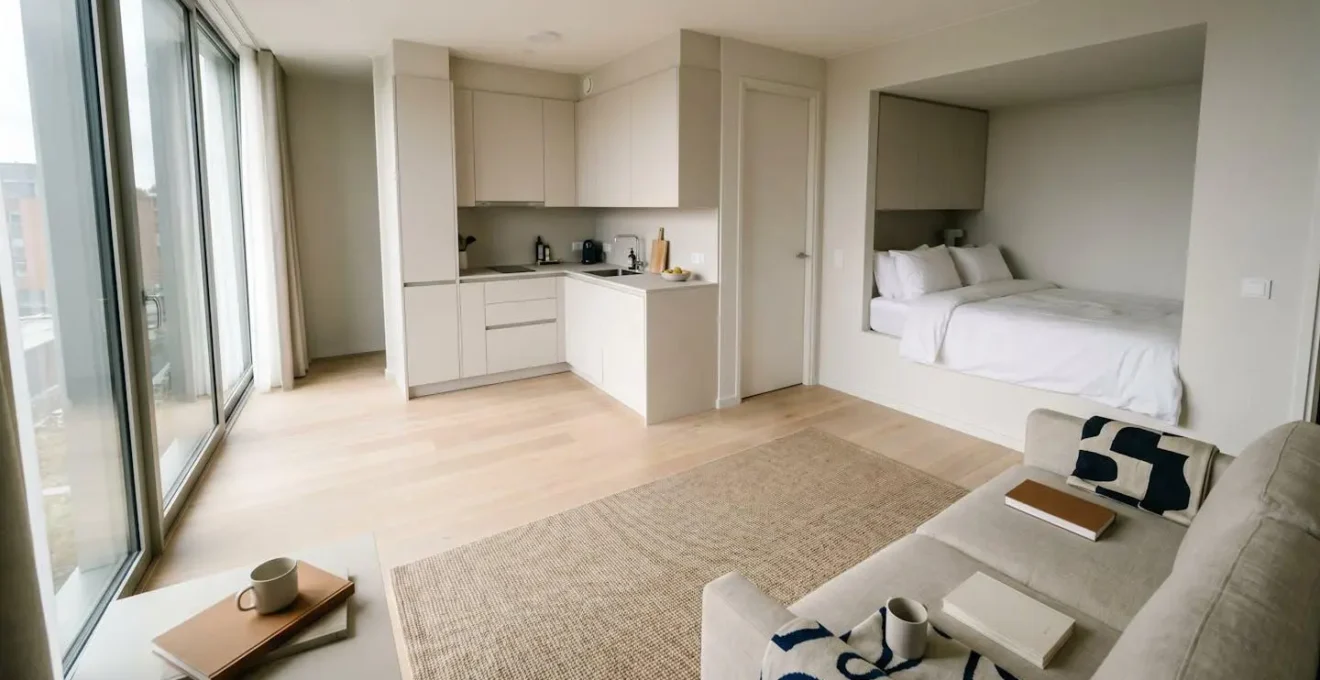
The advertised square footage of an aparthotel is often a poor indicator of its true livable space; layout efficiency is the critical metric.
- The perception of space is dictated by functional zoning and the elimination of “dead space,” not just gross area.
- Effective storage solutions and the separation of work, sleep, and living areas are more valuable than an open, but poorly designed, floor plan.
Recommendation: Prioritize aparthotels that demonstrate intelligent layout choices, such as L-shaped studios or one-bedroom units with clear functional separation, over larger but less efficient options.
For the extended-stay guest, the promise of an aparthotel is simple: the space and autonomy of an apartment with the convenience of a hotel. Yet, a common frustration quickly emerges. A generously advertised 40m² unit can feel surprisingly cramped, while a seemingly smaller 30m² space in a different building feels spacious and functional. This paradox isn’t about misleading measurements; it’s about a fundamental misunderstanding of what creates livable space. The industry-standard approach of focusing on gross square footage often overlooks the critical factors that truly matter for a month-long stay: layout efficiency, smart storage, and functional zoning.
Most travelers resort to flipping through photos or trusting the listed area, but these are superficial metrics. The real key to finding a space that enhances productivity and relaxation lies in learning to see beyond the wide-angle lens and the marketing copy. It requires developing an eye for “layout forensics”—the ability to analyze a floor plan and gallery photos for clues about workflow, sensory bleed, and storage capacity. This guide moves beyond the platitudes of “check the reviews” and instead offers a consultant’s framework for evaluating aparthotel layouts.
We will deconstruct why advertised size is deceptive, provide actionable checklists to verify storage and decode photos, and establish clear decision matrices for choosing between different layouts. By adopting this layout-optimization mindset, you can ensure the space you book isn’t just a place to sleep, but a functional and comfortable base for the duration of your stay.
This article provides a structured approach to help you analyze and select the most efficient aparthotel space for your needs. The following summary outlines the key areas we will explore to transform you into a savvy assessor of livable space.
Summary: A Consultant’s Guide to Aparthotel Space Efficiency
- Why Does a 40m² Aparthotel Feel Smaller Than a 30m² Apartment?
- How to Verify Aparthotels Have Adequate Storage for Month-Long Stays?
- Studio or One-Bedroom Aparthotel for Solo Extended Business Trips?
- The Aparthotel Studio Where Kitchen Light Ruins Sleep
- When Does Aparthotel Space Deliver Value Over Equivalent Hotel Rooms?
- How to Convert Hotel Room Measurements Into Realistic Space Expectations?
- City Centre Aparthotel or Residential District: Which Feels Less Touristy?
- When Do Aparthotels Make More Sense Than Traditional Hotels?
Why Does a 40m² Aparthotel Feel Smaller Than a 30m² Apartment?
The core of this spatial deception lies in the concept of the Building Efficiency Ratio. This metric represents the difference between the gross square footage advertised and the actual net usable (or “livable”) space you can occupy. The advertised number includes shared walls, structural columns, and sometimes even portions of corridors, while your perceived space is only what’s inside the walls. For residential buildings, this ratio can be surprisingly low. While commercial buildings are highly optimized, industry data reveals a significant gap in space efficiency, with apartments often averaging only 70-75% usable space.
This means your 40m² aparthotel might only offer 28-30m² of actual floor area. A competing 30m² apartment with a higher efficiency ratio (e.g., 85%) could offer 25.5m² of space, making the functional difference almost negligible. The real differentiator then becomes the layout. A 40m² unit plagued by “dead space”—long, narrow entrance hallways, poorly placed structural pillars, or awkward corners—will feel significantly smaller than a 30m² unit with an open, squared-off floor plan. The less efficient layout forces furniture into suboptimal arrangements, disrupts natural pathways, and wastes valuable area on circulation rather than function.
Ultimately, a smaller, well-designed square or L-shaped layout will always feel more spacious and functional than a larger, irregularly shaped unit with significant dead space. The advertised size is a starting point, but the efficiency of the layout is the true determinant of livability.
How to Verify Aparthotels Have Adequate Storage for Month-Long Stays?
For an extended stay, insufficient storage is a critical failure that turns a promising space into a cluttered, stressful environment. Relying on a single photo of an empty closet is a common mistake. True verification requires a “digital detective” approach to analyze promotional images for concrete evidence of storage capacity. You must hunt for clues that reveal not just the existence of storage, but its depth, variety, and practicality for a stay lasting several weeks.
Look for multi-functional furniture, which is a hallmark of efficiently designed spaces. Ottomans with lift-up tops, bed frames with built-in drawers, and coffee tables with lower shelving are all positive indicators. Conversely, a room filled with purely decorative, single-purpose furniture suggests that storage was not a design priority. The goal is to find at least 8-10 distinct and concealed storage points (closets, drawers, cabinets, integrated furniture) to comfortably accommodate a month’s worth of belongings without resorting to living out of a suitcase.
The image above exemplifies what to look for: integrated solutions where storage is seamlessly built into the primary furniture. This approach maximizes floor space while providing the necessary capacity for long-term guests. Pay close attention to the details in photos to perform your own remote audit.
Action Plan: Auditing Aparthotel Storage from Photos
- Closet Depth Analysis: Check photos for hangers. If they are perpendicular to the wall, it indicates a standard depth of 60cm+ suitable for suits and coats. Hangers parallel to the wall signal shallow storage (under 45cm), which is less practical.
- Hidden Storage Identification: Scrutinize furniture for clues. Look for visible seams on sofa bases (suggesting drawers), ottoman beds with thick bases (indicating lift-up mechanisms), and multi-level coffee or end tables.
- Scale Reference Check: Use known objects in photos to gauge size. A standard carry-on suitcase (approx. 56cm tall) placed next to a wardrobe can help you estimate its height and capacity. A bedside lamp can help gauge the width of a nightstand and its drawers.
- Storage Unit Tally: Systematically count every visible cabinet door and drawer pull in the kitchen, bedroom, and bathroom areas. Tally these “storage points” to ensure they meet the minimum of 8-10 for a month-long stay.
- Staged vs. Functional Space Assessment: Be wary of photos where all shelves are filled with decorative objects. This “staging” can conceal a lack of practical, empty storage space. Look for at least some empty shelving or cabinet interiors shown in photos as a sign of true utility.
Studio or One-Bedroom Aparthotel for Solo Extended Business Trips?
For the solo business traveler on an extended assignment, the choice between a studio and a one-bedroom unit is a critical decision that impacts both budget and productivity. While a studio is often 15-25% cheaper, the value of a one-bedroom’s physical separation cannot be overstated, especially for trips longer than two weeks. The ability to close a door between your workspace and your relaxation area creates a powerful psychological boundary that is essential for maintaining work-life balance and protecting sleep hygiene.
As the experts at RentCafe point out, the benefit is clear for remote work. In their guide, they note:
A one-bedroom usually works better for remote work because it allows physical separation between work and rest.
– RentCafe, Studio vs. 1-bedroom apartment: Which is better for a first-time solo renter?
This separation becomes crucial when your work involves frequent video calls, requiring a professional, uncluttered background, or deep, “heads-down” project work that demands a dedicated zone free from the distractions of a living area. A large, well-designed studio with a designated work nook can suffice for shorter trips or lighter workloads. However, for any stay involving intensive work or lasting three weeks or more, the modest additional cost of a one-bedroom often pays significant dividends in productivity and well-being.
The following table provides a decision matrix to help evaluate which option is better suited to the specific characteristics of your trip. The analysis provided by Apartment List’s comparative guide highlights that the choice is less about absolute size and more about the nature of the stay.
| Trip Characteristic | Studio Recommendation | One-Bedroom Recommendation | Key Factor |
|---|---|---|---|
| Duration | 1-2 weeks | 3+ weeks | Mental separation becomes critical after 2 weeks |
| Work Type | External meetings, light laptop work | Heads-down project work, video calls | Need for dedicated, professional workspace |
| Sleep Hygiene Priority | Low (flexible schedule) | High (strict sleep routine required) | Physical barrier between work/sleep zones |
| Budget Flexibility | Cost-conscious (15-25% savings) | Comfort-prioritized | Productivity gains vs. cost increase |
| Square Footage Efficiency | Large studio (35-40m²) with work nook | Any one-bedroom (even small 30m²) | Layout quality over absolute size |
The Aparthotel Studio Where Kitchen Light Ruins Sleep
One of the most common design flaws in studio aparthotels is the failure to mitigate “sensory bleed”—the unwelcome intrusion of light, sound, and smells from one functional zone into another. The prime offender is the kitchenette. The glow from a microwave clock, the hum of a refrigerator compressor, or the lingering aroma of dinner can severely disrupt sleep, turning the convenience of a kitchen into a liability. This issue is not just a minor annoyance; research on urban residential environments confirms that tolerance to combined light and sound stimuli during pre-sleep states is significantly lower, directly impacting sleep quality.
The problem stems from layouts that place the sleeping and kitchen areas in a direct sightline or in close parallel proximity. The most effective studio layouts use architectural features to create separation. Look for L-shaped floor plans where the bed is tucked around a corner, or units with a recessed sleeping alcove. These designs create a physical barrier that blocks light and dampens sound. A simple “line of sight” test is your most powerful tool: if you can draw an imaginary straight line from the pillow to the kitchen appliances on a floor plan, you will experience sensory bleed. An effective layout forces this line to bend around a wall or a structural element.
Before booking a studio, it is crucial to conduct “floor plan forensics” to predict potential sensory issues. By analyzing the layout for sightlines, noise corridors, and ventilation paths, you can identify poorly designed units and avoid a stay plagued by preventable disruption.
- Check direct sightlines: Draw an imaginary line from the pillow position to the kitchen area—if unobstructed, expect light pollution from appliance displays and under-cabinet lighting.
- Identify the ‘noise corridor’: Trace the path from the bed to kitchen plumbing walls—if they share a wall or are within 3 meters, refrigerator hum and water pipes will disrupt sleep.
- Look for layout zones: Optimal studios have L-shaped or alcove configurations where the sleeping area is recessed or perpendicular to the kitchen, not parallel.
- Assess ventilation paths: Check if the kitchen and sleeping area share the same air circulation zone—cooking smells will linger without physical or architectural separation.
- Evaluate entrance-to-bed exposure: If the bed is visible from the main door with the kitchen in between, you’ll face triple sensory bleed (light, sound, smell) from the most active zone.
When Does Aparthotel Space Deliver Value Over Equivalent Hotel Rooms?
The value of an aparthotel is not simply in having more space, but in having the *right kind* of space for a specific trip mission. For short tourist trips of 1-3 nights, a traditional hotel room is often superior in its simplicity and service. The aparthotel’s true value emerges on longer stays (4+ nights) or when the traveler needs to do more than just sleep in the room. It’s for those who are not just visiting a city, but temporarily living in it. As Randall Cook, CEO of Method Co., explained to Hospitality Design, this shift in travel behavior is driving the sector’s growth.
The key value proposition is functional zoning and autonomy. The ability to prepare your own meals in a kitchenette offers significant cost savings and dietary control, a crucial factor for anyone with specific health needs or a budget to maintain. The presence of a separate living area, even a small one, provides a dedicated space to work, relax, or entertain without being confined to the bedroom. This separation is fundamental for digital nomads, project-based workers, or anyone needing to maintain a professional routine on the road. The space delivers value when your trip requires a ‘home base’ rather than just a ‘hotel room’.
Case Study: Bundled Costs vs. Hidden Expenses
Extended Stay America’s analysis highlights a crucial financial benefit. While a traditional apartment’s monthly rent might seem lower, it comes with a cascade of hidden costs: security deposits, utility setup fees, and the significant expense of purchasing or renting furniture. Aparthotels bundle all these costs—utilities, Wi-Fi, furniture, and housekeeping—into a single, predictable rate. Their research demonstrates that for stays under three months, the ‘Total Cost of Stay’ for an aparthotel is often significantly lower than that of a short-term apartment lease once all ancillary costs are factored in.
This image captures the essence of aparthotel value: an unstructured, flexible environment that supports work, wellness, and relaxation within a single, private space. It’s this versatility that a standard hotel room, regardless of its luxury level, cannot replicate.
How to Convert Hotel Room Measurements Into Realistic Space Expectations?
The advertised square footage is often inflated by wide-angle photography and the inclusion of non-livable space. To get a realistic expectation, you must learn to read photos for scale and apply a simple correction factor. First, remember the efficiency ratio: as real estate industry standards indicate, an apartment’s usable area is often only 75% of its gross advertised size. A 40m² room is, in reality, closer to 30m² of livable space. Start by mentally discounting any advertised number by 25%.
Next, become a “photo scale reader.” Ignore the distorted fish-eye views and instead, find fixed-dimension objects in the photos to use as a mental measuring stick. This technique allows you to decode the true proportions of the room, bypassing the lens trickery. For example, a standard interior door is almost universally 80-90cm wide. A queen-sized bed is 153cm wide. By comparing these known objects to the lengths of walls or the space between furniture, you can build a more accurate mental model of the room’s dimensions.
Watch for the telltale signs of extreme wide-angle lens distortion: walls that appear to curve at the edges, or furniture near the frame that looks stretched and elongated. If you see these signs, it’s a red flag that the space will feel significantly smaller in person. The peripheral areas of such photos are particularly misleading; you should discount the perceived space in those zones by an additional 20-30%.
Your Photo Scale Reading Technique
- Locate a standard door: Interior doors are universally 80-90cm wide—use this as your measurement baseline to mentally calculate adjacent wall lengths.
- Identify dining chairs: A standard dining chair seat is 45-46cm high and 40-45cm deep—if the chair looks oversized, the room is shot with a wide-angle lens creating distortion.
- Check bed dimensions: A queen bed is 153cm wide, a king is 193cm wide—compare the bed width to the room width to estimate true floor area.
- Look for floor tiles or planks: If visible, count tiles between two known objects (e.g., door to window)—standard tiles are 30cm, 45cm, or 60cm square.
- Identify the lens distortion telltale: If walls appear to curve outward or furniture near frame edges looks stretched, the photographer used a wide-angle lens (16-24mm)—discount peripheral areas by 20-30%.
City Centre Aparthotel or Residential District: Which Feels Less Touristy?
For the extended-stay traveler seeking an authentic, “less touristy” experience, a property in a residential district almost always surpasses one in a city’s tourist core. While a city centre location offers proximity to major attractions, it often comes at the cost of immersion in local life. These areas are characterized by transient crowds, tourist-trap restaurants, and a constant, high-energy buzz that can be draining over a multi-week stay. A residential district, by contrast, offers a chance to experience the city at a local’s pace, with neighborhood bakeries, independent grocers, and local parks.
This philosophy is about prioritizing the *feeling* of a space over its geographical convenience. As Kelly Morgan, Managing Director of Wilde Aparthotels, states, this is the new definition of luxury:
Luxury today is about space, privacy, and ultimately how a place makes you feel.
– Kelly Morgan, Managing Director of Wilde Aparthotels, Hospitality Design: Aparthotels Gain Ground
This principle is perfectly illustrated by the expansion strategy of brands that prioritize the guest’s well-being and sense of place over a central pin on a map.
Case Study: Wilde Aparthotels’ Residential Strategy
Wilde Aparthotels has strategically built its European portfolio in residential-feel neighborhoods across cities like Berlin, London, and Lisbon. Their model focuses on “wellbeing fundamentals”—elevated acoustic soundproofing, blackout blinds, high-quality air and water filtration, and carefully considered layouts. By choosing locations slightly outside the chaotic tourist centers, they provide guests with a quieter, more restorative environment. Their success demonstrates that for the modern extended-stay guest, the feeling of “waking up better than when they arrived” is a more powerful draw than being next door to a famous landmark.
Choosing a residential district aparthotel is a vote for quality of life over sheer proximity. It’s a strategic decision for travelers who want to connect with the city’s authentic rhythm rather than just observe it from a distance.
Key Takeaways
- Advertised square footage is an unreliable metric; focus on layout efficiency and the percentage of usable “net” space.
- For extended stays, prioritize a one-bedroom unit for the crucial mental separation between work and rest zones.
- Audit all potential layouts for “sensory bleed”—the intrusion of light, sound, and smells between functional areas, especially in studios.
When Do Aparthotels Make More Sense Than Traditional Hotels?
The decision to choose an aparthotel over a traditional hotel hinges on a simple “Rule of Three”: the duration of your stay, the number of functional zones you require, and your preference for autonomy. While a hotel is designed for short-term comfort and convenience, an aparthotel is optimized for longer-term living and independence. It becomes the default best choice when your trip’s needs cross a certain threshold of complexity.
If your stay extends beyond three or four nights, the benefits of establishing a routine in a home-like environment begin to outweigh the novelty of daily hotel services. If your daily activities require more than just a place to sleep—for example, if you need a dedicated space for more than four hours of laptop work, or if you want control over your meals due to dietary needs or budget—the multi-zone layout of an aparthotel becomes a necessity. Finally, if you value control over your environment and schedule, finding daily housekeeping more intrusive than helpful, the aparthotel model is inherently more suitable.
The following decision framework clarifies these tipping points, helping you determine when the shift from a hotel to an aparthotel is not just a preference, but a strategic imperative for a successful extended stay. This table, based on common industry insights like those from Placemakr’s analysis of the extended-stay model, provides clear guidelines.
| Decision Factor | Traditional Hotel Better | Aparthotel Better | Tipping Point |
|---|---|---|---|
| Stay Duration | 1-3 nights | 4+ nights | After 4 nights, aparthotel routine benefits outweigh hotel convenience |
| Functional Zones Needed | Single zone (sleep only) | 2+ zones (work + sleep, cook + live) | When laptop work exceeds 4 hours daily |
| Dietary Independence | Happy eating out all meals | Want control over meals, dietary needs | When meal costs exceed $40/day or dietary restrictions exist |
| Autonomy Preference | Prefer full service, housekeeping | Want control over schedule, environment | When daily housekeeping feels intrusive vs. helpful |
| Trip Mission | Tourism, short meetings, events | Project work, relocation, digital nomad | When you need a ‘home base’ not a ‘hotel room’ |
By shifting your evaluation from simple square footage to a sophisticated analysis of layout efficiency, storage, and functional zoning, you fundamentally change your ability to select the right space. Adopting this consultant-grade mindset ensures that your next extended stay is not only comfortable but also highly productive and restorative.