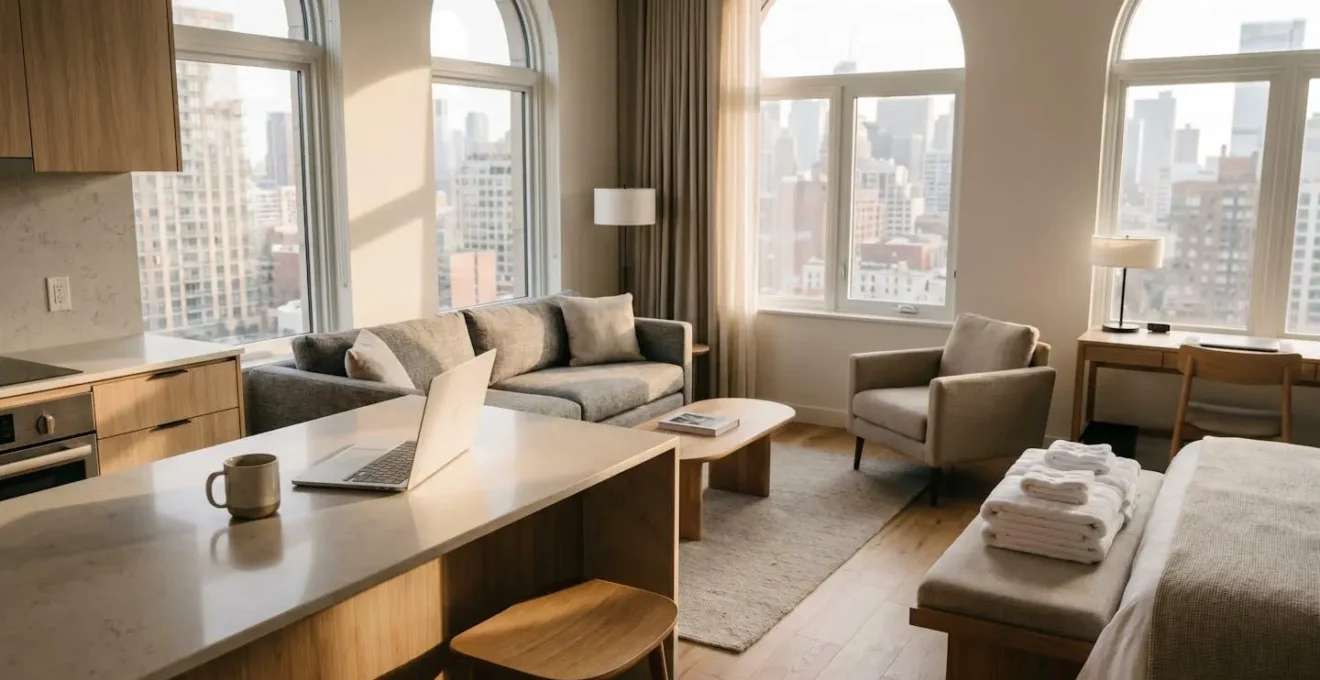
The economic tipping point for choosing an aparthotel over a hotel isn’t about a lower nightly rate; it’s a calculable breakeven analysis that typically occurs around the fourth night.
- For stays of 4+ nights, quantifiable savings on self-catering and reduced service fees begin to outweigh a hotel’s all-inclusive convenience.
- The value of “more space” is only realized with layouts offering true zonal separation (work/live/sleep), not just raw square footage.
Recommendation: Before booking an extended stay, verify the kitchen’s actual equipment list and analyse the floor plan for functional separation to ensure you’re paying for economic utility, not just a label.
The classic travel dilemma for any trip longer than a weekend: does the convenience of a traditional hotel outweigh the promised freedom of an aparthotel? For many extended-stay travellers and families, the decision is often based on vague notions of “more space” or having a “kitchen”. This approach, however, ignores the fundamental economic principles at play. The real choice isn’t about preference; it’s a breakeven analysis. The financial and practical advantage decisively shifts from one model to the other at a surprisingly predictable point.
The standard hotel model is built on high-frequency service and bundled amenities, a structure that becomes economically inefficient for longer stays where guest needs change. Conversely, the aparthotel’s unbundled, lower-touch service model presents significant cost savings, but only if the duration of the stay is sufficient to amortise its fixed costs. The key is to move beyond surface-level comparisons and analyse the underlying operational cost models that dictate pricing and value. This involves quantifying the real value of a usable kitchen, understanding the economics of housekeeping, and evaluating space not in square feet, but in functional livability.
This article provides a framework for that analysis. We will dissect the cost equation, verify the actual utility of advertised amenities, and provide a clear methodology for determining when an aparthotel is not just a different option, but the economically superior one for your stay.
Contents: When Do Aparthotels Make More Sense Than Traditional Hotels?
- Why Does the Aparthotel vs Hotel Cost Equation Flip at 4+ Nights?
- How to Verify Aparthotel Kitchens Are Actually Usable?
- City Centre Aparthotel or Residential District: Which Feels Less Touristy?
- The Aparthotel Housekeeping Assumption That Costs £15 Daily
- When Do European Aparthotels Enforce 5-Night Minimum Bookings?
- Why Does Weekly Aparthotel Housekeeping Cost £45 Extra?
- When Does Aparthotel Space Deliver Value Over Equivalent Hotel Rooms?
- How to Choose Aparthotel Layouts That Maximize Livable Space?
Why Does the Aparthotel vs Hotel Cost Equation Flip at 4+ Nights?
The four-night mark is not an arbitrary number; it’s the typical breakeven point where the economic structure of an aparthotel begins to overpower the traditional hotel model. This shift is driven by two core financial factors: the aparthotel’s lower operational cost model and the traveller’s ability to significantly reduce subsistence costs. Hotels are designed for high turnover, with daily services like housekeeping, room service, and concierge staff creating a high daily operational cost per room. While convenient for short stays, the guest is implicitly paying for these services whether they are used or not.
Aparthotels operate on a leaner model. With housekeeping provided weekly instead of daily, there are substantial labour savings. CBRE Hotels Research data shows that labor costs per occupied room are lower for extended-stay properties. While the difference may seem small on a daily basis, it compounds over a week, allowing operators to offer more competitive rates for longer durations. The most significant factor, however, shifts from the operator to the guest.
The ability to self-cater is the primary driver of savings. Dining out for every meal on a week-long trip accumulates rapidly. Having a functional kitchen allows for breakfast, coffee, and several meals to be prepared in-house at a fraction of the cost of restaurants. Research indicates that this can lead to substantial savings on a project or trip, with some analyses showing that self-catering can reduce total subsistence costs by up to 40% compared to relying on hotels and restaurants. After four nights, these accumulated food savings typically surpass any premium the aparthotel might have on its nightly rate compared to a budget hotel, causing the total cost equation to flip decisively in its favour.
How to Verify Aparthotel Kitchens Are Actually Usable?
The single greatest economic advantage of an aparthotel—the potential for self-catering savings—is entirely contingent on one crucial factor: the kitchen’s actual usability. A listing that boasts a “kitchenette” with only a mini-fridge and a microwave offers zero practical value for preparing meals and therefore no real cost savings. Distinguishing a functional kitchen from a decorative one before arrival is a critical step in the booking process. The goal is to verify the presence of core appliances and adequate workspace.
Photos can be misleading. A wide-angle lens can make a tiny counter look spacious. Look for specific visual evidence: a full-size refrigerator (not a small cube hidden in a cabinet), a stovetop with at least two burners, and evidence of an oven. An extractor fan is a strong indicator of a kitchen designed for actual cooking. Pay close attention to the amount of counter space available *between* the sink and the stovetop; this is the primary preparation area and a lack of it renders a kitchen highly impractical.
Ultimately, direct verification is the most reliable method. Do not ask “Do you have a kitchen?”. Instead, send a polite but specific email to the property before booking. Phrasing the request as “Could you please provide a list of the specific cooking equipment, utensils, and crockery included in the apartment?” forces a detailed response rather than a simple ‘yes’. This proactive diligence ensures the aparthotel’s key feature will deliver its promised financial benefit.
Your Action Plan: Kitchen Usability Verification Checklist
- Review analysis: Search guest reviews for keywords like ‘pots’, ‘pans’, ‘oven’, and ‘counter space’ to find mentions of actual cooking experiences.
- Equipment inventory request: Email the property to request a detailed list of all cooking equipment, appliances, and utensils provided.
- Refrigerator sizing: Scrutinise listing photos to distinguish between mini-fridges and full-size refrigerators suitable for a week’s groceries.
- Workspace assessment: Evaluate photos for adequate food preparation surfaces between the sink and stovetop, not just a collection of appliances.
- Appliance confirmation: Identify if the property offers a full convection oven, a combination microwave-oven, or only a microwave.
City Centre Aparthotel or Residential District: Which Feels Less Touristy?
A common platitude suggests that aparthotels inherently offer a more “local” or less touristy experience than hotels. This is often based on the assumption that they are more frequently situated in residential areas. As Luxflat Serviced Apartments notes in an industry analysis:
Hotels are often located in tourist areas, while aparthotels are more commonly found in residential areas. If you prefer a quieter, more local experience, an aparthotel may be the way to go.
– Luxflat Serviced Apartments, Industry comparison analysis
While this can be true, relying on it as a rule is a strategic error. The modern aparthotel market, especially in Europe, is heavily focused on prime commercial locations. Major operators target areas with high concentrations of business and leisure travellers, meaning they are often located directly adjacent to the very hotels and tourist hubs one might be trying to avoid. In many cities, the newest and best-equipped aparthotels are in prime city-centre locations, prized for their easy access to attractions and business districts.
Therefore, the feeling of being “less touristy” is not a function of the property type (hotel vs. aparthotel) but a direct result of its geographical location. A hotel in a quiet, residential neighbourhood like London’s Notting Hill will feel far more “local” than a high-rise aparthotel in the heart of Covent Garden. For the extended-stay traveller seeking authenticity, the strategy should be to first identify a desired residential neighbourhood and then search for *all* accommodation types within it. The choice is not between a hotel and an aparthotel, but between a central, convenient location and a quieter, more integrated residential one.
The Aparthotel Housekeeping Assumption That Costs £15 Daily
One of the most misunderstood aspects of the hotel cost structure is the “free” daily housekeeping. This service is not free; its cost is bundled into the high nightly rate. The assumption that this service is a zero-cost default is an economic fallacy that can cost a traveller on an extended stay. In an aparthotel, this service is unbundled. The baseline is typically a weekly clean, which dramatically lowers the operator’s labour costs and, in turn, the rate offered to the guest. The value of the daily service you forgo in an aparthotel can be conceptually valued at around £15 per day.
This figure isn’t arbitrary. It represents the combined cost of a hotel’s daily labour, cleaning supplies, laundry services for linens and towels, and the convenience premium. The core of this is the service frequency. As Extended Stay America policies show, the industry standard for extended stays is one full housekeeping service per week, not daily. This operational difference is the primary reason the aparthotel model is more cost-effective for longer stays. You are not paying for a service you may not need or want.
For a five-night stay, a guest at a traditional hotel has implicitly paid roughly £75 for daily room tidying. The extended-stay traveller, who is often more self-sufficient, effectively saves this amount by opting for a model where cleaning is less frequent. It’s a classic case of paying only for what you use. The “cost” is the loss of the daily refresh, but the saving is a tangible reduction in the total accommodation bill, a trade-off that becomes increasingly logical the longer the stay.
When Do European Aparthotels Enforce 5-Night Minimum Bookings?
Encountering a minimum stay requirement, often five or even seven nights, can be frustrating for travellers, but it’s a critical economic strategy for European aparthotel operators. This policy is not arbitrary; it’s a direct mechanism to manage the high fixed cost associated with turning over an apartment. Unlike a standard hotel room, which requires a relatively quick clean, an apartment with a kitchen demands a much more thorough and expensive servicing between guests. This includes deep cleaning the kitchen, checking all appliances, and managing a larger space. The policy is designed to amortise this fixed cleaning cost over a longer, more profitable booking.
Case Study: The Economics of Minimum Stay Policies
An analysis of cleaning cost amortization shows how minimum stay rules protect an aparthotel’s profit margins. Assuming a fixed cleaning and laundry cost of €60 per stay and a nightly rate of €100, the economics break down as follows: A single-night booking incurs a 60% overhead from cleaning costs alone, making it barely profitable. For a two-night stay, that overhead drops to 30%. By the third night, it’s a more manageable 20%. To combat this, properties often implement dynamic rules: a 7-night minimum might be required for bookings made 30+ days in advance during peak season to secure a profitable stay, while this restriction is lifted for last-minute bookings to fill vacant rooms, as some revenue is better than none.
These policies are most common in two scenarios: during peak tourist season (e.g., summer in Mediterranean cities, Christmas markets in Germany) and in high-demand business hubs (e.g., London, Paris, Frankfurt). During these times, operators can be confident they will attract guests willing to meet the longer stay requirement. This trend is further supported by shifting travel behaviours; post-pandemic travel has seen a notable move towards longer, more immersive trips, which aligns perfectly with the aparthotel model.
Why Does Weekly Aparthotel Housekeeping Cost £45 Extra?
Since the standard aparthotel model includes only a light refresh or no service for stays under a week, opting for a “full weekly clean” often comes as a separately priced add-on. A figure around £45 (or its euro equivalent) may seem steep, but it reflects the comprehensive nature of the service, which is far more akin to a residential “deep clean” than a hotel’s daily tidy-up. This price point is directly aligned with market rates for servicing apartment-sized units. According to accommodation industry analysis, the average cleaning and laundry costs for a single service in an apartment are around €60, making a £45 charge entirely reasonable.
The cost covers a detailed, time-consuming process that goes far beyond making the bed and emptying the bin. The fee accounts for the labour and materials required for a service that resets the apartment to its original check-in condition. This includes:
- Complete linen change: All bedding, including sheets, pillowcases, and duvet covers, is replaced with fresh linens.
- Full towel replacement: All bathroom towels, hand towels, and bath mats are exchanged for clean sets.
- Deep bathroom cleaning: This involves a thorough scrubbing and sanitization of the toilet, shower, sink, and all surfaces.
- Kitchen deep clean: A comprehensive cleaning of the stovetop, microwave, countertops, and sink area.
- Extensive vacuuming and dusting: The entire apartment’s flooring is vacuumed, and all surfaces, including furniture, are dusted.
- Restocking and trash removal: All bins are emptied, and consumables like soap and toilet paper are replenished.
Essentially, the £45 fee is not for a simple “clean”; it’s for a full service that restores the entire living environment. For guests on very long stays (e.g., a month or more), this optional service provides a valuable reset without the hassle of cleaning themselves, representing a fair market price for the extensive work involved.
When Does Aparthotel Space Deliver Value Over Equivalent Hotel Rooms?
The promise of “more space” is a cornerstone of aparthotel marketing, and it’s often quantitatively true. Some accommodation studies indicate aparthotel properties offer significantly more square footage—sometimes up to five times more—than a standard hotel room. However, square footage is a vanity metric if the space is not functional. The true value of this extra space is only unlocked when it is intelligently designed to provide functional and psychological separation, a factor that becomes exponentially more valuable on stays exceeding three or four nights.
For a single night, a combined living and sleeping space in a large hotel room is perfectly acceptable. By the fourth night of a business trip or family holiday, this lack of separation can lead to “cabin fever” and friction. The value emerges when the layout allows for different activities to occur simultaneously without disturbing others. Can one person take a work video call while another watches television in a separate area? Can you prepare a morning coffee without waking your partner? This is the concept of “livable space”—an environment zoned for distinct activities like working, relaxing, and sleeping.
This zonal separation is the true luxury. It’s the ability to close a bedroom door for privacy, to have a dedicated desk for focused work that isn’t the dining table, and to relax on a sofa in a living area that feels distinct from your sleeping quarters. The monetary value is found in productivity for business travellers and harmony for families and couples. The space delivers value not when it is merely bigger, but when it allows you to live, not just sleep, within its walls.
Key Takeaways
- The 4+ night stay is the typical breakeven point where self-catering savings surpass hotel convenience costs.
- Verify kitchen usability with checklists and photos; a “kitchenette” with no oven or counter space offers no real economic value.
- True “livable space” comes from functional separation provided by “True One-Bedroom” layouts, not just total square footage.
How to Choose Aparthotel Layouts That Maximize Livable Space?
Maximising livable space in an aparthotel is not about finding the largest unit, but about selecting the smartest layout. For extended stays, the right floor plan can be the difference between a comfortable, functional base and a cluttered, stressful environment. The key is to analyse how a layout supports your daily routine through functional zoning. There are three primary layout types to consider, each with a different level of privacy and functionality.
| Layout Type | Configuration | Privacy Level | Best For | Key Drawback |
|---|---|---|---|---|
| Studio | Single open space combining sleeping, living, and kitchen areas with separate bathroom only | Low – no physical separation between functional zones | Solo travelers, 1-2 night stays, budget-conscious guests | Cooking smells permeate sleeping area; limited ability to separate work from rest |
| Open-Plan One-Bedroom | Bedroom separated but living area and kitchen remain combined in shared space | Medium – sleeping privacy but living/cooking areas merged | Couples, short business trips (3-5 nights), small families with young children | Kitchen activity and aromas affect living/work space; one person’s cooking disrupts another’s relaxation |
| True One-Bedroom | Fully separated bedroom with door, distinct living area, kitchen with partial or full separation | High – complete zonal independence with physical barriers | Extended stays (7+ nights), remote workers needing workspace, families, business travelers hosting meetings | Higher price point; may be over-sized for solo travelers on shorter stays |
For any stay longer than a few nights, the “True One-Bedroom” layout consistently provides the highest livable value. The ability to physically close a door between the sleeping area and the living/working area is a non-negotiable feature for maintaining productivity and personal space. To evaluate a floor plan before booking, perform a “Daily Routine Test” by mentally walking through your day in the space:
- Morning Routine: Is there an entrance hallway to act as a buffer for shoes and coats, or do you step directly into the living space?
- Work Session: Is there a dedicated desk or table for laptop work that is separate from both the bed and the main relaxation area?
- Meal Preparation: Can you trace a logical flow from the fridge to a prep counter to the stovetop without disrupting someone watching TV?
- Evening Relaxation: Can you decompress on a sofa that is psychologically and physically separate from your workspace and sleeping area?
- Storage Check: Are there sufficient built-in closets for luggage and clothing to prevent clutter from spilling into the living zones?
–
Answering these questions provides a far more accurate assessment of a layout’s livability than its listed square footage. Choosing the right layout is the final step in ensuring your aparthotel stay is both economically sound and genuinely comfortable.
Now that you have the economic framework, the next step is to apply it. Start by evaluating your upcoming trip’s length and daily routine to determine if the aparthotel breakeven point works in your favor, and then scrutinize property layouts to find the one that offers true livable value for your specific needs.