The true value of any aparthotel service is not its price, but its “Return on Time” (ROT) for your specific stay profile.
- Housekeeping and grocery services offer high ROT on arrival and for time-poor professionals but diminish for budget-conscious or long-term guests.
- Core utilities like reliable Wi-Fi and functional workspaces are non-negotiable foundations, while “smart home” features are often low-value luxuries.
Recommendation: Before booking, audit each optional service against your schedule and priorities. Opt-in for services that buy back your most valuable asset—time—and decline those that are merely convenient amenities.
For the long-stay guest, the aparthotel promises the best of both worlds: the space and autonomy of an apartment with the services of a hotel. Yet, this hybrid model introduces a complex menu of optional extras, each with a price tag. The common advice to simply “check what’s included” is insufficient. It fails to address the core dilemma facing the modern business traveler or relocating family: which services are a strategic investment in productivity and well-being, and which are just expensive conveniences?
Many guests default to a simple cost-benefit analysis, comparing a £45 housekeeping fee to an hour of their time. This approach is flawed because it overlooks the critical variable in any extended stay: momentum. The real cost of forgoing a service isn’t just the time spent doing it yourself; it’s the “friction cost”—the mental energy, planning, and context-switching that disrupts your work or personal life. The question is not just whether a service is “worth it” in a vacuum, but how it impacts your primary mission for the trip.
This guide reframes the evaluation process. We will move beyond sticker prices to introduce the concept of Return on Time (ROT). The true value of a service is measured by how effectively it frees you to focus on what matters. We will dissect the most common aparthotel services—from housekeeping and grocery delivery to laundry and tech—through this analytical lens. This framework will empower you to build a service package tailored to your specific stay profile, ensuring every pound spent is a direct investment in a smoother, more productive, and ultimately more successful extended stay.
To help you navigate these choices, this article breaks down the value proposition of each key service. The following sections provide a detailed analysis to help you distinguish between essential utilities and costly amenities.
Summary: A Deep Dive into Aparthotel Service Value
- Why Does Weekly Aparthotel Housekeeping Cost £45 Extra?
- How to Use Aparthotel Grocery Services Without Overpaying?
- In-Unit Washer or Shared Laundry Room: Which Aparthotel Option Works Better?
- The Aparthotel Desk That’s Not Actually Workable
- When Do Aparthotels Offer Real Concierge Versus Just Reception?
- The Aparthotel Housekeeping Assumption That Costs £15 Daily
- Smart Room Controls or Dependable Basics: Which Aparthotel Tech Matters?
- When Do Aparthotels Make More Sense Than Traditional Hotels?
Why Does Weekly Aparthotel Housekeeping Cost £45 Extra?
The £45 charge for a weekly clean can seem steep, especially when you’re used to daily service being bundled into a hotel rate. The price isn’t arbitrary; it reflects the direct operational costs of labor, supplies, and administration. In fact, this fee is closely aligned with industry averages, with CBRE Hotels Research data from H2 2024 showing an average of $44.62 for housekeeping labor cost per occupied room in U.S. hotels. This figure covers not just the cleaner’s time but also insurance, management overhead, and the cost of professional-grade cleaning products. The aparthotel model unbundles this cost, offering you the choice—and the savings if you decline.
The real question is not about the cost’s fairness but its value to you. The Return on Time (ROT) for housekeeping is highest at two key moments: upon arrival and during intensely busy work weeks. Paying for the first clean ensures you start your stay in a pristine environment, saving you 90 minutes of cleaning after a long journey. For a project-based consultant billing at £100/hour, spending £45 to reclaim 1.5 hours of focus or rest is a clear financial win. The value proposition is about buying back high-value time.
However, for a month-long stay, the calculation changes. Four weekly cleans total £180. If you have downtime on weekends, the ROT diminishes. The smarter strategy is to use the service selectively. Engage it for the first week, then switch to a bi-weekly schedule or handle light tidying yourself. Before committing, always ask for an itemized breakdown of what “weekly service” includes—is it a full linen change and deep clean, or just a light refresh? This transparency allows you to match the service level to your actual needs, preventing you from overpaying for a service that delivers diminishing returns over time.
How to Use Aparthotel Grocery Services Without Overpaying?
Arriving after a long-haul flight to a fully stocked fridge is a powerful convenience. Aparthotel grocery services are designed for this exact moment, maximizing your Return on Time when you are at your most fatigued. You trade a 15-25% service fee for immediate rest and recovery, avoiding the friction of navigating an unfamiliar supermarket. For the first 24 hours of an extended stay, this service often provides the highest ROT of any add-on. The ability to prepare a simple meal without leaving your apartment can be a crucial factor in combating jet lag and starting your work assignment fresh.
This premium service is, however, a tool for specific situations, not a default for your entire stay. Once you are settled, its value diminishes rapidly compared to alternatives. Local delivery apps like Getir or Deliveroo offer a much wider selection at a lower, more transparent cost structure—typically a flat delivery fee rather than a percentage markup. A personal supermarket visit, while demanding the most time, offers the lowest cost and an opportunity to engage with the local culture.
The key to using this service without overpaying is to deploy it surgically. Use the aparthotel’s service for your arrival day essentials: milk, coffee, bread, and simple meal ingredients. For subsequent weekly shops, pivot to a local delivery app or a planned supermarket run. This hybrid approach gives you the best of all worlds: maximum convenience when you need it most and maximum cost control for the remainder of your stay.
This comparative analysis, based on a sample basket, highlights the distinct advantages of each option for an extended-stay guest.
| Option | Total Cost (Sample Basket) | Time Investment | Best For | Key Advantage |
|---|---|---|---|---|
| Aparthotel Service | $75-95 (items + 15-25% fee) | 15 min (list creation) | Arrival day after long flight | Immediate rest & recovery |
| Local Delivery App | $65-80 (items + flat $5-8 fee) | 20-30 min (app browsing) | Ongoing weekly shops | Transparent pricing, wider selection |
| Personal Supermarket Run | $60 (items only) | 60-90 min (transport + shopping) | Long stays, leisure travelers | Lowest cost, local experience |
In-Unit Washer or Shared Laundry Room: Which Aparthotel Option Works Better?
Access to laundry is a non-negotiable utility for any stay longer than a few days, but the choice between an in-unit machine and a shared facility has significant implications for your time and budget. An in-unit washer-dryer offers the ultimate Return on Time. The ability to do laundry while you work, cook, or sleep eliminates the “friction cost” of scheduling, waiting for machines, and transporting clothes. This convenience is paramount for certain stay profiles.
For business travelers on tight schedules, the efficiency of an in-unit machine is a productivity multiplier. For families with children, it’s a “sanity-saver,” allowing for immediate management of spills and the constant cycle of small laundry loads. For these guests, the slightly higher nightly rate for an apartment with this feature is easily justified by the time and stress saved. The convenience far outweighs the often smaller capacity of the European-style combo units found in many aparthotels.
Conversely, a shared laundry room is a perfectly viable option for budget-conscious solo travelers or those with more flexible schedules. The key is to mitigate the friction. Inquire about the number of machines relative to the number of units and ask about peak usage times. Planning your laundry for off-peak hours (e.g., mid-afternoon on a weekday) can replicate the convenience of an in-unit machine at a lower overall cost. The savings in the nightly rate can then be reallocated to other services with a higher ROT for your specific needs.
Case Analysis: The Laundry Decision Tree
Analysis of aparthotel laundry preferences reveals distinct guest needs. Business travelers on tight schedules prioritize in-unit machines for time efficiency, even with smaller capacities. Families view in-unit laundry as non-negotiable for managing daily clothing changes. Budget solo travelers find shared rooms acceptable by using off-peak hours. A third option is emerging: local wash-and-fold services charging by weight. This appeals to work-intensive guests who value complete time liberation over cost, representing the ultimate convenience tier that surpasses both in-unit and shared facilities.
The Aparthotel Desk That’s Not Actually Workable
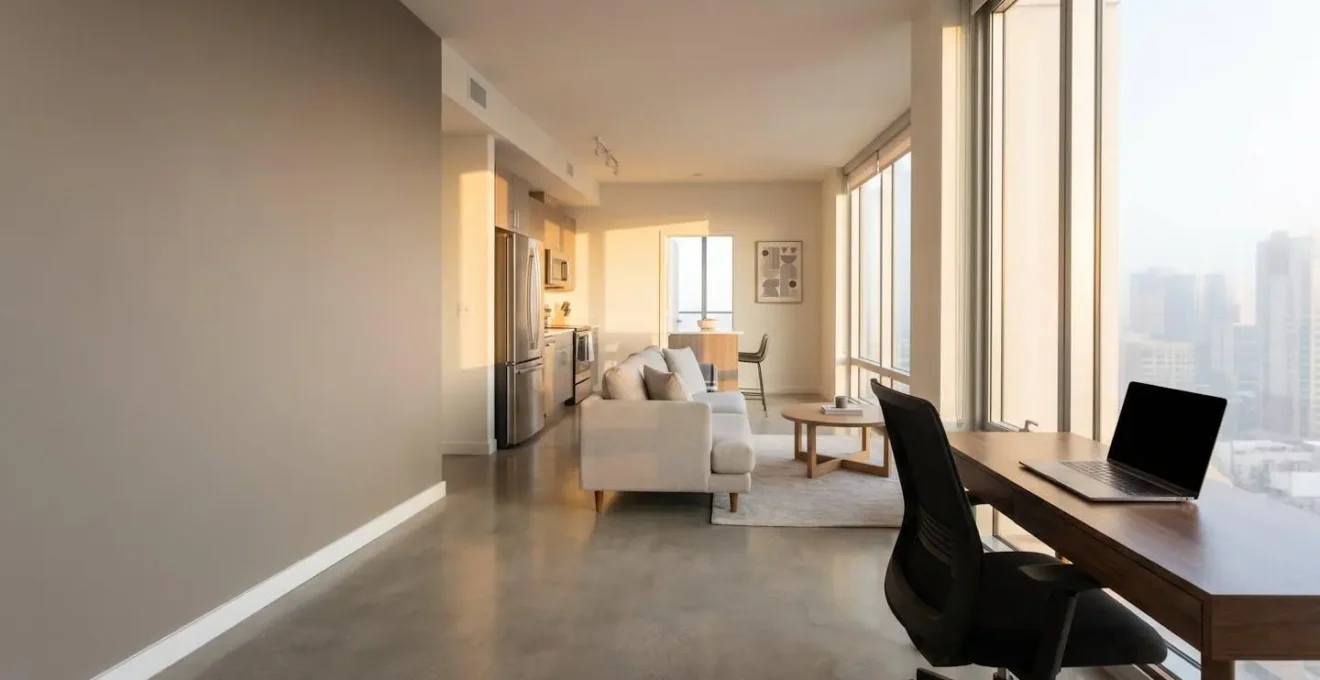
For the digital nomad or remote worker, the “desk” listed as an amenity can be deceptively misleading. A stylish but shallow console table paired with a dining chair does not constitute a workable professional setup. An unproductive workspace carries a high friction cost, leading to poor posture, distraction, and decreased output. True value lies not in the mere presence of a desk, but in its ergonomic and technical viability. This is a foundational requirement, not a luxury.
The core of the issue is that marketing photos often use wide-angle lenses to make spaces appear larger and more functional than they are. A desk that looks spacious can barely fit a laptop, let alone an external monitor and notebook. Therefore, a pre-booking audit is essential. This goes beyond just asking if a desk is present. You must verify its functional dimensions (a minimum of 48 inches wide is ideal), ergonomic support (an adjustable chair is a must), and, critically, power access. A desk without at least three accessible outlets nearby is a design flaw, not a workspace.
Your analysis must also include the digital infrastructure. While a physical desk is important, the top priorities for business travelers are consistent. In fact, research on hotel guest preferences shows that high-speed internet access and guest device connectivity rank as the two most crucial amenities. A beautiful desk is useless if the Wi-Fi is unreliable. For any stay longer than two weeks, don’t hesitate to request a quick video call walkthrough to see the workspace in real-time, bypassing any photographic distortion. This five-minute call can save you weeks of frustration.
Action Plan: Digital Nomad’s Workstation Audit
- Ergonomics Assessment: Verify the chair has lumbar support and adjustable height; the desk surface should be 28-30 inches high.
- Lighting Evaluation: Check for natural light near the desk and inquire about task lighting for evening work; request photos showing actual conditions.
- Power Access Verification: Confirm a minimum of three accessible outlets near the desk and check their type for regional compatibility.
- Desk Space Measurement: Ensure the surface can fit your laptop (e.g., 15″), external monitor (e.g., 24″), and a notebook simultaneously—aim for at least 48 inches wide.
- Pre-booking Video Request: For long stays, request a video walkthrough to expose wide-angle lens distortion and verify the setup.
When Do Aparthotels Offer Real Concierge Versus Just Reception?
Many aparthotels list “concierge services” as an amenity, but the term is often used loosely. It’s crucial for long-stay guests to differentiate between a standard reception desk and a true concierge. A receptionist is a logistical expert: they handle check-in, issue keys, and answer basic questions about the property. Their role is primarily transactional and reactive. They are a necessary utility for the building’s operation.
A true concierge, however, is a proactive service professional and a local expert. Their value lies in their ability to provide personalized recommendations, secure hard-to-get reservations, and solve complex, non-standard problems. For a long-stay guest, a great concierge can be an invaluable asset, acting as a local fixer to smooth the friction of living in a new city. They provide a significant Return on Time by leveraging their network and knowledge on your behalf—a service you cannot easily replicate yourself. This is an amenity that can transform an extended stay from functional to exceptional.
The presence of a true concierge is almost always tied to the property’s price point and positioning. As one industry analysis points out, this level of personalized service is a major investment for the property.
A true concierge service is a significant operational expense. It’s usually only viable in properties commanding a high price point where guests expect and will pay for a high-touch service level.
– Industry operational analysis, Aparthotel service model differentiation
To determine what you’re getting, look for clues. Are they a member of a professional organization like Les Clefs d’Or? Does the property’s marketing emphasize personalized service and local expertise? When in doubt, call and ask a specific, complex question. The quality of the response will tell you everything you need to know about whether you’re dealing with a receptionist or a true concierge.
The Aparthotel Housekeeping Assumption That Costs £15 Daily
One of the most common and costly mistakes for extended-stay guests is assuming housekeeping works the same way as in a traditional hotel. Many aparthotels operate on an “opt-out” model for daily service, especially for stays booked through certain platforms. This means you are automatically enrolled in—and charged for—a daily light clean unless you explicitly decline it. This seemingly small charge, often around £15, can accumulate into a significant expense.
The financial impact is not trivial. For an extended-stay guest who doesn’t explicitly opt out, that £15/day charge adds up to £450 over a 30-day month. That’s a substantial sum for a service you may not need or want daily. Unlike a short-stay tourist, a long-stay resident typically prefers less frequent intrusions and has the facilities to maintain their own space between deeper weekly cleans. Paying for a daily bin emptying and bed-making service offers a very low Return on Time.
To avoid this hidden cost, you must be proactive. At check-in, your first question should be to clarify the default housekeeping model: is it opt-in or opt-out? Request a written menu of service frequencies and their associated costs. Many properties offer a more cost-effective full weekly service alongside the pricier daily option. Some even frame the opt-out model as a “green initiative.” While reducing laundry and cleaning is indeed more sustainable, you should verify if those savings are passed on to you in the form of a rate reduction or simply retained by the property as additional revenue. Document your preferences in writing to prevent any disputes when you review your final folio at check-out.
Smart Room Controls or Dependable Basics: Which Aparthotel Tech Matters?
The modern aparthotel is often a showcase for the latest in-room technology. From voice-controlled blinds to app-managed climate zones, these “smart” features are impressive marketing tools. However, for the long-stay guest, their practical, day-to-day value is often minimal. The novelty of asking a speaker to close the curtains wears off quickly. The true measure of an aparthotel’s tech stack is not its futuristic flair, but the reliability of its foundational elements.
For anyone staying more than a few nights, there is a clear hierarchy of technological needs. The make-or-break foundation is connectivity. Fast, free, and reliable Wi-Fi is the single most critical tech amenity, alongside ample and accessible power outlets. Without this, no other feature matters. The next tier includes practical technologies that reduce friction, such as keyless entry and smart TVs with easy-to-use interfaces for logging into your own streaming accounts. These are high-value conveniences that improve the efficiency of your stay.
Advanced smart controls occupy the top—and least essential—tier. They are luxury differentiators that are “nice to have” but provide a low Return on Time in daily use. A glitchy smart lighting system is far more frustrating than a simple, reliable light switch. As a value analyst, you should prioritize properties that master the basics over those that boast about superficial smart features. The most important technologies are those that work flawlessly in the background to support your stay, not those that demand your attention.
This hierarchy clearly shows where guests, particularly business travelers, place the most importance when it comes to in-room technology.
| Priority Tier | Technology Type | Critical Features | Impact on Stay Quality | Guest Segment |
|---|---|---|---|---|
| Foundation (Must-Have) | Dependable Basics | Fast, free, reliable Wi-Fi; Ample accessible power outlets; Strong signal in all rooms | Make-or-break for extended stays | All guests, especially business travelers |
| Convenience (Nice-to-Have) | Practical Tech | Keyless entry; Easy smart TV with streaming login; Mobile check-in/out | Removes friction, improves efficiency | Tech-comfortable travelers |
| Luxury (Differentiator) | Advanced Smart Controls | Voice-controlled blinds/lighting; Climate zones; App-controlled everything | Impressive initially, limited daily value | Luxury segment, short stays |
Key Takeaways
- Evaluate all services based on their “Return on Time” (ROT) relative to your specific work and personal schedule.
- Prioritize foundational utilities (Wi-Fi, workspace) over luxury amenities (daily housekeeping, smart controls) for long stays.
- Use high-cost services like grocery delivery and concierge surgically for maximum impact, not as a default.
When Do Aparthotels Make More Sense Than Traditional Hotels?
The decision between an aparthotel and a traditional hotel hinges on the length and purpose of your stay. For short trips of one to three nights, the traditional hotel often wins on sheer convenience. The bundled costs, daily housekeeping, and full-service amenities like on-site restaurants provide a frictionless experience for a brief visit. The setup is simple, the rate is predictable, and no effort is required from the guest.
The break-even point occurs around the four to six-night mark. Here, the choice becomes a toss-up dependent on your personal habits. Do you prefer dining out or cooking your own meals? Do you require laundry facilities? Do you need a separate area to work? At this duration, the savings from an aparthotel’s kitchen can begin to offset the convenience of a hotel’s full service.
For any stay of a week or longer, the aparthotel becomes the clear winner, both financially and psychologically. For extended stays, serviced apartments can be up to 25% cheaper than hotels when factoring in all expenses. The ability to cook meals, do laundry in-unit, and have separate living and working spaces creates significant cost savings and a more sustainable, comfortable living environment. As Extended Stay America notes, while traditional apartments might seem cheaper monthly, the bundled, predictable rate of an aparthotel avoids the hassle of deposits and utility setup, offering a key advantage.
The following scorecard provides a clear decision-making framework based on stay duration, highlighting where the aparthotel’s value proposition becomes decisive.
| Stay Duration | Winner | Key Decision Factors | Total Cost Advantage |
|---|---|---|---|
| 1-3 nights | Hotel | Convenience, full service, no setup needed, daily housekeeping included | Comparable nightly rates; hotel wins on simplicity |
| 4-6 nights | Toss-up | Depends on dining habits (eat out vs cook), laundry needs, workspace requirements | Break-even point; calculate meal + laundry savings |
| 1-4 weeks | Aparthotel | Kitchen saves on meals, in-unit laundry, separate living/work space, weekly discounts | 15-25% lower total trip cost factoring all expenses |
| 1+ month | Aparthotel (decisive) | Monthly rates, psychological comfort (autonomy vs service), routine establishment, cost control | 25-35% savings; comfort and cost both favor aparthotel |
Ultimately, the choice to use an aparthotel’s extra services is a strategic one. By applying the “Return on Time” framework, you can move from being a passive consumer to an active value analyst of your own stay. Use this analytical approach on your next booking to ensure every pound spent on services delivers a clear and justifiable return on your time, comfort, and productivity.