Unproductive hotel stays aren’t a matter of willpower; they’re a failure of workflow design.
- True productivity requires pre-trip verification of core facilities, not just assuming they exist.
- The key is to create strict physical and mental boundaries between “work” and “rest” zones, even in a small room.
Recommendation: Systematically audit your temporary workspace upon arrival to eliminate “environmental friction” before it sabotages your focus.
The scene is painfully familiar: a crucial video conference call drops, the desk is a wobbly postage stamp, and the line between your laptop and your pillow has blurred into a productivity-killing haze. For the corporate traveler, the hotel room is often the single biggest point of failure in maintaining peak work performance. We are told to “make the best of it,” find a nearby coffee shop, or rely on the hotel’s often-underwhelming business center. This advice misses the fundamental problem.
The issue isn’t a lack of effort; it’s the absence of a system. Peak performance isn’t achieved by chance or through sheer willpower. It is engineered. Thriving on the road requires treating your temporary accommodation not as a passive place to sleep, but as a dynamic work environment that must be actively shaped and controlled. It demands a shift in mindset from adapting to your environment to making the environment adapt to your professional workflows.
This guide provides a blueprint for that engineering process. We will move beyond generic tips to establish a concrete, workflow-optimization strategy. This framework will empower you to de-risk your travel, eliminate environmental friction, and transform any hotel stay from a liability into a strategic asset for productivity.
This article will break down the essential strategies for structuring your business hotel stays. From understanding the psychological traps of a hotel room office to verifying facilities before you book, you will gain a comprehensive framework for maximizing your output on the road.
Summary: A Workflow-Optimization Guide for Business Travel
- Why Can’t You “Switch Off” When Your Hotel Room Is Your Office?
- How to Verify Hotel Business Centers Actually Support Your Work?
- Aparthotel or Traditional Hotel for 3-Week Business Projects?
- The Hotel WiFi That Fails During Your 9am Video Conference
- When Do Corporate Hotel Rates Actually Save Your Company Money?
- How to Verify Paris Hotel Business Facilities Actually Work?
- The Aparthotel Desk That’s Not Actually Workable
- How to Choose Paris Business Hotels That Don’t Waste Your Time?
Why Can’t You “Switch Off” When Your Hotel Room Is Your Office?
The core problem is a lack of psychological separation. Our brains rely on environmental cues to switch between modes of thinking. At home, the commute from an office to a living room provides a clear mental break. In a hotel room, your “office,” “dining room,” and “bedroom” occupy the same 30 square meters. This constant context-switching leads to cognitive fatigue and a persistent feeling of being “on,” even during downtime. This isn’t just a feeling; it’s a measurable drain on performance. In fact, research from the University of Exeter found that employees in enriched, well-designed workspaces were up to 32% more productive than those in lean spaces.
To combat this, you must actively manufacture separation. This involves creating spatial rituals—small, repeatable actions that signal a transition. For instance, at the end of the workday, don’t just close your laptop. Pack it away completely into its bag, along with notebooks and chargers, and place the bag in a wardrobe or drawer. This physical act of “packing up” serves as a mini-commute, signaling to your brain that the work portion of the day is definitively over. This allows your mind to truly disengage and recharge, preventing the slow burnout that comes from a workspace that never disappears.
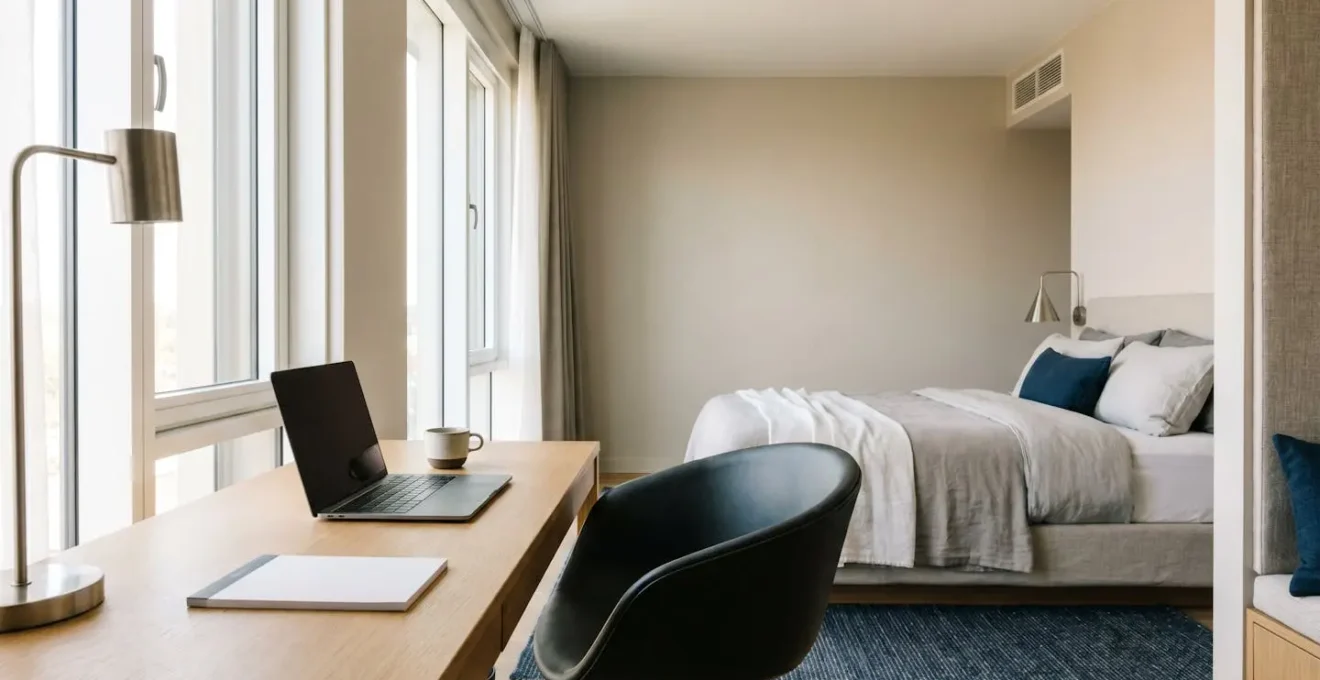
As this visualization suggests, the goal is to create distinct zones. Dedicate a specific chair and table for work, and consciously avoid using that space for leisure activities like eating or watching movies. By enforcing these boundaries, you preserve the sanctity of both your focus during work hours and your ability to relax afterward. It’s about taking deliberate control of your environment to manage your own mental state, a crucial skill for any road warrior aiming for workflow integrity.
How to Verify Hotel Business Centers Actually Support Your Work?
The term “business center” on a hotel website can mean anything from a fully equipped, 24/7 workspace to a single, decade-old PC in a hallway. Assuming it will meet your needs is a high-risk gamble. The key to avoiding this productivity trap is pre-emptive verification. This means asking specific, operational questions during the booking process, long before you arrive. Do not accept vague assurances; demand concrete details about the infrastructure that will support your work.
This level of oversight is critical. The quality of business facilities often reflects the overall management philosophy of the property. For example, the JD Power 2024 North America Third-Party Hotel Management Guest Satisfaction Benchmark found that hotels run by professional management companies consistently scored higher in satisfaction, largely due to better maintenance and upkeep of facilities. This shows a direct link between professional oversight and a functional environment for business travelers. Before you book, call the front desk directly and ask pointed questions.
Is the center a shared public space or a private, bookable room? What is the specific model of the printer/scanner, and is it compatible with your devices? Is access available 24/7 with a room key, or is it limited to reception hours? How many workstations are available, and what are the peak usage times? These questions shift you from a passive guest to an active stakeholder in your own productivity. Getting clear answers allows you to build a reliable productivity infrastructure, or choose a different hotel if the answers are unsatisfactory.
Aparthotel or Traditional Hotel for 3-Week Business Projects?
For an extended project spanning several weeks, the choice between an aparthotel and a traditional hotel becomes a strategic decision with significant impacts on both budget and productivity. While traditional hotels offer convenience through services like daily housekeeping and room service, aparthotels provide space, autonomy, and a more sustainable living environment for longer stays. The correct choice depends entirely on the nature of your work and your personal workflow needs.
For projects exceeding a week, the cost-benefit analysis often tilts in favor of aparthotels. Not only do nightly rates tend to decrease for longer bookings, but industry analysis indicates that having kitchen facilities makes them significantly more cost-effective by reducing reliance on expensive restaurant meals. Beyond cost, the larger footprint and separation of living and working areas in an aparthotel can be a massive boost to maintaining workflow integrity and mental well-being over a three-week period. The following matrix breaks down the key decision factors.
| Decision Factor | Aparthotel Advantage | Traditional Hotel Advantage |
|---|---|---|
| Cost for 3+ weeks | Nightly rates decrease for longer bookings; kitchen facilities reduce food costs | Corporate negotiated rates may offset base price; loyalty points accumulation |
| Workspace Quality | Separate dedicated work areas; more square footage; private environment | 24/7 business center access; professional meeting rooms for client presentations |
| Service Dependency | Flexible housekeeping schedule; self-catering reduces reliance on hotel schedules | Daily housekeeping; concierge assistance; on-site restaurants save time |
| Privacy & Focus | Private entrances; no corridor foot traffic; control over cleaning schedule | Soundproofed rooms (variable); established quiet hours policies |
| Client-Facing Work | Space to host small informal meetings in-suite | Professional lobby and dedicated meeting spaces create stronger business impression |
| Amenities | Full kitchen; in-unit laundry; living room separation from bedroom | Room service; gym/pool access; premium WiFi tiers; business lounge access |
Ultimately, the decision rests on your specific project requirements. If your work is primarily client-facing and requires professional meeting spaces, a traditional hotel with robust business services may be superior. However, if your project requires long hours of focused, individual work and you value the ability to control your own schedule and environment, the aparthotel is almost always the more productive and sustainable choice.
The Hotel WiFi That Fails During Your 9am Video Conference
Unreliable internet connectivity is the number one saboteur of business travel productivity. In today’s work environment, stable WiFi is not a luxury; it is a fundamental utility, as essential as running water. The expectation for seamless connectivity is incredibly high; according to YouGov research, a staggering 79% of US business travelers state that a reliable WiFi connection is “very important” when choosing a hotel. This reliance makes any instability a critical point of failure.
Many hotels offer a free, basic tier of WiFi that is often oversaturated and throttled, especially during peak morning and evening hours. This is the “best-effort” internet that buckles under the pressure of a high-definition video stream. As the experts at Otto the Agent note in their analysis of top business hotels, the importance of this utility cannot be overstated.
WiFi outranks room rate, and unreliable connectivity remains a top hotel frustration for business travelers.
– Otto the Agent, Top Business Trip Hotels for Efficient Travel analysis
The solution is to build personal redundancy into your productivity infrastructure. Never rely on a single point of failure. Your workflow should include a triple-redundancy protocol for connectivity: 1. Primary: The hotel’s premium, paid WiFi tier, which is often faster and more stable. Inquire about this at check-in. 2. Secondary: A dedicated mobile hotspot device with its own data plan. This is your first line of defense when the hotel network fails. 3. Tertiary: Your smartphone’s tethering capability. This is your final backup for critical, short-term tasks like sending an urgent email if both other options fail.
When Do Corporate Hotel Rates Actually Save Your Company Money?
A negotiated corporate rate can seem like an obvious win, but its true value is often misunderstood. Focusing solely on the discounted room price is a narrow view that ignores the larger concept of a total value equation. A slightly cheaper room that forces you to pay for essential services like premium WiFi or breakfast can quickly become more expensive in both real cost and lost productivity time than a rate that bundles these amenities.
The most effective corporate hotel programs understand this distinction and prioritize value over simple discounts. They build packages that directly address the pain points and workflow needs of business travelers, creating a frictionless experience that boosts efficiency. This is a key reason why certain brands consistently outperform in corporate satisfaction surveys.
Case Study: Hilton’s Value-Driven Corporate Program
In BTN’s 2024 annual hotel survey, which polled 249 corporate travel buyers, Hilton Hotels emerged as the top-ranked brand. Its success wasn’t just due to price but to its high marks across nearly all criteria. Buyers noted that Hilton’s negotiated rates often include productivity-enhancing perks like complimentary premium WiFi, included breakfast, and free laundry services for extended stays. For organizations with significant travel budgets, the consensus was clear: these bundled amenities deliver a better return on investment than standalone discounted rates that nickel-and-dime travelers for essential business services, demonstrating a sophisticated understanding of the corporate traveler’s needs.
Therefore, when evaluating a corporate rate, the critical question is not “How much cheaper is the room?” but “What environmental friction does this rate eliminate?” Does it include high-speed internet, saving you from a connectivity surcharge? Does it include breakfast, saving you 30 minutes of prep time each morning? Does it offer access to a proper lounge or business center, protecting your in-room work/life separation? A rate that proactively supports your workflow is always a better investment than one that merely offers a discount on the room.
How to Verify Paris Hotel Business Facilities Actually Work?
Applying the principle of pre-emptive verification is especially critical in cities like Paris, where architectural charm can sometimes conflict with technological needs. The city is a major global hub for business, trade shows, and corporate events, making the functionality of hotel facilities a high-stakes issue. However, the very thing that makes many Parisian hotels appealing—their location in beautiful, historic buildings—can also be their biggest technical liability.
You cannot assume that a hotel’s stated amenities will perform to modern standards, especially when it comes to connectivity. This is a point frequently emphasized by industry technology experts who analyze hotel infrastructure.
The beautiful, historic architecture of many Parisian buildings means thick stone walls that can kill WiFi and cell signals.
– Hospitality Technology Experts, Business hotel infrastructure analysis
This physical reality makes direct verification essential. When booking a hotel in a historic Parisian arrondissement, your questions must be even more pointed. Ask the hotel staff directly: “Given the age of the building, are there any known connectivity blackspots?” or “Can you confirm strong and stable WiFi signal in the specific room type I am booking?” Request a room that is closer to a WiFi access point. If you will be relying on cellular data as a backup, check coverage maps for your carrier in that specific area. In Paris, more than anywhere, assuming connectivity is a recipe for frustration. Active, specific, and architecturally-aware verification is the only way to guarantee your productivity infrastructure will hold up.
The Aparthotel Desk That’s Not Actually Workable
A photo on a booking site showing a desk is not a guarantee of a functional workspace. All too often, the “desk” in an aparthotel or even a traditional hotel room is a flimsy, poorly lit piece of furniture better suited for holding a room service tray than supporting hours of focused work. This is a prime example of environmental friction—a subtle but constant drain on your energy and focus. A wobbly surface, a non-ergonomic chair, or poor lighting can lead to physical discomfort and mental fatigue, directly undermining your performance.
To combat this, the first thing you should do upon entering your room—before you even unpack your suitcase—is conduct a rapid workspace audit. This isn’t about redecorating; it’s about identifying and mitigating potential productivity killers within the first five minutes of your stay. If the provided workspace is inadequate, you can immediately request a different chair, an extra lamp, or even a room change before you’ve settled in. This proactive approach ensures you start your stay with a workspace that supports, rather than hinders, your workflow.
This quick audit allows you to take immediate control of your environment. Don’t wait until you’re an hour into a project to realize your setup is unsustainable. By identifying and addressing these issues upfront, you eliminate a significant source of frustration and preserve your focus for the actual work at hand.
Your 5-Minute Ergonomic Workspace Audit:
- Stability Test: Push firmly on all four corners of the desk. Any wobble indicates an unstable surface that will cause distraction and fatigue.
- Chair Assessment: Sit and check for a height adjustment mechanism, lumbar support, and armrests. Test if the chair rolls smoothly without squeaking.
- Screen Position Check: Place your laptop and verify the screen sits at or slightly below eye level to prevent neck strain. If it’s too low, use books or a travel stand to elevate it.
- Lighting Evaluation: Turn on the desk lamp and check for adequate task lighting without creating glare on your screen.
- Power Access: Confirm there are sufficient outlets within arm’s reach for all your devices and test that they are functional.
Key Takeaways
- Productivity is a system, not a location. It must be engineered, not hoped for.
- Verify critical infrastructure like WiFi, desk space, and business center access before you book. Never assume.
- Create strict physical and mental work/rest separation rituals to prevent burnout and maintain focus.
How to Choose Paris Business Hotels That Don’t Waste Your Time?
In a sprawling and often congested city like Paris, time is the most valuable and fragile commodity for a business traveler. The most well-appointed hotel room is useless if a significant portion of your day is consumed by inefficient transit. Therefore, the strategic selection of a hotel must prioritize time preservation above almost all else. This begins with location. Indeed, recent business travel surveys indicate that for 82% of business travelers, proximity to their work location, be it an office or a meeting venue, is the top priority when selecting a hotel.
However, proximity is only part of the equation. A truly time-efficient choice also requires cross-referencing your travel dates with the city’s event calendar. Paris is a major host of international trade shows (salons), which can paralyze entire districts, sending accommodation prices soaring and travel times through the roof. Failing to account for this can have disastrous consequences for your schedule and budget, as many corporate travel managers can attest.
One purchasing director shared a cautionary tale: her team, traveling during a major trade show at Paris Nord Villepinte, found all preferred hotels within a reasonable radius were fully booked. This forced them into last-minute bookings at premium rates in distant arrondissements, adding over 90 minutes of commute time to their daily schedule. The result was a severe impact on meeting productivity and team morale. This scenario underscores a critical rule of Paris business travel: your hotel choice is also a transportation strategy. Choosing a hotel on the right metro or RER line for your primary meeting location can save you hours over the course of a trip, protecting your energy for the work that matters.
To put these principles into practice, your next step is to build a pre-travel checklist based on this workflow. Before your next booking, systematically audit your hotel options not on their star rating, but on their ability to support your specific, non-negotiable work requirements.