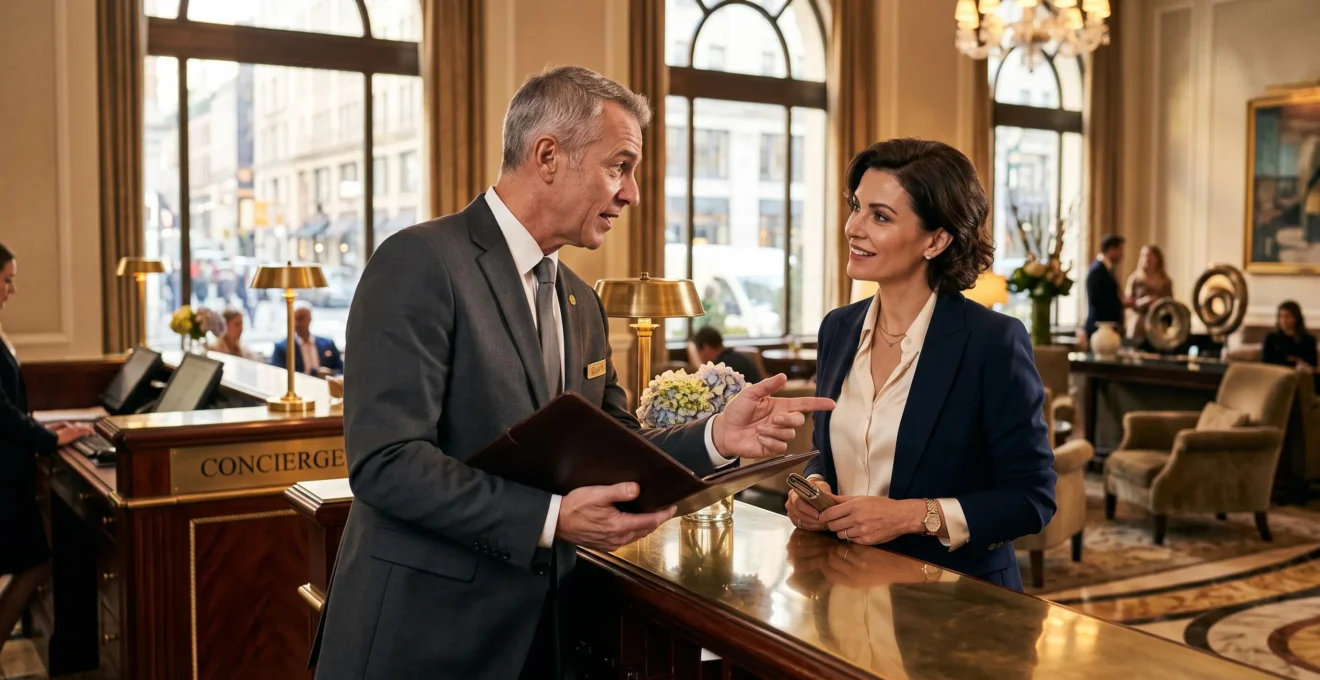
You’ve booked a magnificent hotel, ready for a special dinner or a landmark show, only to hit the digital brick wall: “Sold Out.” The common advice is to “ask the concierge,” as if they hold a magical key. Yet when you do, you often receive a polite apology or a recommendation for a different, widely available restaurant. This leaves many guests wondering whether the legendary power of the concierge is a myth from a bygone era.
The power is real, but it isn’t magic. It’s a system. Most guests fail to unlock sold-out experiences not because the concierge can’t help, but because they don’t understand how to engage the system properly. They treat the concierge desk like a customer service hotline rather than the headquarters of a master networker. The key isn’t simply asking; it’s understanding the psychology, timing, and strategy that transform a concierge from a simple guide into a dedicated partner in achieving the impossible.
This guide moves beyond the platitudes of “be polite” and “tip well.” It dissects the operational reality of a world-class concierge, explains why some guests get a shrug while others get a text confirming an 8 PM table at the city’s most coveted spot, and shows you how to reframe an impossible request into a compelling mission a great concierge will be eager to accept.
- Securing “impossible” access isn’t about asking nicely; it’s about framing your request as a strategic challenge the concierge is uniquely equipped to solve.
- Engage the concierge before arrival via a pre-arrival email — lead time is the most valuable resource in the reservation world.
- Les Clefs d’Or concierges don’t work magic; they activate a global, trust-based network that bypasses public booking channels.
- The concierge’s real value is arbitrage: time saved, risk avoided, and access to “invisible” inventory money alone can’t buy.
Why do hotel concierges recommend the same 5 restaurants repeatedly?
Hotel concierges repeat the same handful of restaurant recommendations because those venues are battle-tested partners that reliably deliver a great evening. The “top 5” is a risk-management safe bet, not a ceiling: with the right questions, a concierge will unlock a far deeper network of hidden gems and exclusive addresses.
When a guest perceives a concierge cycling through the same handful of restaurant recommendations, it’s easy to assume a lack of imagination or, worse, a commission-based arrangement. The reality is rooted in risk management and a misunderstanding of the request. A concierge’s primary duty is to guarantee a positive outcome, and the “top 5” are proven partners known for consistently delivering quality food, service, and atmosphere.
The suspicion of kickbacks is a common but largely unfounded myth in high-end hospitality. As Claude Parenteau-Rodriguez, a Les Clefs d’Or concierge, explained in an interview with Gentologie, the primary driver is the guest’s satisfaction, not financial incentives:
Restaurant suggestions are not made on the basis of rebates or commissions on bookings; it will really be a recommendation based on the customer’s expectations and requests.
– Claude Parenteau-Rodriguez, Gentologie interview with Sofitel Montréal concierge
The secret is that this initial, safe recommendation is a conversational starting point. Industry research shows that top concierges maintain networks of 50+ local contacts, encompassing hidden gems, niche eateries, and up-and-coming chefs. To access this deeper list, the guest must signal they are willing to move beyond the safe bet. Phrases like “What’s a new place you’re excited about?” or “Where do the local chefs eat on their night off?” break the script and empower the concierge to tap into their more exclusive knowledge base. It communicates that you are an adventurous partner, not just a tourist needing a reliable meal.
This same logic of a trusted, locally rooted network extends beyond hotels. In resort destinations, dedicated concierge providers apply the identical model to entire stays. Altitude Courchevel, a prestige agency in the French Alps with 30 years of local presence, builds tailored experiences — private chefs, transfers, activities, even hot-air balloon flights — through precisely the kind of established local relationships a great concierge cultivates. Whether at a front desk or across a destination, the principle is the same: deep networks, not public channels, unlock the exceptional.
How to ask concierges for help without sounding demanding?
To ask a concierge for help without sounding demanding, frame your request as a collaborative challenge — “I have a bit of a challenge for you, and I was hoping for your expertise” — rather than a demand, build rapport first with small requests, and proactively offer a Plan B.
The difference between a guest who gets results and one who gets a polite “no” often lies in their approach. The goal is to shift the dynamic from a demanding transaction to a strategic collaboration. A concierge is a problem-solver who takes professional pride in overcoming challenges. By framing your “impossible” request as a compelling mission, you invite them to become your partner. Start by building rapport with a small, easy request or a friendly chat upon arrival: this deposits “relationship equity” you can draw on later for the big ask.
When making the significant request, avoid demands. Instead, present it as a collaborative puzzle. Compare two formulations of the same need:
Same request, two outcomes: “You have to get me into this show” puts the concierge in a service-obligation position. “I have a bit of a challenge for you, and I was hoping for your expertise — if ‘The Unobtainable’ isn’t possible, we’d also be thrilled with a great chef’s counter somewhere you love” invites problem-solving and signals you respect their time.
Proactively mentioning a Plan B demonstrates that you are reasonable and understand the difficulty of the task. This collaborative spirit transforms the interaction from a service obligation into a shared goal. The concierge is no longer just serving you; they are working with you — and they become personally invested in the mission you’ve presented. While tipping is appreciated for a job well done, a genuine, respectful partnership is what inspires a concierge to attempt the extraordinary in the first place.
Your Action Plan: Phrases to Unlock Deeper Collaboration
- Build rapport first: start with a simple, friendly conversation or an easy request upon arrival to establish a human connection before “the big ask.”
- Frame as a challenge: use collaborative language like, “I have a fun challenge for you… I was hoping to get into X. What do you think is possible?” to engage their problem-solving skills.
- Offer a backup plan: proactively suggest a Plan B to show you respect their time and are a reasonable partner in the process.
- Show appreciation early: a small, early tip for a simple task like directions signals that you value their service.
- Acknowledge their expertise: say, “I’m coming to you because I know the online systems can’t do what a personal connection can,” to show you understand their unique role.
Les Clefs d’Or Golden Keys or regular concierge: does It actually matter?
For standard requests, the difference between a regular concierge and a Les Clefs d’Or member is negligible. For complex, international, or high-scarcity requests, Les Clefs d’Or membership matters decisively: members activate a global “warm network” of trusted colleagues that bypasses public booking channels entirely.
To the untrained eye, the crossed golden keys on a concierge’s lapel might seem like a mere flourish. To the initiated, they are the single most important signal of access and influence in the hotel world. Les Clefs d’Or (The Golden Keys) is not an award; it is a prestigious international association of rigorously vetted professional hotel concierges — approximately 4,000 members across 80 countries, built on personal trust.
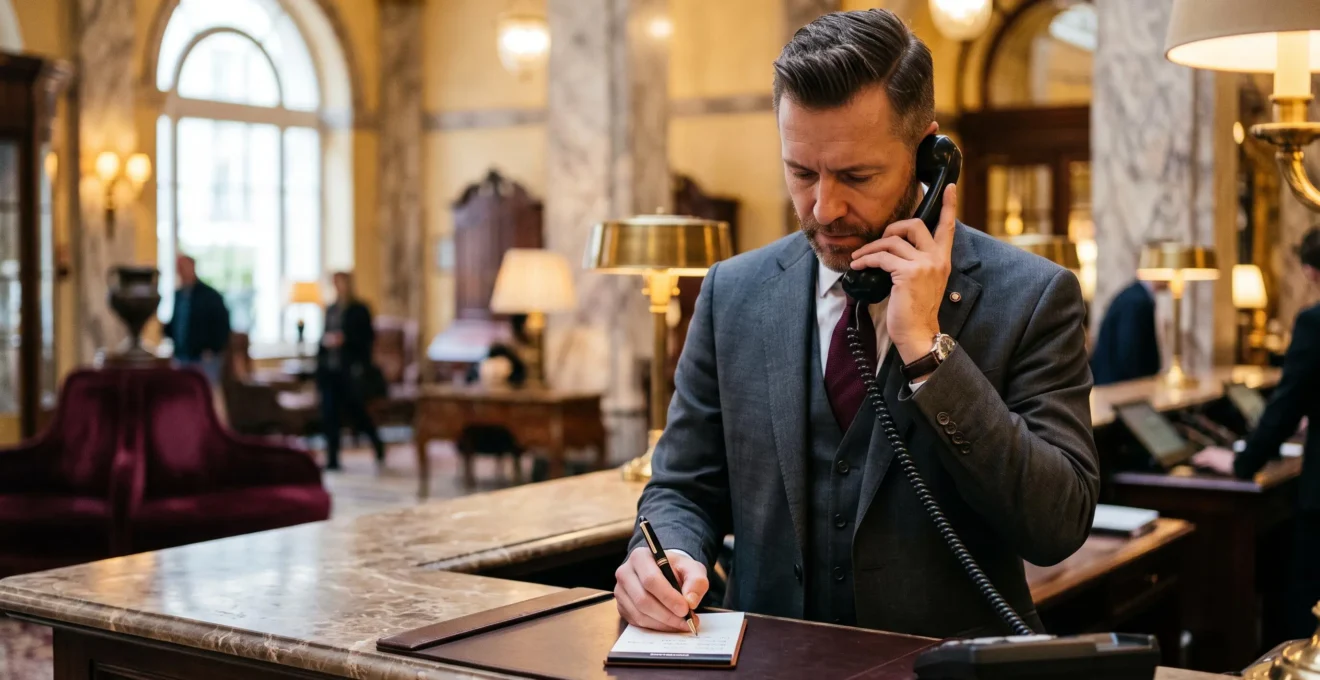
The chasm in capability appears when the request is complex, international, or involves high-scarcity access. A regular concierge must make cold calls or use public booking systems. A Les Clefs d’Or member, by contrast, doesn’t call a restaurant’s public line; they call the mobile phone of another Les Clefs d’Or member in that city, who in turn calls the personal contact of the restaurant’s general manager. It’s a chain of trusted, personal relationships that bypasses all official channels.
The following table shows when the golden keys provide a decisive advantage — and when they make little difference.
| Request Type | Regular Concierge | Les Clefs d’Or Concierge | Advantage |
|---|---|---|---|
| Standard taxi/directions | Excellent | Excellent | No meaningful difference |
| Basic restaurant reservations | Very Good | Very Good | Minimal difference |
| Sold-out venue access | Limited success | High success rate | Critical advantage via global network |
| Multi-city trip coordination | Cold outreach | Warm colleague introductions | Significant advantage |
| Exclusive local experiences | Good | Superior | Ethical recommendations, no commission bias |
| Cross-border requests | Language/network barriers | Verified global contacts | Essential advantage |
Case Study: The Multi-City Network Advantage
A guest staying at a hotel in Puerto Vallarta needs last-minute tickets for a sold-out opera in Vienna. A regular concierge would be limited to searching online ticket brokers, likely with inflated prices and questionable legitimacy. A Les Clefs d’Or concierge places a call to a fellow member at a hotel in Vienna. This Vienna-based colleague, leveraging their personal relationship with the opera house’s box office manager, can often secure “house seats” or last-minute returns that are never made available to the public. The request is fulfilled through a warm introduction within the certified network — a result money alone cannot buy.
The hierarchy is clear: the simpler the request, the less the distinction matters; the rarer and more international the access, the more decisive the golden keys become.
The after-arrival concierge request error costing you access
The most costly mistake is waiting until you’re at the concierge desk to make your most important request. Savvy travelers plant their biggest ask via a pre-arrival email about a week before check-in, giving the concierge the lead time needed to activate their network.
In the world of high-stakes reservations, the “after-arrival” approach puts you at the back of a very long queue. The savviest travelers understand that the concierge’s work begins long before they check in, and they leverage a powerful but often overlooked tool: the pre-arrival email.
Hotels invest significant resources into pre-arrival communication because it is a proven revenue driver — which means this channel is closely monitored. Research on hospitality upselling shows an almost 24% revenue increase from pre-arrival emails, and an 8.23% boost in conversion rates for offers made before check-in. As a strategic guest, you can co-opt this channel for your own mission.
Instead of using it to book a taxi, use it to plant the seed for your “impossible” request. A week before your arrival, reply to the hotel’s welcome email with a polite, well-framed inquiry:
We are so looking forward to our stay next week to celebrate our anniversary. A dream of ours has always been to dine at ‘Le Rêve’. We know it’s nearly impossible to get a table, but we were hoping to draw on your legendary expertise to see if any magic is possible for the evening of the 15th.
This approach achieves three critical objectives:
- It gives them lead time: the most valuable resource for a concierge. A week is an eternity in the reservation world, allowing them to put out feelers and call in favors without pressure.
- It shows you are a planner: it marks you as a serious, organized guest, not someone making a last-minute whim.
- It frames the request collaboratively: asking for their “legendary expertise” appeals to their professional pride.
Pre-Arrival Email Checklist
- Reply to the hotel’s welcome email about a week before arrival to maximize lead time.
- Mention the occasion (anniversary, milestone) to give the request meaning and urgency.
- Name your dream venue and date explicitly, acknowledging that it is a difficult ask.
- Frame the request as a call on their expertise, not a demand.
- Keep it polite and open-ended so the concierge has room to propose alternatives.
By the time you arrive at the hotel, the concierge has already been working on your behalf for days. You are no longer just another face in the check-in line; you are “the guest who is hoping for Le Rêve.” You have moved from the bottom of the pile to the top, simply by understanding that the game begins before you even leave home.
When does concierge access actually save you more than it costs? Choosing a hotel where it truly pays off
Concierge access pays off when the stakes are highest: the value is an arbitrage of time, risk, and hidden access that exceeds the monetary cost — but only in hotels (or providers) whose service culture genuinely empowers anticipatory, creative problem-solving.
Engaging a top-tier concierge is an investment — in the form of a tip, and in the premium paid for a luxury hotel. The return on this investment is often misunderstood. The real value isn’t about saving a few dollars; it’s about value arbitrage: gaining a return in time, experience, and risk mitigation that far exceeds the monetary cost.
Consider the hours a guest might spend researching restaurants, navigating foreign-language booking websites, and trying to vet legitimate ticket brokers from scams. A concierge condenses this multi-hour, high-risk process into a single, trusted conversation. More importantly, the concierge acts as an insurance policy against disappointment: for a milestone anniversary or a critical business dinner, the cost of a ruined evening — a bad table, a missed reservation, a tourist trap — is immeasurable, and the tip is a small premium to guarantee success.
Concierges also provide value that never appears on a bill. They don’t just get you a reservation; they get you a better table. Their relationships with brokers and season ticket holders can unlock sold-out shows impossible for an individual to secure. Skipping a two-hour museum queue, receiving a complimentary glass of champagne, or being upgraded to a quieter room with a better view are all forms of currency a great concierge dispenses.

Why standardized packages undermine the value
Hotels love selling “Romantic Getaway” packages: a bottle of mid-range sparkling wine, a trail of rose petals, and a pre-set dinner at the partner restaurant. These products offer the illusion of a special occasion without any of the substance. The true value of a luxury hotel lies in moving beyond pre-set menus toward a curated experience tailored to you, not to a marketing department’s checklist.
Case Study: Curated Narrative vs. Pre-Set Package
A couple books a standard romantic package. They receive generic chocolates and a fixed dinner reservation — pleasant, but indistinguishable from a hundred other hotels. Now consider the alternative. During a brief check-in conversation, a skilled concierge learns the couple shares a passion for modern sculpture. Instead of the package, the concierge uses their network to arrange a private, after-hours tour of a local art gallery with the curator, followed by a chef’s table at a restaurant known for its artistic plating, noting the couple’s dietary preferences. The cost difference might be minimal, but the memory value is monumental: a generic getaway became a deeply personal story.
By sharing your interests, passions, and the “why” behind your trip, you give the concierge the raw materials to build a bespoke experience. Ditching the package deal and initiating a conversation is the first step toward a genuinely unique stay.
The Concierge Litmus Test: Evaluating a Hotel Before You Book
The quality, creativity, and responsiveness of a hotel’s concierge team is the single most reliable indicator of its overall service culture. You can assess this before committing thousands of dollars by sending a “feeler” email to the concierge desks of your top 2-3 hotel choices with a specific, slightly challenging, but plausible request. The nature of the response is incredibly revealing:
- Speed: a quick response indicates a well-staffed and attentive team.
- Tone: is it corporate and scripted, or warm, personal, and engaging?
- Creativity: do they simply say “no” to a difficult request, or do they offer creative alternatives? The latter is the sign of a true problem-solver.
Beyond this test, look for external signals: the presence of Les Clefs d’Or members is the most obvious. Research reveals that properties with concierges speaking two or more languages report 43% higher satisfaction scores, indicating a hotel that understands the nuances of communication and service. A “celebrity concierge” — a head concierge featured in travel magazines — is another strong signal that management empowers its service superstars. These are the properties where unique rituals are born and nurtured.
Anticipatory service: what makes a stay unforgettable versus just expensive
Any hotel with a high enough budget can provide expensive amenities: fine linens, designer toiletries, a grand lobby. These are the table stakes of luxury. What elevates a stay is a single, elusive quality: anticipatory service — the art of meeting a guest’s needs before the guest is consciously aware of them. As hospitality expert George Polyard notes, this is the definition of a frictionless luxury experience: the guest’s only concern should be enjoying their stay. A concierge who offers an umbrella as the sky darkens, or has a preferred bottled water waiting after a workout, is practicing this art — the result of careful observation, active listening, and a culture that empowers staff to act on their intuition.
Case Study: The Human Network in a Digital World
The post-COVID era provides a stark illustration of this principle. During shutdowns, many restaurants replaced their human gatekeepers with online booking systems. Jeffrey Thoennes, a veteran concierge at New York’s iconic Carlyle hotel, found that 24 years of relationship-building had been partially nullified: 70% of his personal restaurant contacts were gone, and he spent the better part of a year rebuilding those human connections from scratch. This highlights a fundamental truth: unforgettable service is not powered by technology, but by a concierge’s resilient, personal network — relationships with chefs, maîtres d’s, and gallery owners that cannot be bought or automated.
The through-line across value, choice of hotel, and destination-based providers is the same trusted-network model already seen with Altitude Courchevel in the Alps: whether at a front desk or across a resort, true value comes from a culture that empowers creative, connected professionals — not from standardized products. This is why the most memorable luxury experiences are profoundly human: born from genuine connection and the meticulous, behind-the-scenes work of a dedicated professional who orchestrates moments of seamless delight.
Key takeaways
- Engage the concierge via a pre-arrival email a week in advance to give them the crucial gift of lead time for your most important request.
- Frame your most difficult requests as a collaborative “challenge” for their expertise, not a demand for service.
- Always look for the Les Clefs d’Or “golden keys” on a concierge’s lapel; this is your most reliable signal for a master networker capable of handling complex, international, or high-scarcity asks.
- Use the Concierge Litmus Test before booking: speed, tone, and creativity of response reveal a hotel’s true service culture.
Transform your next hotel stay from a simple transaction into a masterclass in access. Begin today by applying these principles of strategic collaboration, and you will unlock a level of service and experience you never thought possible.