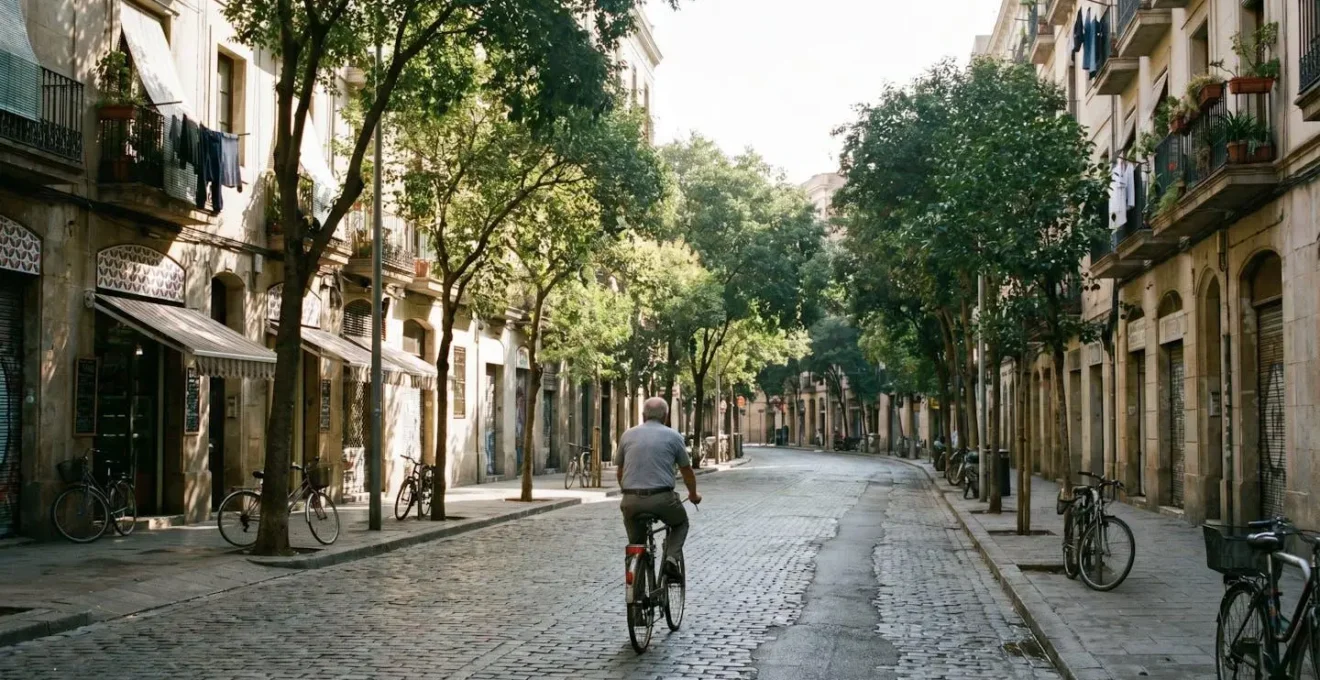
Finding an authentic bike tour isn’t luck; it’s about decoding its operational DNA before you book.
- True quality lies in verifiable details: route logic, guide-to-rider ratio, and safety policies, not just marketing promises.
- The best experiences connect you to a neighborhood’s “third places”—the real community hubs—a feature that extends from the tour to your choice of hotel.
Recommendation: Use this framework to question tour operators about distance, elevation, and group management to ensure their “leisurely” ride matches your expectations.
For the active traveller, a city bike tour promises the perfect blend of discovery and movement, a way to feel the pulse of a place from beyond a bus window. Yet, many of us return with a familiar sense of disappointment. The “hidden gem” tour felt suspiciously like a conveyor belt shuttling between the same three monuments, the “leisurely” pace was a frantic dash through traffic, and the “local culture” was a brief photo stop. The travel industry is saturated with promises of authenticity, but these often feel like a thin veneer over a standardized, commercial product.
The common advice is to “read reviews” or “go with small groups,” but these are starting points, not a strategy. The real challenge is that most travellers don’t know what to look for—the subtle clues in a tour’s description that reveal its true nature. What if the key wasn’t in trusting vague marketing slogans, but in learning to deconstruct a tour’s promises? The secret to finding a genuinely immersive cycling experience lies in understanding its operational DNA: the underlying logistics, safety protocols, and group dynamics that dictate whether a tour is engineered for deep neighbourhood discovery or just efficient landmark-hopping.
This guide provides a new framework. We will move beyond the surface and give you the tools to analyse bike tours and hotels like a sustainable tourism specialist. We’ll explore why so many tours feel the same, how to accurately gauge a tour’s physical demands, and what really separates an intimate ride from a commercial one. By understanding the ‘why’ behind the ‘what’, you can finally choose experiences that connect you to the living, breathing culture of a neighbourhood, not just its most famous facades.
Summary: A Cyclist’s Handbook to Deeper Urban Exploration
- Why Do Most City Bike Tours Cover Identical Routes?
- How to Know if a “Leisurely” Bike Tour Will Actually Exhaust You?
- 8-Person Intimate Bike Tour or 25-Person Commercial Ride: Which Experience?
- The Bike Tour Safety Equipment Reality No One Mentions
- When Do European City Bike Tours Avoid Rush Hour and Rain?
- Why Do International Hotel Chains Feel Identical Regardless of City?
- Tourist District or Residential Quarter: Where Do Real Treasures Hide?
- How to Choose Hotels That Connect You to Neighbourhood Culture?
Why Do Most City Bike Tours Cover Identical Routes?
The feeling of déjà vu is common among seasoned travellers: you book a bike tour in a new city, only to find yourself tracing a path that feels remarkably similar to the one you took in the last city. This isn’t a lack of imagination; it’s a product of powerful logistical and commercial forces. The primary driver is a combination of municipal infrastructure and safety regulations. As operators in cities like Amsterdam demonstrate, routes are meticulously planned to utilize designated bike lanes and low-traffic streets. These “safety corridors” naturally channel tours towards the same major landmarks that are equipped to handle groups, creating a well-worn path that is efficient and defensible from an insurance standpoint.
Furthermore, the commercial reality of the tourism market plays a significant role. With group and social cycling experiences representing a massive 45% of the global cycle tourism market, operators are incentivized to create products with the broadest possible appeal. This often means designing routes around a checklist of “must-see” sights that tourists expect. A tour that bypasses the Eiffel Tower or the Colosseum in favour of an obscure residential street is a harder sell. The result is a convergence towards a handful of standardized routes that are optimized for volume and marketing, even if it means sacrificing genuine neighbourhood exploration.
A truly great operator, however, works within these constraints. They use the mandatory landmark stops as anchor points in a larger narrative, weaving in detours through hidden courtyards, quiet canals, and residential quarters that lie just off the main path. The skill is in balancing regulatory demands with authentic discovery.
How to Know if a “Leisurely” Bike Tour Will Actually Exhaust You?
The word “leisurely” is perhaps the most subjective and misleading term in the bike tour industry. One person’s gentle pedal is another’s grueling ordeal. The key to avoiding exhaustion and disappointment is to look past the marketing adjectives and ask for specific, quantifiable data about the tour’s physical demands. The terrain itself is a primary factor. A flat 15km ride in Amsterdam is vastly different from a 10km ride over the hills of Lisbon. The type of surface you’ll be riding on is equally important; a long stretch of cobblestone requires significantly more effort and concentration than smooth asphalt.
To truly assess a tour’s difficulty before you book, you need to become an investigator. Don’t be afraid to contact the operator and ask a series of pointed questions. A transparent and professional company will have no problem providing these details. The frequency and duration of stops, for example, can turn a long ride into a very manageable one. Verifying that the guide will adjust the pace to the slowest rider, or that large groups are split with multiple guides, provides a crucial safety net for those concerned about keeping up.
Here is a practical checklist of questions to arm yourself with:
- Distance: Ask for the total distance in kilometers or miles (10-15km is typical for a 2-3 hour city tour).
- Elevation: Request details on hills, bridges, and overall topography. A good operator will be honest about any challenging climbs.
- Surfaces: Inquire about pavement types, specifically asking about cobblestone or unpaved sections that increase effort.
- Stop Frequency: Confirm the number and average duration of pauses for photos, water, and storytelling.
- Pace Adjustment: Verify that the guide’s policy is to match the speed of the slowest rider in the group.
- Group Management: For larger tours, check if they are split into smaller sub-groups with their own guides for better control and safety.
8-Person Intimate Bike Tour or 25-Person Commercial Ride: Which Experience?
The debate between small and large group tours often oversimplifies a complex dynamic. While it’s intuitive that a smaller group offers a more personal experience, the ‘why’ is rooted in operational logistics. A small group of 8-12 people is more nimble; it can navigate narrow alleyways, stop spontaneously at a newly discovered cafe, and fit entirely inside a small artisan shop. This flexibility is essential for the “engineered discovery” that defines a superior tour. Quality-focused operators often codify this, with some premium Amsterdam tours, for instance, setting a strict maximum of 11 persons per group to guarantee this level of intimacy and maneuverability.
In contrast, a large group of 25 riders functions more like a platoon. Its movements are slower and more deliberate, and its path is restricted to wider avenues that can accommodate its size. Spontaneity is sacrificed for the sake of control and safety. The guide’s attention is focused on logistics—keeping the group together, navigating intersections—rather than on personal interaction and storytelling. The experience inevitably becomes less about connection and more about crowd management.
However, the raw number of participants is not the only metric. The guide-to-rider ratio is arguably even more critical. As tour operations experts at BreezyTracks point out, the quality of interaction can change dramatically with staffing:
A 12-person tour with two guides can feel more personal than an 8-person tour with one guide.
– BreezyTracks Tour Operations, Small Group Tour vs Large Group Tour: Key Differences
This insight is crucial. A second guide (a “sweeper”) can manage the back of the group, handle mechanical issues, and ensure no one gets left behind, freeing the lead guide to focus on engagement. When evaluating a tour, asking about the guide-to-rider ratio can be a more revealing question than asking about group size alone.
The Bike Tour Safety Equipment Reality No One Mentions
When it comes to safety on a bike tour, the conversation almost always begins and ends with one piece of equipment: the helmet. Its importance is undeniable. Wearing a helmet is a proven lifesaver, with safety analyses confirming it can lead to a 50% reduction in the odds of head injury in an accident. Any reputable tour operator will offer well-maintained, properly-fitting helmets as a standard, non-negotiable part of their service. For travellers, the availability and quality of helmets should be a baseline expectation and a primary filter for choosing a tour.
However, the unspoken reality is that a helmet is a reactive measure—it protects you *during* a crash. A truly comprehensive approach to safety focuses just as much on proactive measures to *prevent* a crash from happening in the first place. This is where visibility comes in. A cross-sectional study of injured cyclists in two major Canadian cities revealed a critical insight: while helmet use was common, equipment like bike lights and conspicuous clothing were significantly underutilized. The research highlighted that visibility aids are crucial not just at night, but during daytime trips as well, to help cyclists stand out in a complex urban environment.
This deeper understanding of safety shifts the traveller’s focus. Instead of just asking, “Do you provide helmets?” the more sophisticated questions become: “Are the bikes equipped with front and rear lights, even for daytime tours?” “Do you offer high-visibility vests or accessories?” A tour operator that has considered these proactive elements demonstrates a more profound commitment to safety. They understand that being seen is just as important as being protected, a reality that is often overlooked in the standard safety briefing.
When Do European City Bike Tours Avoid Rush Hour and Rain?
The timing of a bike tour can fundamentally alter the experience, turning a pleasant ride into a stressful battle with traffic or a miserable, rain-soaked slog. In dense European cities, navigating peak commuter times is a major challenge. The most savvy operators design their schedules around these daily rhythms. They offer “early bird” tours that start and finish before the morning rush hour clogs the streets, providing a serene and atmospheric ride through a waking city. Conversely, “golden hour” tours in the evening take advantage of the beautiful light and calmer post-work traffic patterns.
Weather is the other great variable. A rigid “rain or shine” policy can be a red flag. While no one can control the weather, a top-tier operator has a robust contingency plan. This might include providing high-quality, breathable ponchos (not cheap plastic bags), having a modified route that incorporates more covered passages or indoor stops, or offering a flexible rescheduling or cancellation policy. Their goal is to preserve the quality of the experience, not just fulfill the booking.
The best time to ride also varies geographically. In Southern Europe, operators adapt to the intense midday heat by favouring early morning and late evening slots during the summer. In Northern Europe, the focus is more on avoiding the concentrated morning and evening commuter rushes. As a traveller, you can vet an operator’s professionalism by examining their schedule and weather policies for these signs of strategic adaptation.
- Morning Timing: Look for tours that finish before 9 AM traffic peaks.
- Evening Options: Seek tours that leverage the calmer streets and beautiful light after 6 PM.
- Weather Policy: Verify if they offer quality ponchos, modified routes, or flexible rescheduling.
- Seasonal Adaptation: Confirm schedules are adjusted for regional climate patterns (e.g., midday heat in the south).
- Booking Windows: Note that prime slots on weekends and holidays fill fast, often with 24-hour cancellation policies.
Why Do International Hotel Chains Feel Identical Regardless of City?
The disorienting feeling of waking up in a hotel room in Rome that could just as easily be in Singapore or Chicago is a hallmark of the global hotel industry. This phenomenon is not an accident; it is the direct result of a core business strategy built around brand standards. These are meticulously detailed rulebooks that dictate nearly every aspect of the guest experience. As a SafetyCulture analysis notes, these standards are all-encompassing: they cover “design, service, amenities, and even the ambiance to create a cohesive brand image that resonates with guests.” The goal is to deliver a predictable, reliable, and uniform product, no matter where in the world the property is located.
This consistency is a key part of the value proposition for many travellers, particularly business travellers who prize efficiency and predictability above all else. For the brand, it’s about quality control and brand equity. To ensure these standards are met, franchisors employ systematic and rigorous brand audits. Research into international hotel franchise networks shows how these audits are used to enforce franchisee compliance with global standards, directly impacting customer satisfaction and brand value. This process is so crucial to the business model that it often prioritizes global uniformity over local cultural expression.
The consequence for the active traveller seeking neighbourhood connection is a sterile environment. The lobby is designed as a transient space, not a community hub. The art is corporate, not local. The breakfast buffet features the same international items everywhere. While this model guarantees a certain level of quality, it does so by creating a hermetically sealed bubble that isolates guests from the very neighbourhood culture they may have travelled so far to experience.
Key takeaways
- Deconstruct the DNA: To find a great tour, analyze its operational details—route, group size, safety—not just its marketing.
- Hunt for “Third Places”: The true heart of a neighborhood is in its community anchors, like local cafes and markets, not just its tourist sights.
- Apply the Same Lens to Hotels: A hotel’s connection to its neighborhood is revealed in its lobby design, local partnerships, and community events.
Tourist District or Residential Quarter: Where Do Real Treasures Hide?
The greatest travel treasures are rarely monuments or museums; they are the moments of authentic human connection and the discovery of a place’s living culture. These moments don’t happen in the curated tourist districts, but in the residential quarters, specifically within what sociologist Ray Oldenburg famously termed “third places.” These are the spaces where a community’s informal public life unfolds, distinct from the first place (home) and the second place (work). They are the anchors of a neighbourhood’s social fabric.
Third places are anchors of community life and facilitate and foster broader, more creative interaction—where you relax in public, encounter familiar faces and make new acquaintances.
– Ray Oldenburg, The Great Good Place
For a traveller, identifying and visiting these third places—the neighbourhood coffee shop where locals debate politics, the small park where families gather, the independent bookstore with a talkative owner, or the bustling local market—is the fastest way to connect with the genuine spirit of a city. These are the places a great bike tour should be designed to reveal. But how can a visitor distinguish a genuine third place from a tourist-oriented facsimile?
Urban design studies provide tangible clues. Research on Main Streets in Massachusetts found that authentic third places have distinct physical qualities. They exhibit high levels of personalization (unique signage, decor, and a recognizable character) and permeability to the street. The most crucial design elements contributing to sociability were provisions for seating and shelter, inviting people to linger rather than just transact. When on a tour or exploring on your own, look for these signs: benches outside a shop, an open garage door on a workshop, or a cafe with tables spilling onto the sidewalk. These are the markers of a place that is integrated into the life of its community.
How to Choose Hotels That Connect You to Neighbourhood Culture?
Escaping the sterile uniformity of global hotel chains requires a conscious shift in what you look for in accommodation. It’s about seeking out hotels that see themselves not as isolated entities, but as integral parts of their neighbourhood. Some hotel groups build their entire brand around this philosophy. A prime example is Rosewood Hotels & Resorts, who famously manage a “collection” rather than a chain, a strategy that embraces unique local design over rigid, imposed standards. This approach signals a fundamentally different priority: connection over consistency.
For the traveller, spotting these genuinely integrated hotels involves looking for evidence that they function as a “third place” for their community, not just a “first place” for their guests. The lobby is the first and most important clue. Is it a vibrant, multi-use space with a coffee bar, co-working areas, or local art exhibitions that attract residents? Or is it a silent, formal waiting area? A hotel that actively welcomes the neighbourhood into its public spaces is one that understands and values its local context.
This ethos of connection should be visible across the hotel’s operations. Do they celebrate their staff’s local roots? Do they host events like farmers’ markets or local musician nights? Are their suppliers local artisans or generic national distributors? Answering these questions provides a clear picture of a hotel’s commitment. To help you in this audit, use the following action plan to assess a potential hotel’s neighbourhood connection.
Your Action Plan: Auditing a Hotel’s Neighbourhood Connection
- Points of Contact: Review the hotel’s website (About Us, Events pages), social media feeds, and guest reviews for clues about community involvement.
- Lobby Functionality: Examine photos of the lobby. Does it look like a vibrant community hub (cafe, co-working, art) or a sterile waiting room?
- Event Calendar & Partnerships: Check for a public event calendar. Do they host local markets or artists? Look for named local businesses they partner with (e.g., coffee, baked goods, toiletries).
- Staff & Ethos: Look for concierge profiles highlighting local expertise or an “About Us” section that talks about hiring from the community and supporting local causes.
- Plan for Integration: Based on your audit, decide if the hotel is a bubble or a bridge. Choose the bridge to ensure your stay enriches both your trip and the local community.
By applying this analytical lens, you move from being a passive consumer of accommodation to an active curator of your travel experience. You choose to stay in places that don’t just house you but connect you.
Start applying this framework on your next trip. Question the promises, look for the operational proof, and choose the bike tours and hotels that act as bridges to genuine neighbourhood culture, not bubbles that isolate you from it.