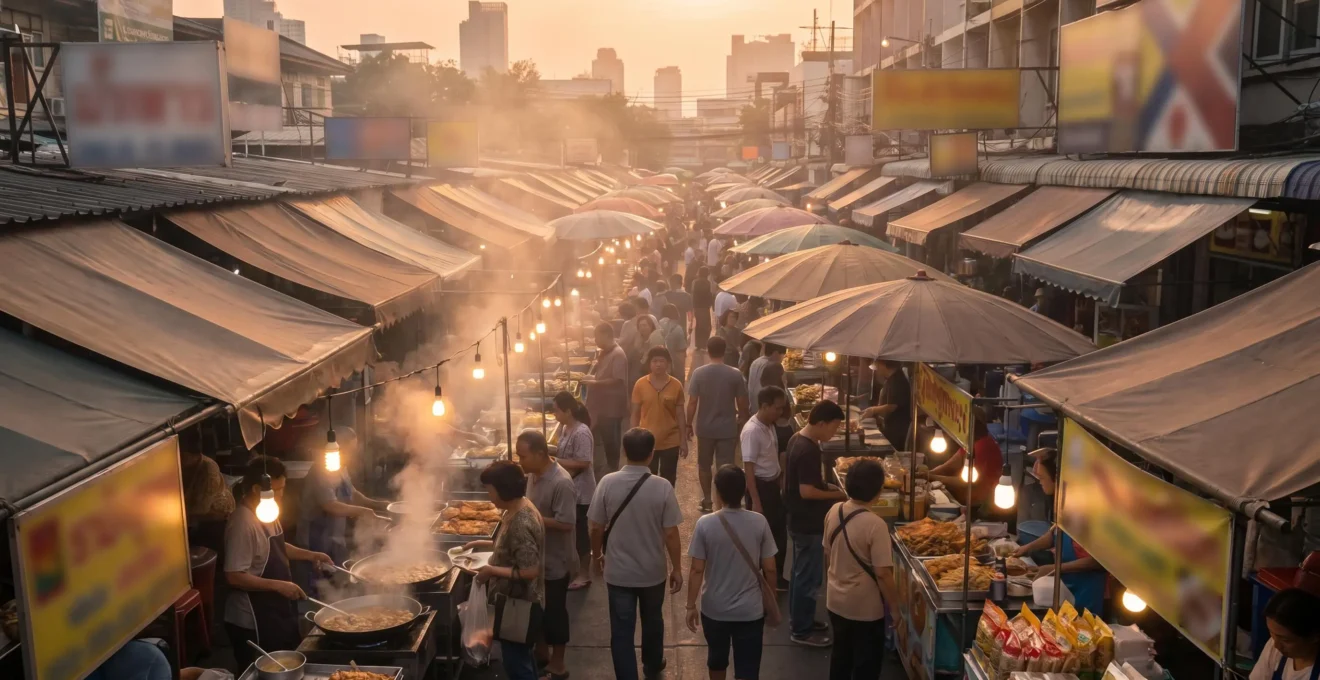
The allure of Bangkok’s street food is undeniable—the sizzle of a hot wok, the fragrant steam of lemongrass and chili, the promise of the most authentic Pad Thai you’ve ever tasted. Yet, for the first-time visitor, this excitement is often shadowed by a nagging fear. Whispers of “Bangkok Belly” and cautionary tales from fellow travelers can turn a culinary dream into a source of anxiety. This fear isn’t entirely unfounded; a prospective study by BNH Hospital Bangkok found the cumulative incidence of Travelers’ Diarrhea among foreign travelers in Thailand could reach 33.0% after 28 days in the country.
Conventional advice often presents a list of rigid prohibitions: “don’t eat this,” “avoid that.” This approach, while well-intentioned, strips the joy and spontaneity from one of travel’s greatest pleasures. It treats the traveler as a passive victim of circumstance rather than an active, intelligent participant. The truth is that millions of Thais eat this food daily without issue, not because they have iron stomachs, but because they intuitively understand a system of signals that tourists often miss.
This guide rejects the notion of a fearful checklist. Instead, it will equip you with a new framework—a consultant’s mindset for navigating the vibrant chaos of the street food scene. We will move beyond the platitudes to understand the underlying principles of food safety in this unique environment. You will learn not just *what* to look for, but *why* it matters, transforming you from a worried tourist into a confident connoisseur who can decode the market’s subtle language of safety and quality.
This article provides a complete system, from understanding the science behind safe stalls to mastering the local etiquette that enhances your experience. Explore the sections below to build your confidence and prepare for an unforgettable culinary journey.
Summary: A System for Safely Navigating Bangkok’s Street Food Scene
- Why Do Busy Thai Street Stalls With Queues Cause Fewer Stomach Problems?
- How to Explain Allergies in Thai Markets When Vendors Speak No English?
- Bangkok Night Markets or Day Markets: Which Offer Better Value?
- The Thai Market Bargaining Error That Doubles Your Prices
- When Do Bangkok’s Hotel District Street Markets Actually Set Up?
- Why Do International Hotel Chains Feel Identical Regardless of City?
- How to Map Your Hotel’s 15-Minute Walk Circle for Hidden Finds?
- How to Find Neighbourhood Treasures Hotels Never Mention?
Why Do Busy Thai Street Stalls With Queues Cause Fewer Stomach Problems?
The most common piece of advice—”look for a busy stall”—is often repeated but rarely explained. The reason it’s the golden rule of street food safety lies in a powerful combination of thermodynamics and social proof, a concept we can call the socio-thermal signal. A long queue of locals is not just a sign of popularity; it’s a visible indicator of high “food velocity.” This means ingredients are being replenished constantly, and cooked food is served almost immediately, never sitting around for long. This rapid turnover is your number one defense against foodborne illness.
Scientifically, this is crucial because it prevents food from lingering in the “danger zone.” According to the USDA, bacteria multiply rapidly between 4°C and 60°C, potentially doubling in number every 20 minutes. The high heat of a wok or grill, often exceeding 200°C, effectively sterilizes the food. A busy stall ensures the time between this sterilization and consumption is minimal. The visible steam, the sound of sizzling, and the rapid-fire cooking are all parts of this protective thermal process.
Furthermore, the social proof of a local queue is a rigorous, real-time quality control system. These are repeat customers who would not return to a vendor that made them sick or served substandard food. Their continued patronage is a testament to the vendor’s consistent quality and hygiene. This local trust is far more reliable than any tourist-facing review. In fact, the overall system is remarkably effective; research shows that 98% of food samples in Bangkok passed biological testing during 2019-2023, confirming that when you follow the local cues, the food is overwhelmingly safe.
This intense, high-heat cooking process, visible at a busy stall, is a key safety feature. The constant motion and high turnover mean ingredients are fresh, and the food spends virtually no time at temperatures where bacteria can thrive. Watching the vendor is like watching a safety procedure in action.
Therefore, when you choose a stall, you aren’t just picking a meal; you are actively looking for the strongest socio-thermal signal. The queue is your proof of trust, and the searing heat is your guarantee of safety.
How to Explain Allergies in Thai Markets When Vendors Speak No English?
For travelers with food allergies, the language barrier in a bustling Thai market can transform a culinary adventure into a high-stakes health risk. Gesturing and pointing can only go so far, and a simple misunderstanding about an ingredient like peanuts, shellfish, or gluten can have serious consequences. Relying on translation apps can be risky due to a lack of context or connectivity. The most effective strategy is to bypass verbal communication entirely and use a clear, concise, and universally understood visual tool: a customized allergy card.
Creating this card is a crucial pre-trip preparation step. It’s not just about writing “I am allergic to nuts”; it’s about creating an unambiguous message that a busy vendor can understand in seconds. The card should be your first line of defense. When you approach a stall, before even attempting to order, you present the card with a polite smile. The vendor can quickly glance at it and give you a clear “yes” or “no” nod, or point to safe items. This removes guesswork and puts both you and the vendor at ease.
This method is respected and understood, as it shows you have taken your condition seriously and made an effort to communicate it clearly. It is far more effective than trying to shout an English word over the noise of the market. Below is a practical plan to create a card that is both durable and highly effective in a real-world market setting.
Action Plan: Creating an Effective Allergy Communication Card
- Include the Thai script for your specific allergen written in large, clear letters to ensure accurate local understanding.
- Add a high-resolution color photograph of the actual ingredient you must avoid; a picture of a peanut is more universal than the word.
- Place a prominent red circle with a diagonal slash (the universal ‘NO’ symbol) over the image for immediate recognition.
- Laminate the card to make it waterproof and durable enough to withstand the heat, humidity, and potential splatters of market conditions.
- Keep multiple copies easily accessible: one in your wallet, one in your phone case, and another in your day bag so you are never without it.
Ultimately, a well-made allergy card is not just a piece of paper; it’s a passport to a safer and more enjoyable culinary experience, allowing you to explore with peace of mind.
Bangkok Night Markets or Day Markets: Which Offer Better Value?
A common question for visitors is whether to focus their culinary explorations on Bangkok’s daytime markets or its vibrant night markets. While both offer incredible experiences, they serve different purposes and clientele, leading to a clear difference in “value.” The best choice depends on whether your priority is authentic local pricing or a lively, tourist-friendly atmosphere. Day markets are the engine of local life, catering to office workers and residents. Here, prices are at their lowest, and the food is uncompromisingly authentic. You are eating what Thais eat for lunch, at the price they pay.
Night markets, in contrast, are often a blend of dining and entertainment. They cater to a mix of tourists and locals seeking a social evening out. While the food is still excellent, the prices are moderately higher, and the offerings may be slightly tweaked to appeal to an international palate. However, they offer better spoken English and a festive, accessible atmosphere. From a food safety perspective, night markets have a slight edge as the cooler evening temperatures are less conducive to bacterial growth than the heat of the day. As Johnny Africa from The Ultimate Bangkok Street Food Guide notes:
Most of the food in Thailand is cooked with extremely high heat being seared on a wok which ensures that germs are fried away.
– Johnny Africa, The Ultimate Bangkok Street Food Guide
This high-heat cooking is a constant in both market types, but the ambient temperature difference is a factor. The following table breaks down the key differences to help you decide where to invest your time and appetite.
This comparative analysis, based on a deep understanding of the city’s rhythms, shows a clear trade-off between authenticity, price, and convenience as detailed in guides for savvy travelers.
| Factor | Day Markets | Night Markets |
|---|---|---|
| Primary Clientele | Local residents, office workers | Mix of tourists and entertainment-seeking locals |
| Price Range | Lower (10-40 baht per dish) | Moderate (30-80 baht per dish) |
| English Spoken | Minimal to none | Basic to conversational |
| Food Safety Temperature | Higher risk: food sits in daytime heat (30-35°C) | Lower risk: cooler evening temperatures (25-28°C) |
| Best Value For | Fresh produce, groceries, authentic local dishes | Ready-to-eat meals, atmosphere, social experience |
| Operating Hours | 6 AM – 2 PM | 5 PM – midnight |
For the absolute best monetary value and a truly local experience, day markets are unbeatable. For a fun, easy, and atmospheric introduction to street food, night markets provide fantastic value in terms of experience and convenience.
The Thai Market Bargaining Error That Doubles Your Prices
Many travel guides mention that bargaining is a part of the market experience in Thailand. This is true, but it comes with a critical cultural nuance that many tourists miss. The common Western approach to haggling—treating it as a confrontational, zero-sum game to get the lowest price possible—is the single biggest error you can make. Aggressive or lowball offers (like starting at 50% of the asking price) are seen as disrespectful and insulting. This approach doesn’t get you a better deal; it often results in the vendor shutting down, refusing to sell, or even quoting a higher “tourist price” to the next person to make up for the unpleasant interaction.
In Thailand, the concept of “sanuk” (fun) permeates many aspects of life, including commerce. Successful bargaining is a lighthearted, friendly interaction, not a battle. A smile, a respectful “wai” (a slight bow with hands together), and a pleasant tone are your most powerful negotiating tools. As the Thailand Routes Cultural Guide advises, “Bargaining is common in markets but should be done politely. Smiling and friendliness often lead to better deals.” The goal is not to “win,” but to arrive at a price that feels fair to both you and the vendor, maintaining mutual respect.
Crucially, this entire practice applies only to goods like clothing, souvenirs, and handicrafts. You never bargain for street food. Food prices are fixed and are already incredibly low. Attempting to haggle over a 40-baht bowl of noodles is a major cultural faux pas that will mark you as an uninformed and disrespectful tourist. Understanding this distinction is key to navigating the markets gracefully.
The correct approach is a gentle dance of mutual respect. It’s about showing you appreciate the item and the vendor’s livelihood, while politely asking if a small discount is possible, especially when buying multiple items. This respectful approach is far more effective and enjoyable for everyone involved.
Ultimately, saving 20 baht through aggressive haggling is a hollow victory if it comes at the cost of goodwill and a positive cultural exchange. The best “deal” is one that ends with both parties smiling.
When Do Bangkok’s Hotel District Street Markets Actually Set Up?
One of the most disorienting things for a first-time visitor is the seemingly magical appearance and disappearance of street markets. A street that was empty and quiet at 10 AM can become a bustling hub of dozens of food stalls by noon, only to vanish again by 3 PM. This is not random; it’s a highly organized system tuned to the rhythms of local life. Understanding this daily ebb and flow is key to finding the best food and having the most authentic experience. The markets are not there for tourists; they are there to serve the local workforce, and their timing reflects that.
The day is typically divided into two main waves: the lunch rush and the evening/night wave. The lunch rush (approx. 11 AM – 1 PM) is when you’ll find the highest density of vendors, particularly those serving classic lunch dishes like noodle soups and rice with curry. This is when office workers flood the streets, and the “food velocity” is at its peak. Conversely, the mid-afternoon (2-4 PM) is a lull; many vendors pack up and go home, making it the worst time to look for food but the best time for a quiet reconnaissance walk.
The evening wave brings a completely different set of vendors and a different atmosphere, shifting from a functional lunch service to a more social dinner and late-night snack scene. This is when you’ll see more grilled skewers, seafood, and dessert carts appear.
Case Study: The Sam Yan Breakfast Market Timing Strategy
The Sam Yan breakfast market perfectly illustrates the importance of timing. Operating from 6 AM, the peak quality and freshest food are found between 7-9 AM when crowds are busiest. This timing ensures maximum turnover, meaning ingredients are at their freshest and vendors maintain the highest standards. Visiting during this window guarantees you experience the market as it’s intended, with a full selection of Thai and Chinese-style breakfast dishes. Arriving after 10 AM means you’ll find a diminished selection and food that has been sitting longer, increasing food safety risks and missing the vibrant energy of the morning rush.
By learning to read this daily schedule, you can anticipate where and when the best food will appear, rather than wandering aimlessly and hoping to get lucky. You can plan your day to be at the right place at the right time, catching the peak of each wave.
Instead of chasing the markets, you let them come to you, arriving with the confidence of a local who knows exactly when their favorite noodle cart is about to set up.
Why Do International Hotel Chains Feel Identical Regardless of City?
After a day of navigating the vibrant, unpredictable, and sometimes chaotic streets of Bangkok, stepping back into the lobby of an international hotel chain can feel like entering another world. The air conditioning is crisp, the surfaces are polished, and everything—from the scent in the lobby to the font on the room service menu—is comfortingly familiar. This feeling of sameness is not an accident or a lack of imagination; it is the core product. This consistency is a meticulously engineered feature designed to deliver one thing: predictability.
For many travelers, especially those on business or those who are more cautious, this predictability is invaluable. It eliminates variables and reduces the cognitive load of being in a new and foreign environment. You don’t have to wonder if the bed will be comfortable, if the Wi-Fi will work, or if the breakfast will be safe. You know it will be, because it’s the same as it was in Berlin, New York, or Dubai. The hotel isn’t just selling a room; it’s selling the absence of unpleasant surprises.
This strategy is what one industry analysis astutely calls a “Risk-Reduction Product.” It’s a bubble of standardization that provides a safe, comfortable, and utterly reliable home base from which to explore the “real” city.
Standardization as a ‘Risk-Reduction Product’: The hotel isn’t selling a room, it’s selling predictability. For a global business traveler or a cautious tourist, knowing the bed, bathroom, and breakfast will be exactly the same in Bangkok as in Berlin is a feature, not a bug.
– Hospitality Industry Analysis, Understanding Hotel Standardization Strategy
The trade-off for this risk reduction, of course, is a lack of local character and soul. The hotel isolates you from the very culture you came to experience. It provides physical comfort at the expense of authentic connection. The generic hotel restaurant will never rival the flavour of a local-approved street stall, and the concierge’s recommendations are often limited to sanitized, tourist-tested venues.
The savvy traveler, therefore, learns to use the hotel as a strategic asset—a safe and comfortable base—but understands that the real treasures of the city lie just outside its perfectly polished, predictable doors.
How to Map Your Hotel’s 15-Minute Walk Circle for Hidden Finds?
The single greatest barrier to discovering authentic local food is the bubble created by your hotel. Concierges often recommend tourist-friendly (and overpriced) restaurants, and the immediate vicinity is frequently designed for visitor convenience, not local life. The key to breaking out is to systematically explore your own neighborhood. The most effective way to do this is by defining and mapping your 15-minute walk circle—a radius of roughly one kilometer around your hotel that is easily explorable on foot.
This isn’t just about aimless wandering. It’s a strategic reconnaissance mission you can conduct from your hotel room before you even step outside. By using free digital tools like Google Maps, you can transform from a passive tourist into a neighborhood analyst. Instead of searching for “restaurants,” you’ll learn to search for “local anchor points”—the places that dictate the rhythm of daily life for residents, not tourists. Food stalls and authentic eateries cluster around places where locals congregate: office buildings at lunchtime, banks, pharmacies, and the ubiquitous 7-Eleven stores.
The real power of this technique comes from using Street View to “virtually walk” the streets within your circle. You can scout for the physical signs of street food life: the carts, the plastic stools, the cooking equipment. This allows you to identify promising zones and even specific stalls before you’ve spent a single minute walking in the heat. It turns exploration from a game of chance into a targeted search, maximizing your chances of finding a hidden gem that no hotel guide will ever mention.
Action Plan: The Three-Layer Digital Mapping Technique
- Layer 1 – Radius Mapping: Open Google Maps, drop a pin at your hotel, and use the ‘measure distance’ tool to draw a 1km (approx. 15-minute walk) radius circle around your location. This is your exploration zone.
- Layer 2 – Local Anchor Points: Within the circle, search for non-tourist indicators like ‘pharmacy’, ‘bank’, ‘office building’, or ‘7-Eleven’. Food stalls naturally cluster around these hubs of local daily life.
- Layer 3 – Virtual Reconnaissance: Use Street View to ‘virtually walk’ the main roads and, more importantly, the side sois (alleys) near your anchor points. Look for visible food carts, cooking equipment, and vendor setups.
- Time-Sensitive Mapping: If the Street View data allows, check images from different times of day. A location can be an empty sidewalk at 10 AM and a bustling food hub at noon.
- Sensory Validation: On your first physical walk, trust your senses. Follow the smells of charcoal, frying garlic, and broth, and listen for the sounds of chopping and sizzling—these are often more reliable than any digital map.
By methodically mapping your 15-minute circle, you pierce the tourist bubble and empower yourself to discover the authentic neighborhood treasures that are hiding in plain sight, just beyond the hotel’s front door.
Key Takeaways
- True street food safety comes from actively reading signals like stall busyness (“food velocity”) and cooking methods, not from a passive list of foods to avoid.
- Your best guides to authentic, safe, and high-value food are Bangkok’s local workers; follow the office uniforms at lunchtime for a guaranteed good meal.
- Use your hotel as a safe base, but break out of the tourist bubble by systematically mapping and exploring the 1km “walk circle” around you to find neighbourhood gems.
How to Find Neighbourhood Treasures Hotels Never Mention?
Once you’ve stepped outside your hotel and mapped your 15-minute circle, how do you distinguish a truly exceptional street food stall from a mediocre one? The answer is simple and profound: you outsource the decision to the local experts. You don’t need to read a single review or consult a guidebook. You just need to learn the “Follow the Uniforms” golden rule. The most discerning, time-poor, and budget-conscious food critics in Bangkok are its office workers, nurses, bank tellers, and delivery drivers. Their daily lunch choice is a vote for the best quality, value, and hygiene in the area.
This heuristic is far more reliable than looking for other tourists. A stall popular with foreigners might have good marketing or a mention in a blog, but a stall with a queue of people in identical company polo shirts has something better: the trust of a local, repeat clientele. These customers eat there daily or weekly. They cannot afford to get sick, and they know every option in the area. Their presence is the ultimate seal of approval.
The strategy is simple. Position yourself near a large office building, hospital, or bank just before noon. Watch where the groups of uniformed employees go. Follow them. This is not about being sneaky; it’s about being observant. They will lead you to the neighbourhood’s hidden-in-plain-sight treasures—the stalls that have perfected their single dish over years, the vendors who know their customers by name. Another powerful indicator is the 7-Eleven proximity principle: unassuming stalls located directly next to or across from a 7-Eleven are often serving the constant stream of locals stopping for daily necessities, guaranteeing high turnover and authenticity.
Case Study: The Success of Song Wat Road and Bangrak
Areas like Song Wat Road and the streets of Bangrak exemplify the ‘follow the uniforms’ principle. During lunch hours, these streets fill with workers from the nearby financial district. The stalls here thrive not on one-time tourist traffic, but on the daily loyalty of these discerning locals. Their survival depends on rigorous hygiene and consistent quality. This strategy is validated by long-term residents and savvy travelers alike, many of whom note that by sticking to stalls beloved by locals, they have enjoyed years of street food without a single issue, proving the reliability of this local-led approach to food safety.
Stop looking for food and start looking for people. The uniforms will guide you to an authentic culinary experience that no hotel concierge could ever recommend. It’s the ultimate travel hack for eating your way through Bangkok with confidence.