True hotel romance isn’t a checklist of luxury features, but a psychological experience born from shared discovery and intentional design.
- The most romantic hotels create a “psychological threshold,” making you feel you’ve entered a private world together.
- Authenticity is not about aesthetics for Instagram; it’s about genuine character and unique rituals that become part of your story.
Recommendation: Stop searching for features and start learning to spot the signals of “engineered intimacy” to find a hotel that feels like it was chosen just for you.
Planning a romantic city break is an act of profound optimism. You envision whispered conversations in a charming café, getting lost in winding alleyways, and returning to a hotel that feels like a secret haven. Yet, as a travel curator for over 15 years, I’ve seen countless couples fall into a common trap. They meticulously create a checklist: five stars, a king-sized bed, a central location, maybe a bathtub for two. They book a highly-rated hotel, only to arrive and find it feels anonymous, sterile, and ultimately… unromantic. The magic they hoped for never quite materializes, lost in a sea of generic luxury.
The problem is that we’ve been taught to equate romance with a list of amenities. We scour photos for visual cues and assume that a high price tag guarantees a special atmosphere. But what if that’s entirely wrong? What if the most powerful romantic elements are invisible to a casual glance? The true art of a romantic hotel lies not in its features, but in its ability to manipulate space, time, and psychology to create a cocoon of intimacy for two people. It’s about feeling like the main characters in a story, not just another pair of guests.
This guide will pull back the curtain on hotel romanticism. We won’t be making a list of the “Top 10 Hotels in Paris.” Instead, I will teach you the principles of atmospheric design. You’ll learn why a small hotel on a quiet canal can feel more luxurious than a five-star palace, how to spot genuine charm from manufactured cuteness in under three minutes, and how to identify the unique hotel rituals that transform a simple stay into a core memory. Forget the checklist; it’s time to learn how to feel the difference.
Summary: Decoding the Essence of a Romantic Hotel Experience
- Why Do Canal-Side Hotels Feel More Romantic Than City Centre Chains?
- How to Spot Authentically Romantic Hotels in Under 3 Minutes?
- Boutique Intimacy or Five-Star Luxury: Which Delivers Real Romance?
- The Package Deal Trap That Ruins 60% of Romantic Getaways
- When Do Romantic City Hotels Offer Peak Atmosphere: Seasons That Matter?
- Why Do Photogenic Boutique Hotels Feel Cold in Person?
- How to Find Luxury Hotels With Unique Rituals You Can’t Get Elsewhere?
- How to Identify Truly Charming Hotels Versus Manufactured Cuteness?
Why Do Canal-Side Hotels Feel More Romantic Than City Centre Chains?
The answer has less to do with the water and more to do with psychology. A massive city-centre hotel, with its sprawling lobby, multiple elevators, and endless corridors, can subconsciously trigger a feeling of being small and anonymous. You are one of hundreds. The experience, however luxurious, is public. A canal-side hotel, by contrast, often creates what designers call a “psychological threshold.” The moment you step off the bustling street, cross a small private bridge, and enter a quiet, human-scaled lobby, you’ve passed from the public world into a shared private one. This transition is a powerful romantic primer.
This intimate scale changes your behaviour. You’re not navigating a complex; you’re coming home. This feeling of control and privacy is crucial. As noted by a foundational study on the psychology of atmosphere, even in pleasant environments, a perceived loss of control can trigger anxiety. A smaller hotel gives you that sense of control and ownership over your space. It’s no surprise that research on canal-side accommodations reveals that couples who stay along Amsterdam’s canals spend up to 35% more time exploring on foot, fostering a slower, more connected pace of discovery.
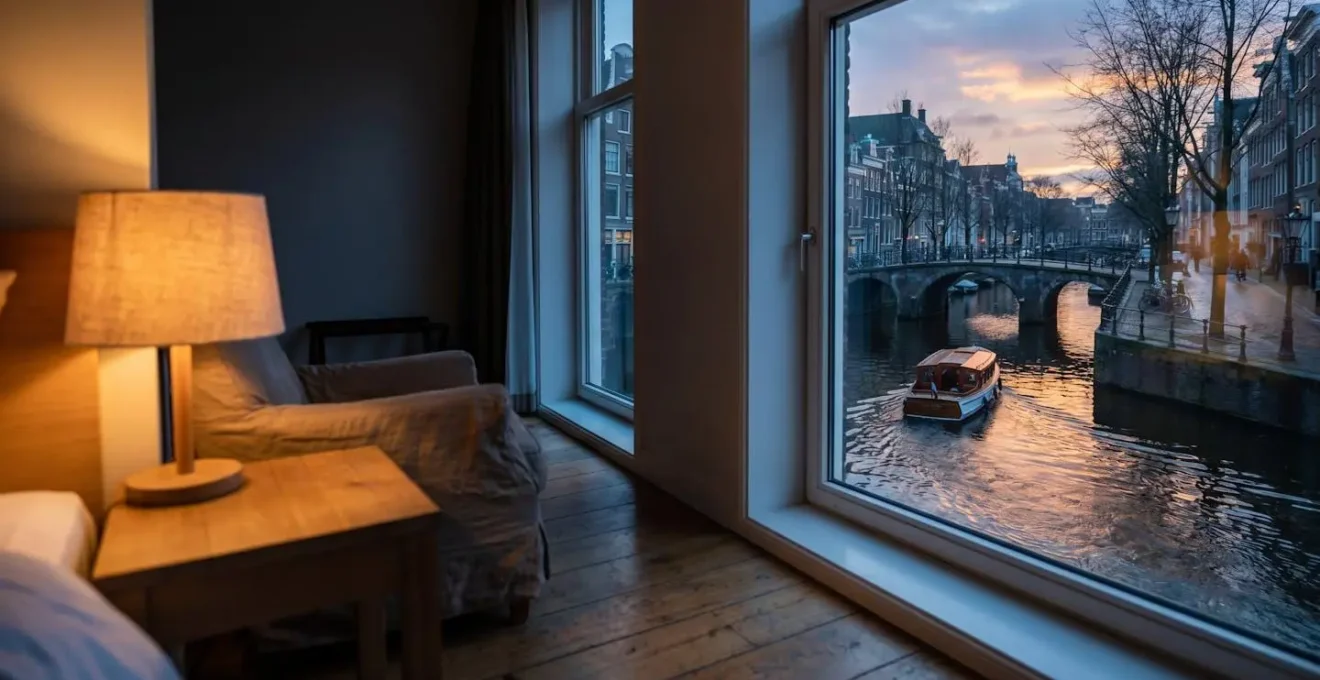
This image perfectly captures that threshold moment. The hotel isn’t a building; it’s a destination at the end of a private journey. The warm light promises sanctuary and separates you from the rest of the world. In contrast, a chain hotel’s entrance is often a revolving door—efficient, but devoid of this crucial psychological transition. The romance of a canal-side hotel begins before you even check in; it begins the moment you feel the world shrink to just the two of you.
How to Spot Authentically Romantic Hotels in Under 3 Minutes?
Now that you understand the feeling you’re chasing, how do you find it in a sea of professionally staged photos and glowing-but-vague reviews? You learn to look for “authenticity signals.” In an era of manufactured experiences, genuine character is the ultimate luxury. It’s not just a preference; it’s a deep-seated need. For instance, a Skift Research survey found that 82 percent of travelers feel that connecting with local culture is vital to their travel fulfillment. An authentic hotel is a gateway to that connection, not a barrier from it.
Authenticity isn’t about having old furniture; it’s about having a soul. It’s the difference between a hotel that has a story and a hotel that has a marketing team. To spot it, you need to become a detective, scanning for clues that reveal the hotel’s true nature. This process shouldn’t take hours. With the right framework, you can get a strong sense of a hotel’s authenticity in the time it takes to brew a cup of coffee. The key is to know exactly what you’re looking for.
Your 3-Minute Authenticity Audit
- Scan Reviews for Emotion: Ignore generic praise like “great service.” Search for keywords like “remembered,” “anticipated,” “genuine,” or “felt like.” Are staff mentioned by name? This signals proactive empathy over scripted politeness.
- Analyze the “Experiences” Tab: Is it a generic “city tour” link, or does the hotel offer something unique they’ve curated themselves? Look for partnerships with local artisans, private after-hours museum access, or a cooking class with the chef. This shows a real connection to place.
- Read the “About Us” Story: Is it corporate-speak about “excellence,” or is it a personal story about the family who owns it, the history of the building, or the passion of the designer? A real story is a strong signal of intentional design and heritage.
- Examine the Photos for Life: Look past the perfect bedspread. Are there books on the shelves? Fresh flowers that look real? A half-full bottle of whiskey on the bar? Signs of life, however staged, suggest an environment designed for living, not just for photography, creating a sense of psychological escapism.
- Check for Personal Recognition: In guest photos or reviews, do you see evidence of small, thoughtful gestures? A handwritten welcome note, a custom recommendation based on a guest’s stated interest, a complimentary treat from a local bakery. This demonstrates that the hotel values guests as individuals, a key part of personal acknowledgment.
Boutique Intimacy or Five-Star Luxury: Which Delivers Real Romance?
This is one of the most common dilemmas couples face, and it’s based on a false premise. We assume “boutique” automatically means intimate and “five-star” means impersonal. The truth is, either can be intensely romantic or disappointingly cold. The defining factor is not the star rating or the room count, but what I call “engineered intimacy.” This is the hotel’s conscious effort to use its resources—be they vast or modest—to foster connection between its guests.
A five-star luxury hotel has incredible resources. The question is how they use them. A romantic five-star doesn’t just offer you a bigger room; it uses its staff-to-guest ratio to provide hyper-personalized service. The concierge doesn’t just book you a restaurant; they remember you love modern art and secure tickets to a small gallery opening. The doorman doesn’t just open your taxi door; he greets you by name. They use their scale to create a world where your every need is anticipated, making you feel like royalty in your own private kingdom. This is luxury in service of intimacy.
On the other hand, a boutique hotel’s primary asset is its inherent intimacy. But this can be a crutch. A great romantic boutique hotel doesn’t just rely on its small size. It leverages it. The owner is present, sharing stories about the neighborhood. The design has personal touches that can’t be scaled. The breakfast isn’t a massive buffet; it’s a carefully prepared meal featuring produce from the local market. The danger is a boutique hotel that is just small, not intimate. It feels less like a charming haven and more like you’re staying in someone’s underfunded project. The key is to look for evidence of passion and intentionality, regardless of size.
The Package Deal Trap That Ruins 60% of Romantic Getaways
The allure of the “All-Inclusive Romantic Package” is undeniable. It promises a stress-free experience: flights, hotel, a bottle of bubbly, and maybe a pre-planned dinner, all bundled into one easy payment. It feels efficient. It feels safe. But in my experience, it’s often the fastest way to sabotage genuine romance. Why? Because it violates the single most important ingredient of a memorable couples’ trip: shared discovery.
When you book a package, you’re not just outsourcing the logistics; you’re outsourcing the adventure. The small, spontaneous decisions—”Should we try that little restaurant?” “Let’s get lost down this street.”—are the building blocks of a shared story. These packages often bundle the most generic, tourist-centric options because they are the easiest to scale and sell. You’ll be sent to the restaurant that gives the tour operator the best commission, not the hidden gem the locals love. You’ll be staying in a hotel that has 200 other couples on the exact same “romantic” package, complete with the same bottle of mediocre prosecco.
This creates an experience that is a copy, not an original. It removes all sense of agency and adventure, turning you from explorers into passive consumers. The “trap” is that it feels convenient, but the convenience comes at the cost of authenticity and personal connection. You don’t create memories when you’re following a script written by a travel corporation. You create them when you write the script yourselves, together. A truly romantic trip should feel like your story, not a pre-fabricated product. Resisting the package deal is the first step toward creating an experience that is uniquely and unforgettably yours.
When Do Romantic City Hotels Offer Peak Atmosphere: Seasons That Matter?
Most travel advice focuses on seasons in terms of crowds and cost. “Go in the shoulder season to save money,” they say. This is practical, but it misses a more romantic point. The right season isn’t just about a better price; it’s about a better sensory experience. The atmosphere of a city and its hotels changes dramatically with the weather, and choosing the right time to go can amplify the romance tenfold.
Think beyond the obvious. Summer in Rome is iconic, but it’s also hot, crowded, and exhausting. The city’s romantic potential is diminished by the sheer stress of navigating it. Now, imagine Rome in late October. The air is crisp, the crowds have thinned, and the golden afternoon light drapes itself over the ancient stones. Returning to your hotel, the lobby is warm and inviting, perhaps with the scent of woodsmoke from a fireplace. This is an atmosphere of coziness and sanctuary, a perfect contrast to a day of exploring. The hotel becomes a true haven.
Each season offers a unique romantic palette. Spring in Amsterdam, when the city is bursting with tulips and you can enjoy a coffee by the canal without shivering, has a feeling of fresh, new–beginnings. Autumn in Prague, with misty mornings and the crunch of leaves in palace gardens, feels like stepping into a fairy tale. Even winter has its magic. A trip to Copenhagen in January, centered around the concept of ‘hygge,’ can be intensely romantic. You spend your days exploring chilly, beautiful streets and your evenings in a hotel designed for warmth, candlelight, and intimacy. The best hotels understand this and subtly change their atmosphere to match the season, making your stay feel perfectly in tune with the time and place.
Why Do Photogenic Boutique Hotels Feel Cold in Person?
You’ve seen them all over Instagram. The minimalist room with a single, perfectly placed fiddle-leaf fig. The stark white walls and the velvet-upholstered chair in a jewel tone. The neon sign with a pithy quote. The hotel looks stunning. It’s a masterclass in aesthetics. You book it, excited to live inside this beautiful design magazine, but when you arrive, something feels… off. The space is beautiful, but it’s also cold, sterile, and unwelcoming. You’ve fallen victim to a hotel designed for the camera, not for humans.
This is the critical difference between aesthetics and atmosphere. Aesthetics are about how a place looks. Atmosphere is about how a place feels. A hotel obsessed with aesthetics prioritizes clean lines, uncluttered surfaces, and “photogenic moments.” A hotel that understands atmosphere prioritizes comfort, warmth, and the sensory details that make a space feel alive. These details are often the enemy of minimalist photography: a plush throw blanket that might look messy, a stack of well-worn books, lighting that is warm and moody rather than bright and even.
A cold, photogenic hotel often lacks layers. It lacks texture. There’s no history in the objects, no sense that people actually live in and enjoy the space. It is a stage set, and you are an actor. This creates a subtle psychological barrier. You’re almost afraid to mess it up, to put your suitcase down in the wrong place. This is the opposite of the feeling of sanctuary and “coming home” that is so essential to romance. A truly romantic space invites you to be comfortable, to be yourselves, to leave your mark. It’s a space that looks even better with your coats slung over a chair and a half-empty glass of wine on the nightstand.
How to Find Luxury Hotels With Unique Rituals You Can’t Get Elsewhere?
If a hotel’s soul is its story, then its rituals are the chapters you get to experience first-hand. A truly exceptional romantic hotel doesn’t just provide a room; it provides a narrative. And the most powerful way it does this is through unique rituals—small, repeated, meaningful actions that are specific to that place alone. These are the details that elevate a stay from “very nice” to “unforgettable,” because they become a part of your shared story.
What is a ritual? It’s more than an amenity. A welcome drink is an amenity. A welcome drink of a specific, house-infused gin, served by the hotel’s resident botanist who explains the local herbs used in its creation, is a ritual. A free breakfast is an amenity. A basket of fresh-baked pastries and a thermos of coffee left silently outside your door at sunrise, a tradition started by the hotel’s founder, is a ritual. These experiences have a sense of place, purpose, and personality. They can’t be replicated in a corporate manual.
Finding these hotels requires reading between the lines. Look for them in the hotel’s own descriptions. Do they talk about their “daily sunset toast” on the rooftop? Their “afternoon ‘fika’ service” with homemade cakes? Their “library candle-lighting ceremony”? These are the keywords you’re looking for. Scour guest reviews for mentions of these special moments. A review that says, “We loved the nightly ritual of choosing a vinyl record from their collection to play in our room” tells you more about the hotel’s soul than a hundred reviews praising the water pressure. These rituals are the ultimate authenticity signal, proving the hotel is committed to creating a unique world for its guests.
Key Takeaways
- True romance is a psychological feeling of intimacy and shared discovery, not a checklist of luxury amenities.
- Focus on a hotel’s “engineered intimacy”—the deliberate choices it makes to help you feel connected and secluded from the world.
- Learn to distinguish between “aesthetics” (how a place looks for a photo) and “atmosphere” (how a place feels to be in).
How to Identify Truly Charming Hotels Versus Manufactured Cuteness?
We have journeyed from the canals of Amsterdam to the psychology of design, and now we arrive at the final, most important synthesis. The ultimate skill is learning to distinguish true, soulful charm from the “manufactured cuteness” that has become so prevalent in the age of social media. Manufactured cuteness is a hotel that looks the part but has no heart. It’s the velvet headboard, the witty neon sign, the perfectly symmetrical breakfast tray—all the aesthetic trappings of romance without any of the underlying substance.
True charm is harder to photograph but infinitely more powerful to experience. It is found in the pleasing imperfections: the slightly worn armchair that is impossibly comfortable, the personal library curated by the owner, the genuine warmth of a host who is passionate about their city. It’s the result of intention and history, not a design trend. It’s the hotel’s unique rituals, its connection to the local community, and its ability to create a psychological threshold that makes you feel you’ve stepped into your own private world.
Your search for a romantic hotel is not just about finding a place to sleep. It is about curating the setting for your next chapter. It’s about finding a space that will not only accommodate you but inspire you, a backdrop that will become as much a part of your memories as the city itself. Armed with the principles of atmosphere, authenticity, and engineered intimacy, you can now look past the superficial and see the soul of a place.
You are no longer just a tourist looking for a room; you are a curator of your own romantic experience. Start searching for your next city break not with a checklist, but with this new perspective, and you will undoubtedly find the perfect stage for your story.