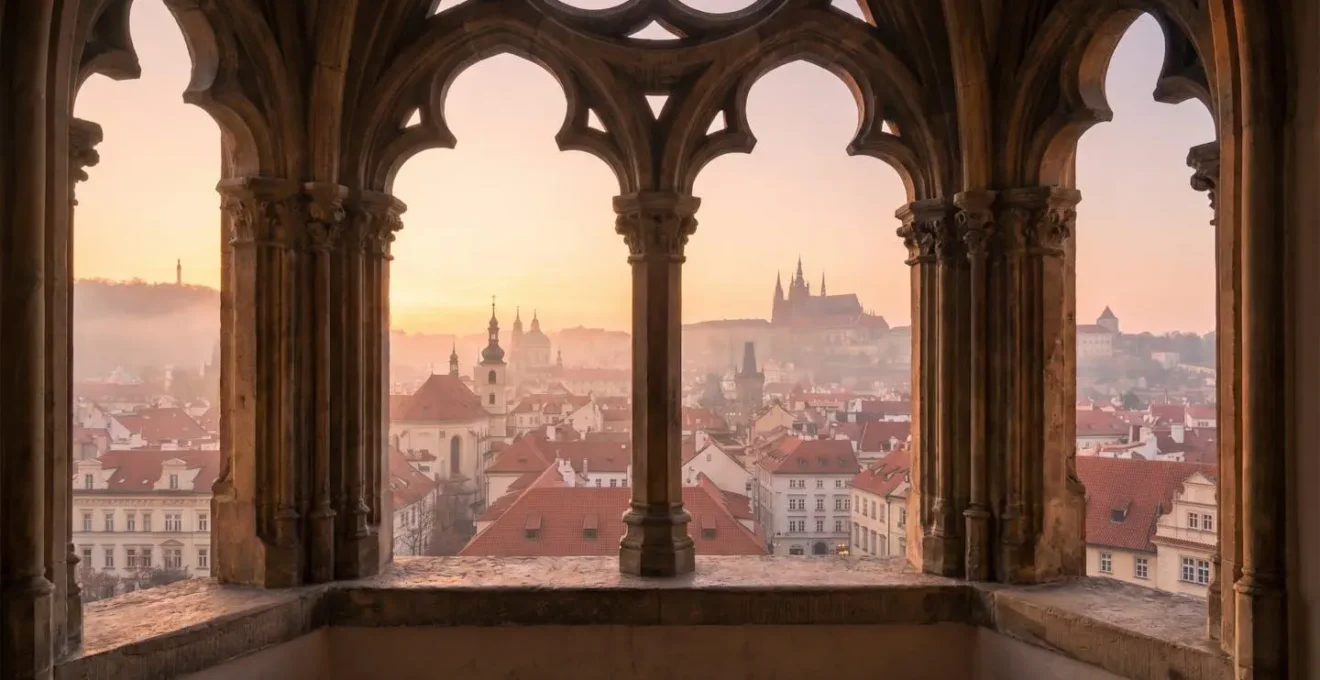
Choosing a Prague hotel is an act of architectural curation, where the goal is to inhabit the city’s history, not just observe it from a window.
- The iconic Old Town Square view comes with a significant price premium and potential noise, a classic trade-off between visual access and serene immersion.
- Authenticity is found in details: genuine antiques, preserved monastic cells, and thoughtful design choices that tell a story of continuity or evolution.
Recommendation: Approach your hotel selection as a historian would—by questioning the narrative presented and seeking the deeper story written in the stone, wood, and light of the space.
The first glimpse of Prague’s skyline is a potent seduction. A forest of Gothic spires, Baroque domes, and terracotta roofs unfolds, promising a journey back in time. For the discerning traveller, the architecture enthusiast, or the romantic couple, the question is not just *if* you will be enchanted, but *how* deeply. The immediate instinct, fuelled by countless travelogues, is to place yourself at the heart of the spectacle: a room overlooking the Old Town Square. This is the common wisdom, the postcard promise of waking up inside a fairy tale.
But this approach, while visually rewarding, often skims the surface of Prague’s profound architectural character. It treats the city as a beautiful backdrop rather than a living, breathing text to be read. What if the most authentic experience of Gothic splendour isn’t found in a panoramic view, but in the cool stone of a 13th-century vault above your bed? This guide adopts a different perspective. It proposes that to truly connect with Prague’s layered soul, you must become a curator of your own stay. The central thesis is this: the perfect hotel is not the one with the best view *of* the city, but the one that offers the most compelling architectural narrative *within* it. We will explore the trade-offs of iconic locations, weigh the merits of different historical aesthetics, and learn how to discern genuine historical substance from clever reproduction, transforming your search for accommodation into a deeper exploration of the city itself.
To guide you through this curated approach, this article delves into the critical questions every architecture lover should ask before booking. We will dissect the costs, comforts, and compromises that define a truly memorable stay in the City of a Hundred Spires.
Summary: A Historian’s Guide to Inhabiting Prague’s Architectural Soul
- Why Does Staying Inside Prague’s Old Town Square Cost £80 Extra Per Night?
- How to Navigate Prague’s Hills to Castle District Hotels With Luggage?
- Art Nouveau Elegance or Medieval Atmosphere: Which Prague Style Wins?
- The Hotel Concierge Restaurant Recommendation That Costs Double
- When Do Prague Hotels Drop Prices by 40%: The Seasonal Sweet Spots?
- Where in Europe Do Hotels Still Furnish With Authentic 18th-Century Pieces?
- Restored Historic Interiors or Modern Local Design: Which Expresses Place Better?
- How to Verify Hotel Antique Furniture Is Genuine Versus Reproduction?
Why Does Staying Inside Prague’s Old Town Square Cost £80 Extra Per Night?
The allure of opening your curtains to the spires of the Church of Our Lady before Týn or the famed Astronomical Clock is undeniable. This is the premium, the “experience” for which hotels charge a significant surplus. The price difference isn’t arbitrary; it’s a calculated fee for direct visual access to history. In fact, 2023 pricing data shows a stark contrast, with Old Town hotels averaging nearly three times the price of those in a district like Prague 10. This “view tax” of roughly £80, or even more, buys you geography and bragging rights.
However, this premium involves an informed compromise. The most coveted resource in a bustling historic centre is not the view, but silence. The very lifeblood of the square—the crowds, the music, the market stalls—can become an acoustic intrusion. This is the architectural trade-off in action. Hotels on the square are masters of mitigating this, but the solution itself reveals the compromise. Many properties position their quietest, often most luxurious, suites in the rear of the buildings, sacrificing the direct view for tranquillity.
Case Study: The Acoustic Trade-off at Old Town Square Residence
Guest experiences at properties like the Old Town Square Residence highlight this dynamic. Reviews often praise the stunning views from rooms facing the square but note that the vibrant energy of the plaza is audible, though significantly dampened by modern soundproofing like double-glazed balcony doors. Conversely, suites located above the ground-floor restaurants or in the back of the historic buildings report absolute silence. This demonstrates a conscious design choice: the hotel offers guests a decision between peak visual access with manageable ambient noise or absolute peace without the iconic, direct-facing view. The premium price, therefore, is not just for the view, but for the engineering that makes the view liveable.
Choosing a room on the square is less about buying a hotel room and more about leasing a theatre box. You are paying for a front-row seat to the daily drama of Prague’s history, with the understanding that the performance is a 24-hour affair.
The question for the architectural enthusiast is whether the story you want to inhabit is the one seen from the window or the one felt in the quiet, historic bones of the building itself.
How to Navigate Prague’s Hills to Castle District Hotels With Luggage?
Prague’s beauty is vertical. The city is a landscape of hills, valleys, and breathtaking vantage points, particularly in the Malá Strana (Lesser Town) and Hradčany (Castle District). While this topography creates romantic, winding streets, it presents a formidable logistical challenge for the traveller laden with luggage. The dream of a quaint hotel on a cobblestone lane leading up to the castle can quickly become a nightmare of dragging suitcases up a steep, car-free incline. Streets like Nerudova or Vlašská are notoriously challenging and best avoided on arrival day if you’re managing your own bags.
Successfully navigating this terrain requires a strategic, not a brute-force, approach. The city’s excellent public transport system is your greatest ally. Rather than attempting a heroic uphill climb from a metro station, consider the tram. Specifically, Tram 22 offers a scenic and practical route to the Pohořelec stop, from which it’s a gentle, picturesque downhill walk to most hotels in the upper Castle District. Remember that while 24-hour or 72-hour passes include luggage, shorter-term tickets do not; you will need to purchase a separate 25 CZK extra luggage ticket for large suitcases.
Alternatively, technology can bridge the final, arduous gap. Ride-sharing services like Bolt or Uber can navigate the winding streets and get you much closer to your hotel’s entrance than a standard taxi might. For the most seamless experience, especially when staying at a high-end property, inquire about porter services. Many hotels in pedestrian zones have arrangements to dispatch staff to meet guests at designated drop-off points, elegantly solving the last-hundred-metres problem. Choosing a hotel in the lower, flatter parts of Malá Strana, closer to the Vltava River, is another simple way to sidestep the luggage challenge entirely while still being in a historically rich and beautiful area.
Ultimately, the key is to plan your final approach with the same care you’d use to plan a day of sightseeing. The reward is waking up in a quiet, historic enclave, far from the bustle below.
Art Nouveau Elegance or Medieval Atmosphere: Which Prague Style Wins?
Prague’s architectural story is not monolithic; it’s a rich tapestry woven with threads from every major European stylistic period. For the visitor, this offers a delicious choice: do you immerse yourself in the intimate, rugged charm of the medieval and Baroque periods, or the opulent, flowing elegance of Art Nouveau? This isn’t just an aesthetic decision; it’s a choice between two entirely different ways of experiencing the city. A hotel in a restored medieval or Baroque building in Malá Strana offers an experience of intimate scale and layered history. You might find yourself staying in a building that has stood since the 14th century, with vaulted ceilings, thick walls, and a palpable sense of the past.
In contrast, a hotel in a grand Art Nouveau villa, perhaps in a district like Vinohrady, offers a narrative of turn-of-the-century prosperity, artistic innovation, and airy grandeur. These buildings speak of a time when Prague was a burgeoning cosmopolitan hub, embracing modernity with unparalleled grace. The experience is one of light, space, and exquisite decorative detail, from sinuous floral motifs in the ironwork to stained-glass windows that paint the rooms with colour.
This contrast is perfectly captured when comparing two distinct types of properties. The choice isn’t about which style is “better,” but which narrative you wish to inhabit.
Case Study: Le Palais Hotel vs. Hotel Nerudova 211
Le Palais Art Hotel, located in a magnificent Belle Époque villa, embodies the Art Nouveau choice. It offers expansive rooms, contemporary art, marble bathrooms, and sweeping views over the city’s rooftops, providing modern luxury within a context of historic opulence. The experience is one of wellness, comfort, and grand scale. On the other hand, Hotel Nerudova 211, in a meticulously restored Baroque building near Prague Castle, offers the medieval atmosphere. It features period furnishings and an old-world charm that is deeply immersive. However, this authenticity comes with certain quirks, such as narrow staircases and a potential lack of elevators, making accessibility a consideration. Here, the luxury lies in the intimacy, the personalized attention, and the powerful sense of place.
Do you prefer the story of a city discovering its modern voice, or the ancient whispers of its medieval heart? The answer will define not just where you sleep, but how you dream of Prague.
The Hotel Concierge Restaurant Recommendation That Costs Double
There is a pervasive myth among travellers that a concierge’s restaurant recommendation is an untrustworthy, commission-driven suggestion that will lead you to an overpriced, tourist-centric meal. The cynical view holds that the “hidden gem” they suggest is only hidden to those who don’t know it’s in the hotel’s kickback network. While this may have been true in the past, the reality in the world of high-end, professional concierges—especially those who are members of esteemed societies like Les Clefs d’Or—is far more nuanced.
The reputation of a top-tier concierge, and by extension the hotel, is their most valuable asset. A bad recommendation reflects poorly on the entire establishment. As one professional noted in a travel forum discussion, the scrutiny on them is immense. This leads to a different, more subtle bias: not towards commission, but towards safety. A concierge is more likely to recommend a well-established, highly polished, and often more expensive restaurant because it’s a known quantity. They can be confident in the quality of the food, the English-speaking staff, and the level of service, ensuring a positive guest experience. The “cost” to the guest is not a kickback, but the price of this curated, risk-free dining experience, which can indeed be double that of a more local, adventurous choice.
Contrary to popular beliefs, many concierges now don’t receive or accept kickbacks for their recommendations. The scrutiny is just as big on them, as it is for the hotel they work in.
– Les Clefs d’Or Concierge discussion contributor, Tripadvisor Food and Travel Forum
To get a more authentic recommendation, the savvy traveller must learn to reframe the question. Instead of a generic “Where should I eat?” which invites a safe answer, try a more personal approach. Asking, “Where would you personally take your family for a special occasion?” or “Where’s the best place for goulash that isn’t in a guidebook?” can break them out of their professional script. It’s also wise to do your own homework. Mentioning you’ve been reading a local food blog like ‘Taste of Prague’ or have a few specific restaurants in mind signals that you are an informed traveller, prompting a more collaborative and genuine conversation.
The goal is to turn the concierge from a simple recommender into a genuine local guide, a subtle but powerful shift that can transform your culinary experience in Prague.
When Do Prague Hotels Drop Prices by 40%: The Seasonal Sweet Spots?
Prague, like many great European capitals, has a rhythm dictated by the seasons, and its hotel prices dance to the same beat. The notion of a simple “high” and “low” season has become increasingly blurred. What were once quiet “shoulder” seasons, like May and September, now command peak prices due to their optimal weather. However, for the strategic traveller willing to trade sunshine for atmosphere, significant savings of up to 40% or more are attainable. The key is to identify the city’s true seasonal sweet spots.
The most dramatic price drops occur in the deep winter, specifically from mid-January to late February. After the Christmas market crowds have departed and before the spring thaw, the city takes a quiet breath. This is when you’ll find the most atmospheric version of Prague: snow-dusted Gothic spires, cozy, half-empty pubs, and the castle emerging ethereally from the morning mist. Hotels are significantly cheaper, and booking 60-90 days in advance can yield even greater savings. Another valuable window is in late October and early November, after the summer rush and before the festive season begins in earnest. The autumn colours provide a stunning backdrop, and the crowds are far more manageable.
Conversely, the summer months and the Christmas market season see prices soar. A 2026 Prague accommodation analysis indicates that rates in June-August can increase by 40-60% compared to the shoulder seasons. December sees an even more dramatic spike due to the world-famous Christmas markets. Planning a trip during these periods requires booking many months in advance and accepting that you are paying a premium for the weather or the festive atmosphere.
The following table, based on an analysis of Prague hotel pricing trends, breaks down the nuanced seasonal differences, offering a clear guide to balancing cost, crowds, and climate.
| Season/Month | Average Price Variation | Best For | Booking Timing |
|---|---|---|---|
| Mid-January to Late February | 31% cheaper than peak (€162/night average) | Most atmospheric with fewer crowds, cozy pubs, snow-dusted castle views | Book 60-90 days ahead for 20-35% savings |
| Late October/Early November | 20-25% below peak | Post-summer rush, pre-Christmas markets sweet spot | Book 3+ months ahead for shoulder season rates |
| April (post-Easter) | 15-20% below May peak | Spring blooms, comfortable weather, manageable crowds | Book 2-3 months in advance |
| May & September | Now essentially high season pricing | Optimal weather but expect peak prices | Avoid unless weather is priority |
| December | 48% increase (€354/night average) | Christmas markets but most expensive | Book 4+ months ahead minimum |
The decision ultimately comes down to a personal calculation: are you seeking the vibrant energy of Prague in full swing, or the poetic, introspective beauty of its quieter moments?
Where in Europe Do Hotels Still Furnish With Authentic 18th-Century Pieces?
In an age of mass-produced “heritage-style” furniture, the discerning traveller might wonder if it’s still possible to find a hotel room genuinely furnished with pieces that have lived through centuries. The answer is a resounding yes, though it requires knowing where to look. While many hotels use reproductions, a special class of properties, often born from the conversion of historic buildings, see the preservation and use of authentic antiques as central to their identity. Prague, with its rich stock of well-preserved monasteries, palaces, and townhouses, is a prime location for such establishments.
These hotels are not museums; they are living spaces where history is tangible. The experience of staying in a room with an 18th-century armoire or a Biedermeier writing desk is profoundly different from staying in a room with mere replicas. Authentic pieces carry the patina of time—the subtle wear on a drawer pull, the deep lustre of old-growth wood. This is not about luxury in the conventional sense of newness and perfection, but about the luxury of direct contact with history. You are not just looking at an antique; you are co-habiting with it, adding another brief chapter to its long story.
The key to finding these properties lies in looking for hotels that have a deep, intrinsic connection to their buildings’ original purpose. Former monasteries, castles, and aristocratic residences are the most likely candidates. Their transformation into hotels often involves a philosophy of careful restoration rather than gut renovation, where original furnishings are seen as an integral part of the building’s soul.
Case Study: The Augustine Hotel, Prague
A prime example of this ethos in action is The Augustine Hotel in Prague’s Lesser Town. Set within a 13th-century monastery, which is still home to a working order of Augustinian friars, the hotel represents the pinnacle of historic preservation in hospitality. The property seamlessly blends five-star amenities with its monastic past. Guests can have a beer made from the original friars’ recipe in the atmospheric basement bar or take an exclusive tour of the monastery’s private library, a space largely untouched by time. The hotel’s design incorporates authentic furnishings and architectural elements, making the history of the building not just a backdrop but the core of the guest experience. This approach, where the property’s narrative is one of continuous, evolving use, is where one is most likely to find and appreciate genuine historic pieces as part of the living environment.
For the architecture enthusiast, seeking out these hotels is the ultimate form of travel, transforming a simple stay into a temporary custodianship of history.
Restored Historic Interiors or Modern Local Design: Which Expresses Place Better?
When a hotel occupies a historic building, its owners face a fundamental philosophical choice: should the interior design be a faithful restoration of a past era, or should it be a bold, contemporary statement that contrasts with the historic shell? Both approaches have the potential to express “Prague-ness,” but they do so in radically different ways, offering guests two distinct narratives about the city. There is no single correct answer; the more successful choice depends on the story the hotel wants to tell.
The restorationist approach argues that the most profound way to express a sense of place is through historical fidelity. This philosophy involves meticulously preserving or recreating original architectural features, sourcing period-appropriate furnishings, and using a colour palette derived from historical research. The goal is to create a time-capsule experience, allowing the guest to feel as if they have stepped directly into the 13th, 17th, or 19th century. The “place” expressed here is a specific, preserved moment in Prague’s past. The luxury is one of immersion and authenticity, a transportive experience that connects the guest directly to a historical narrative.
The modernist approach, on the other hand, argues that a city’s character is not static but constantly evolving. This philosophy places cutting-edge, often minimalist, modern design within the building’s historic framework. The contrast between old and new becomes the central design statement. Exposed medieval beams might hover over a sleek Italian sofa; a contemporary art installation might hang on a 500-year-old stone wall. The “place” expressed here is the dynamic, cosmopolitan Prague of today—a city that respects its past but is not enslaved by it. The luxury is one of sophisticated curation and intellectual engagement, showcasing Prague as a hub of contemporary culture.
Case Study: The Augustine vs. The Emblem Hotel
This dichotomy is perfectly illustrated by comparing The Augustine with The Emblem Hotel (and its sister property, the Old Town Square Residence). As we’ve seen, The Augustine masterfully integrates modern luxury into its 13th-century monastic setting, but its core identity is one of preservation. It tells a story of sacred continuity. In stark contrast, The Emblem places bold, contemporary design inside historic buildings. You’ll find Philippe Starck-designed bathrooms with heated floors and modern art-deco-inspired furnishings within structures that date back centuries. The Emblem’s story is one of cosmopolitan evolution, demonstrating Prague’s place in the modern world. Both are valid and powerful expressions of Prague, but they appeal to different desires: the desire to be transported to the past versus the desire to engage with the city’s vibrant present.
Do you want the building to whisper its original secrets, or do you want it to speak of its new life in the 21st century?
Key Takeaways
- The iconic Old Town Square view is a conscious purchase involving a premium price and a trade-off between visual access and potential noise.
- A successful Prague stay, especially in hilly districts, requires strategic planning for logistics, leveraging trams and porter services over heroic uphill climbs with luggage.
- True hotel authenticity can be verified through tangible details like hand-cut joinery and natural patina, allowing you to distinguish genuine antiques from reproductions.
How to Verify Hotel Antique Furniture Is Genuine Versus Reproduction?
For the guest who has chosen a hotel for its promise of historic authenticity, the final and most satisfying act of curation is learning to “read” the objects within it. Distinguishing a genuine antique from a clever reproduction is a skill that deepens the appreciation of a space, turning you from a passive guest into an active observer. You don’t need to be a certified appraiser; a few key principles can help you identify the tell-tale signs of age and craftsmanship. This is not about exposing fraud, but about engaging with the material history around you.
The first place to look is in the construction. Before the industrial revolution, furniture was made by hand, and this manual process left subtle, beautiful imperfections. Look at the joints. Authentic antique pieces often feature irregular, hand-cut dovetail joints, where the pins and tails don’t match up with machine-like precision. Modern reproductions will have perfectly uniform, machine-cut joints. Similarly, examine the overall symmetry. A truly old piece may have a slight lean or a drawer that isn’t perfectly square—the charming signs of a life lived, not manufacturing defects.
Next, consider the material and its surface. Old-growth wood, used in most genuine antiques, is significantly denser and heavier than the wood used in modern furniture. If a large, solid-wood armoire feels surprisingly light, it’s a red flag. The most poetic evidence of age is its patina—the accumulated finish, wear, and polish from centuries of use. Look for inconsistent wear patterns where hands would have naturally rested, keys would have scraped, or objects would have been placed repeatedly. A fake patina is often uniform and looks “painted on,” lacking the depth and variation of a genuine, time-worn surface. Finally, don’t be afraid to engage with the hotel staff. But instead of asking, “Is this real?”, a question that can put staff on the defensive, ask, “What’s the story behind this piece?” A hotel that invests in genuine antiques will almost always have a provenance narrative—a story of where the piece came from—that they are proud to share.
Action Plan: Your Amateur Authenticator’s Checklist
- Provenance Inquiry: Start by asking the hotel staff for the story or history behind a specific piece of furniture. A genuine piece often comes with a rich narrative.
- Construction Analysis: Examine the joinery. Look for irregular, hand-cut dovetail joints and signs of traditional hand-finishing techniques, which indicate pre-machine era craftsmanship.
- Material & Wear Assessment: Test the weight of the piece and carefully observe its patina. Look for the natural, inconsistent wear patterns on surfaces and edges that develop over decades of use.
- Period Consistency Check: Evaluate if the furniture’s style aligns with the building’s architectural period. A historically accurate hotel will maintain consistency (e.g., no Rococo in a Gothic building).
- Comparative Observation: Look at multiple pieces in the hotel. Note the variations between them. Hand-made antiques will have individual quirks, unlike mass-produced reproductions.
This practice transforms your hotel from a mere place of lodging into a private museum, and the act of observation becomes the ultimate souvenir—a new way of seeing that you can take with you to every city you visit.